© IE Online Media Services Pvt Ltd
 6 min read


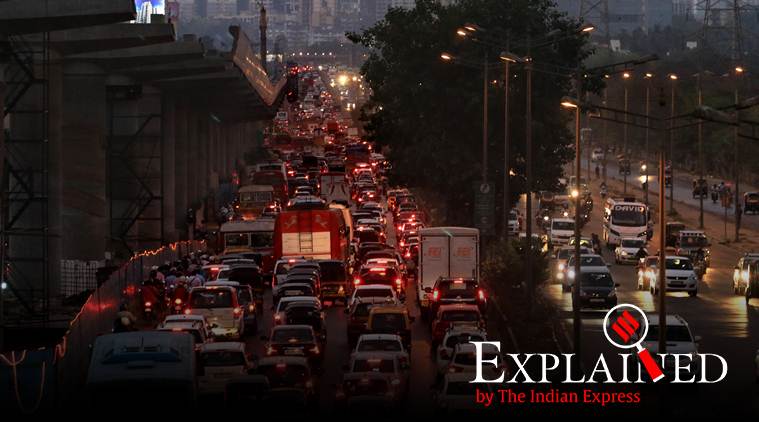 Notably, congestion only plays a significant role in the largest cities of India, such as Delhi and Mumbai, when it comes to the ease of urban travel. (Express Photo: Amit Chakravarty)
Earlier this month, the Brihanmumbai Municipal Corporation (BMC) began a policy of heavy fines for illegally parked vehicles, those that are parked on the road when a public parking lot is available less than 500 metres away. The BMC’s move was not undertaken primarily to increase revenues. Instead, it was meant to decongest the city, therefore reducing travel times and increasing the space available to vehicles providing emergency services. The decision appears to have been a success, with occupancy in parking lots located in the area of the fine’s implementation rising by 24% since.
It is intuitive to think of traffic congestion as the root cause behind mobility problems in urban India, and such policy measures to curtail congestion seem to be the solution to providing easier travel in cities. However, a study by Prottoy Akbar and others published by the World Bank finds a counterintuitive solution to the problem of slow travel in Indian cities.
The study claims that, rather than through decongestion, the path to improving urban mobility in India is through improving the uncongested mobility of cities. Uncongested mobility, the study found, is the main driver behind the variations in mobility across cities in India, as the article published in Ideas for India by the authors of the study says.
As defined in the study, uncongested mobility is the speed at which travel can happen by a motor vehicle “in the absence of traffic”. The study defines congestion as the “average delay due to traffic”, and mobility as “uncongested mobility plus the congestion”.
The study finds that 70% of the variance in mobility is attributable to uncongested mobility alone, with congestion accounting for only 15% of this variance. Notably, congestion only plays a significant role in the largest cities of India, such as Delhi and Mumbai, when it comes to the ease of urban travel.
The common view is that as urbanisation progresses and a city increases in size, so too do the number of motor vehicles on its roads, and thus congestion increases, gradually slowing down traffic and ultimately bringing it to a standstill. However, the study posits that increased levels of urbanisation and economic development can actually improve the mobility of a city, through enhanced travel infrastructure increasing uncongested mobility.
The study associates various indicators of economic development with improved overall mobility, even though congestion also increases, highlighting the role uncongested mobility plays in improving mobility as a whole. This runs counter to the assumption that traffic congestion is the reason why travel on the roads of some cities is slow, while it is fast in others.
When drawing a comparison with other countries such as the US, the evidence suggests that the speed of travel in Indian cities is relatively slow. For example, central Chicago, a location with heavy congestion and deeply on the slower side of travel speeds for the US, still exhibits a higher average travel speed and thus greater mobility than Chandigarh, which is a relatively fast-travelling Indian city.
When Indian cities are compared, the evidence shows that the speed of travel during a normal day does not vary much across the vast majority of Indian cities, with small differences in travel speeds in the early morning, daytime, and late at night. The exceptions to this rule are the large cities, particularly their centres, which show dramatic variations in mobility when comparing hours of the day with little traffic to peak traffic hours.
To put it simply, anything that impedes travel on an otherwise empty road lowers the uncongested mobility of that journey.
Obstacles to uncongested mobility include pedestrians, street-side vendors, stray animals, and cattle on the road. More obstacles present themselves in the form of potholes and flaws in the design of the road system of a city. When travellers encounter a large number of these obstacles on a journey, they are forced to travel at speeds dramatically slower than they would have in the absence of these obstacles.
Because of poor uncongested mobility, travel speeds in most Indian cities remain low across all hours of the day.
One would expect a certain pattern of travel speeds in a city — high in the early morning and late at night, and dipping to their lowest during peak travel hours when congestion is at its worst — but this pattern is only true of a small handful of the largest cities in India, while the majority of cities with travel speeds below average maintain slow travel speeds throughout the day.
As an illustration of this, Gilles Duranton, one of the authors of the study, said, “Kolkata is extremely slow even at 3 am in the morning. There is no way you can go more than 25 km an hour even when there is nobody on the roads”.
Considering that this study demonstrates that urban mobility is primarily affected by the uncongested mobility of its road systems, it concludes that the key to improving urban mobility in India lies with the improvement of uncongested mobility.
The study found that the structure of the network of a city’s roads played a role in the uncongested mobility of that road system, with grid-like roads providing better mobility, Chandigarh being cited by the authors as an example of such a system.
In addition, a greater number of primary roads can also enhance the uncongested and overall mobility of a city. Duranton claims that “better management of roads, better traffic management and making sure people are not blocking intersections” will enhance the mobility of uncongested roads.
Ultimately, this research has provides another way to look at the issue of urban travel in India, and all the Herculean tribulations we associate with it.
(Rudra Mani Tripathi is a student of Ashoka University and an intern with The Indian Express)