10 min read
© The Indian Express Pvt Ltd



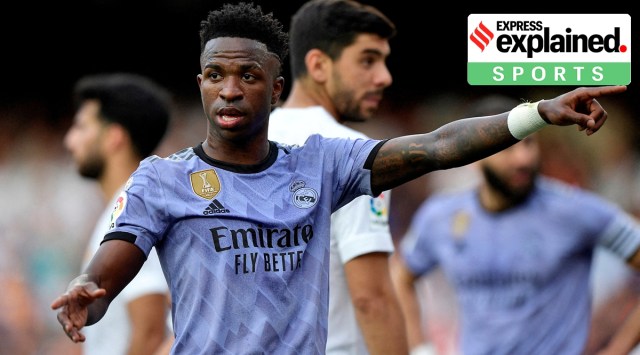 Vinicius Junior, of Real Madrid, points in the direction of a fan who had been hurling racist abuses towards him on Sunday (May 21) (Photo: REUTERS/Pablo Morano)
 Alongside Vinicius Jr’s rise to footballing superstardom has come a torrent of racist abuse, both online and offline, exposing the dark underbelly of the beautiful game.
In the latest instance, La Liga game between Valencia and Vincius Jr’s Real Madrid had to be temporarily stopped after the Brazil forward said he was racially abused by a fan behind one of the goals at Valencia’s Mestalla Stadium.
While an investigation by La Liga is currently underway and authorities have even made arrests, racism and football have far deeper connections than many fans realise. After all, the “monkey chants” thrown at Vinicius Jr on Sunday (May 21) have almost become commonplace in games featuring him. He is also not the first player to face such abuses, with black players from yesteryears arguably facing much worse.
While instances of racism in top professional leagues tend to get a lot of eyeballs, the problem is far deeper and often much more subtle – hence easily ignored.
We briefly explore race and racism in football.
Spectator racism: bringing out society’s ugly side
Sports are an intrinsic part of the cultural fabric of societies. It is sports’ ties to culture and history that give them meaning. This is especially true for football, with its rich history and immense popularity across the world.
When Real Madrid plays Barcelona, it is not just two teams squaring off in a game of football – it is a clash of opposing cultures, ideologies, and identities wrapped in history. While Real Madrid – literally “royal” Madrid – is a symbol of Spanish power, patronised by its ruling elite, Barcelona is the Catalonian club, a symbol for the region’s secessionist movement.
Naturally, football’s cultural salience makes it a deeply emotional game, especially for spectators, whose only agency to affect the outcome of a game lies in the support and emotion they show.
Spectator racism is a product of this emotion that football elicits mixed with racist attitudes prevalent in society. Especially in a rapidly changing world where traditional identities are in a state of flux, football stadiums become venues underlying conflicts in society – whether they be on racial or other lines – find their way to the surface in an emotionally charged atmosphere.
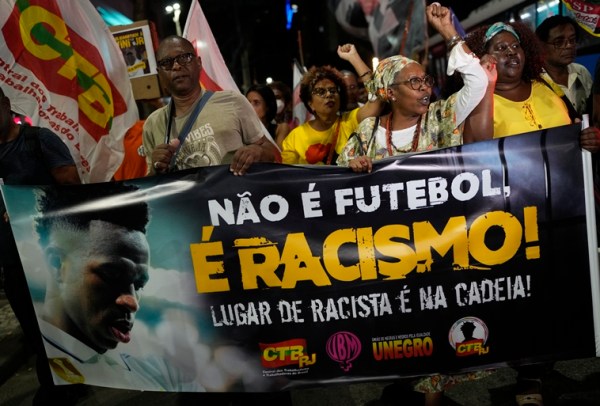 People hold a banner that reads in Portuguese: “It isn’t football, it is racism” during a protest against racism suffered by Brazilian soccer star Vinicius Junior who plays for Spain’s Real Madrid, in Rio de Janeiro, Brazil, Thursday, May 25, 2023. Vinicius, who is Black, has been subjected to repeated racist taunts since he arrived in Spain five years ago. (AP Photo/Silvia Izquierdo)
“If we feel so passionately about this business of striking goals with feet, heads and chests, it is not just because it is a spectacle which plays on our emotions, but also because, like an exaggerated drama, it brings to the fore the symbolic values of our societies”, French anthropologist Christian Bromberger wrote on the subject in “Football, La bagatelle la plus sérieuse du monde” (Football, The most serious trifle in the world).
Crucially, though, while racism is definitely a “football problem”, it is by no stretch just a football problem. “You can’t ask sport to be better behaved than society itself, while knowing that it brings out the worst of certain tendencies,” wrote Fabien Wille, whose work focuses on sports and diversity.
Institutional apathy and inaction
While racists will always exist in football as long as racism exists in society, where football can do better, is in dealing with racism.
When Vinicius Jr, in the aftermath of being subjected to racist abuse once again, said that “in Brazil, Spain is known as a country of racists”, all hell broke loose. La Liga President Javier Tebas clapped back, saying “Neither Spain nor La Liga are racist, it is unfair to say this.”
Others, like Valencia politician Ximo Puig and former Barcelona FC board member Toni Freixa went even further, blaming Vinicius Jr himself for the hate he gets. “He (Vinicius Jr) provokes during every game”, Freixa said, while pointing to the fact that Madrid’s other black players were seldom targeted the same way.
The victim blaming and denial are a part of the larger problem. While football associations are always quick to virtue signal, when it comes to acknowledge the problem and act on it, they fall well short.
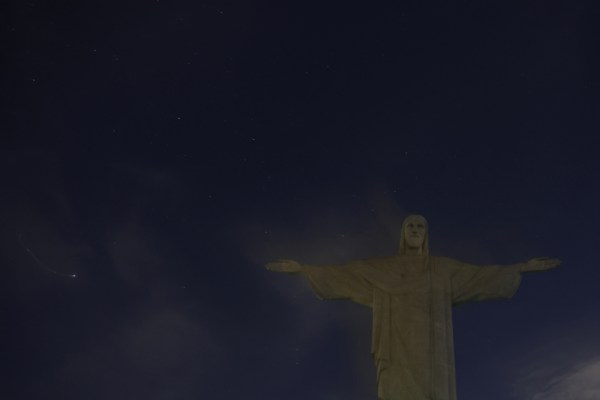 The Christ the Redeemer has its lights turned off to condemn “racist attacks” on Brazilian soccer star Vinicius Jr in Spain, in Rio de Janeiro, Brazil May 22, 2023. (REUTERS/Pilar Olivares)
In fact, as Spanish newspaper El Pais’s striking editorial put it, La Liga only jumped to action in this case after receiving international condemnation from, among others, Brazil President Lula. “La Liga has a problem and that problem is not Vinicius,” the editorial read.
This is also not a problem restricted to La Liga alone. For instance, after three black English players – Jadon Sancho, Marcus Rashford and Bukayo Saka – missed penalties in England’s loss to Italy in the Euro 2020 finals, English fans were quick to show their ugly side. The UK authorities received more than 600 reports of online racist comments made towards England’s black players, 207 of which were judged to be criminal in nature. However, only 11 people were arrested or faced any actual consequences.
Challenge with policing does not excuse lax punishments
Whether it be online or on the ground, policing racist behaviour among fans comes with its challenges. For one, in both arenas, identifying racist individuals is tough. Online abuse can be difficult to trace especially when the volume is such that authorities simply do not have the resources to pursue every single offence. On the other hand, in stadiums with huge crowds, racist individuals are often difficult to single out.
What authorities can do – and have historically failed to – is raise the consequences of any racist behaviour. For instance, in 2019, Montenegro were handed a £17,396 fine and a one-game stadium closure by UEFA, after its fans racially abused three black English players during a Euro qualifier. For context, in 2012, Danish international Nicklas Bendtner was fined £80,000 by UEFA for showing a Paddy Power (betting company) logo on his underwear during a goal celebration.
While FIFA has since updated its disciplinary code to include tougher sanctions for racist or discriminatory behaviour, racism is still not taken “seriously enough” as per many observers and players.
A deeper problem
Conversations around race and racism in football most often emerge out of specific instances of racism or racist abuse – when spectators or players do something “racist”. But race impacts football in far more systemic ways which explain both the inaction as well as the racism itself.
For one, by and large, most professional clubs are owned and run by rich white men, not reflecting the diversity on the pitch itself. The lack of diversity in the upper echelons of football translates into the inaction and institutional apathy that has plagued football’s trysts with racism.
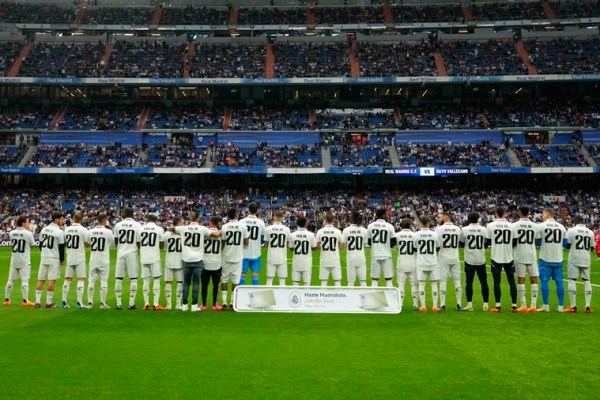 Players of Real Madrid wear jerseys with the name of team mate Vinicius Junior for a Spanish La Liga soccer match between Real Madrid and Rayo Vallecano at the Santiago Bernabeu stadium in Madrid, Spain, Wednesday, May 24, 2023. (AP Photo/Manu Fernandez)
“Somebody makes a monkey chant and we want to ban him for 10 years … or deduct 15 points. But we are looking at the wrong issue,” former Belgium and Manchester City captain Vincent Kompany said during an event organised by the global players’ union FIFPro.
“The issue is that people making the policies have absolutely no diversity, and that also means gender diversity, to even start a debate on what the most appropriate measure is,” Kompany said, adding that “Nobody is walking through the corridors (of power) thinking this (racism) is a main topic.”
This lack of diversity also percolates to other levels in the footballing ecosystem, from lack of black referees at the top level – who might take spectator racism more seriously than some of their white counterparts have in the past – to the overrepresentation of ethnic minorities in lower, underpaid tiers of football.
Then there is the problem of football media and the role it plays. Multiple studies have shown that black footballers are dealt with very differently by the media than their white counterparts.
From the use of racial stereotypes during football commentary (for example, emphasising on black players’ “physicality” and white players’ “skill”) to the sensationalised coverage of black players’ personal lives and choices, the media perpetuates racism in more ways than one.
The coverage of English forward Raheem Sterling is a good example. In recent years, the British media has called him ‘greedy’ for wanting a pay rise, and even ‘obscene’ for posting a photo of the house he bought for his mother. While at the same time, his white teammates have received less criticism or even praise for similar behaviour.
For football to truly tackle racism, there needs to be an introspective and honest reckoning of the many ways in which race impacts the sport. While instances of racist abuse need to be strongly dealt with, more lasting solutions will involve wider changes across all stakeholders of the game.