Premium

Is the ongoing ‘planet parade’ rare?

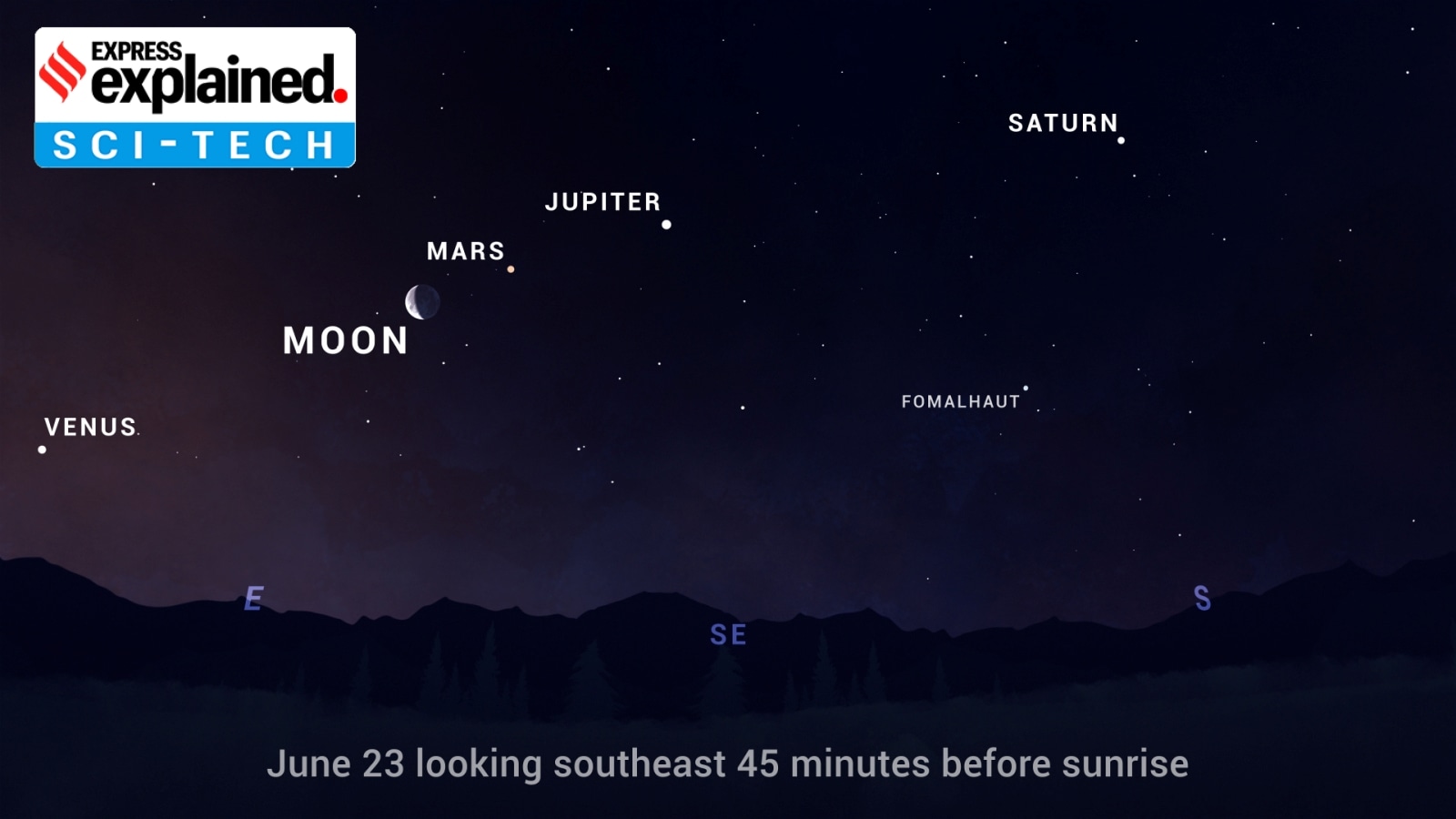
Six planets — Venus, Saturn, Jupiter, Mars, Uranus, and Neptune — are currently forming a breathtaking arc in night night sky

NASA Planet ParadeA parade of planets in June 2022. (NASA)

For the past few days, four planets in our solar system — Venus, Saturn, Jupiter, and Mars — have been visible in the night sky to the naked eye. Uranus and Neptune can also be seen alongside these planets, but with the help of a telescope (even a decent pair of binoculars will do).

These six planets form a breathtaking arc across the night sky, making up what is known as a ‘planet parade’. Skywatchers have till February to catch a glimpse of the celestial spectacle.

What is a ‘planet parade’?

A ‘planet parade’ refers to a situation when several planets in our solar system are visible in the night sky, at the same time. It is not a technical term in astronomy.

“Planets have different motions in the sky. They move at different rates compared to the other stars. Not all of them are visible in the sky everyday, but sometimes a position comes about so that many or all the planets are visible at the same time, or within a few hours of each other,” said Samir Dhurde, radio astronomer and in-charge of the popular outreach programme SciPOP at the Inter-University Centre for Astronomy & Astrophysics (IUCAA), while explaining the phenomenon.

“This can happen in the morning sky or the evening sky,” he said.

Are planet parades rare?

Not all that much. “These multi-planet viewing opportunities aren’t super rare, but they don’t happen every year, so it’s worth checking it out,” according to the NASA website. The last such planet parade occurred in May-June 2024, when all planets of the solar system were visible in the morning sky.

According to Dhurde, “There are a lot of clickbaity headlines but this event is not that rare.” He added that this phenomenon was not a one-day event, and that astronomers have been enjoying a nice view of the planets since December. According to his calculations Mercury, the fifth planet visible to the naked eye, will appear in the evening sky after February 20.

Story continues below this ad

Planets in the sky also always appear in a ‘line’ in the sky as it is defined by the plane of the solar system, which is why NASA says that there is nothing special about their ‘alignment’.

Encouraging people to take advantage of the viewing opportunity, Dhurde said, “It’s a great time to enjoy the planets, all of them being at a convenient time when you can finish work and spend some time looking at the sky.”

How to view planets?

There are eight planets in the solar system: Mercury, Venus, Earth, Mars, Jupiter, Saturn, Neptune, and Uranus. Five out of the seven planets (the eighth being Earth, where we live) are visible to the naked eye. The other two require some form of magnification to be seen, because of how far they are from the Sun and Earth.

Planets are generally visible a few hours after sunset, after the residual light from the Sun is no more. Clear and cloudless skies are helpful, as is the absence of light pollution. This is why planets — like stars — are best observed from places far away from cities and towns.

Story continues below this ad

To determine whether a celestial object is a planet or a star, one needs to see whether it twinkles or not. Stars twinkle, while planets shine with a constant brightness. The latter are also usually brighter than stars. Nowadays, there are multiple mobile apps and websites that can help pinpoint the exact locations of celestial bodies in the sky.

Soham Shah is a Correspondent with The Indian Express, based in Pune. A journalism graduate with a background in fact-checking, he brings a meticulous and research-oriented approach to his current reporting. Professional Background Role: Correspondent coverig education and city affairs in Pune. Specialization: His primary beat is education, but he also maintains a strong focus on civic issues, public health, human rights, and state politics. Key Strength: Soham focuses on data-driven reporting on school and college education, government reports, and public infrastructure. Recent Notable Articles (Late 2025) His late 2025 work highlights a transition from education-centric reporting to hard-hitting investigative and human-rights stories: 1. Investigations & Governance "Express Impact: Mother's name now a must to download birth certificate from PMC site" (Dec 20, 2025): Reporting on a significant policy change by the Pune Municipal Corporation (PMC) following his earlier reports on gender inclusivity in administrative documents. "44-Acre Mahar Land Controversy: In June, Pune official sought land eviction at Pawar son firm behest" (Nov 9, 2025): An investigative piece on real estate irregularities involving high-profile political families. 2. Education & Campus Life Faculty crisis at SPPU hits research, admin work: 62% of govt-sanctioned posts vacant, over 75% in many depts (Sept 12, 2025): An investigative piece on professor vacancies at Savitribai Phule Pune University. "Maharashtra’s controversial third language policy: Why National Curriculum Framework recommends a third language from Class 6" (July 2): This detailed piece unpacks reasons behind why the state's move to introduce a third language from class 1 was controversial. "Decline in number of schools, teachers in Maharashtra but student enrolment up: Report" (Jan 2025): Analyzing discrepancies in the state's education data despite rising student numbers. 3. Human Rights & Social Issues "Aanchal Mamidawar was brave after her family killed her boyfriend" (Dec 17, 2025): A deeply personal and hard-hitting opinion piece/column on the "crime of love" and honor killings in modern India. "'People disrespect the disabled': Meet the man who has become face of racist attacks on Indians" (Nov 29, 2025): A profile of a Pune resident with severe physical deformities who became the target of global online harassment, highlighting issues of disability and cyber-bullying. Signature Style Soham is known for his civil-liberties lens. His reporting frequently champions the rights of the marginalized—whether it's students fighting for campus democracy, victims of regressive social practices, or residents struggling with crumbling urban infrastructure (as seen in his "Breathless Pune" contributions). He is adept at linking hyper-local Pune issues to larger national conversations about law and liberty. X (Twitter): @SohamShah07 ... Read More

 

Latest Comment
Post Comment
Read Comments
Advertisement
Advertisement
Advertisement
Advertisement