4 min read
© The Indian Express Pvt Ltd



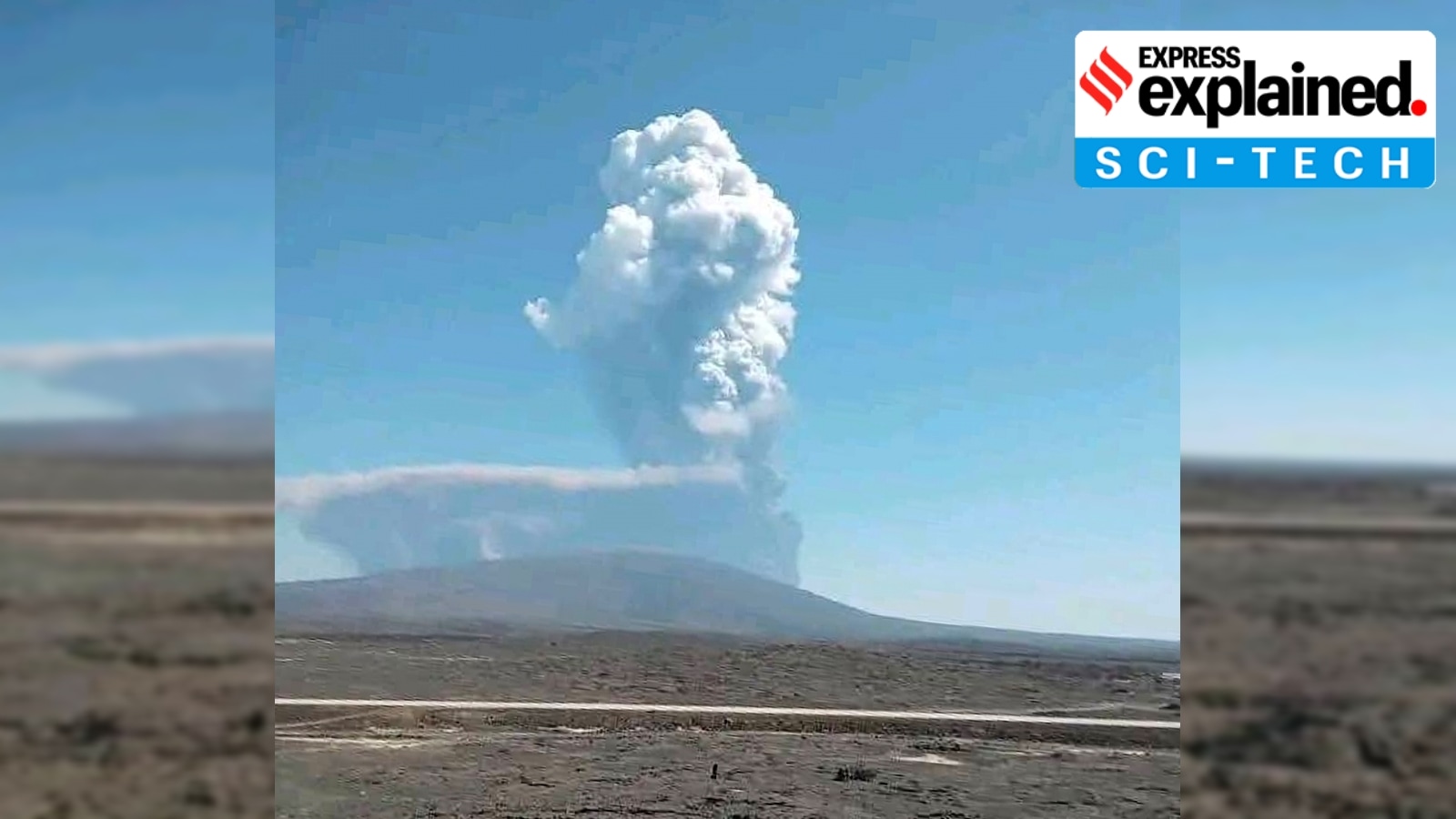 In this photo released by the Afar Government Communication Bureau, ash billows from an eruption of the long-dormant Hayli Gubbi Volcano in Ethiopia's Afar region, Sunday, Nov. 23, 2025. AP/PTI
After laying dormant for 12,000 years, the Hayli Gubbi volcano in northeastern Ethiopia erupted on Sunday (November 23). But instead of molten hot lava flowing down the mountainside, thick plumes of ash and gaseous matter dominated visuals of the eruption.
The explosive power and content of a volcanic eruption are determined by two key factors: the viscosity of the magma and its dissolved gas content. This in turn is a product of the rock composition at the base of the volcano, that is, the composition of the rock that heats up to become magma.
Speaking to The Indian Express about the explosive eruption of Hayli Gubbi, Hetu Sheth, Professor, Department of Earth Sciences at IIT Bombay, said, “In case the magma is poor in silica, it is more fluid in nature that allows the volatiles to easily escape as opposed to silica-rich magma, which keeps the volatiles trapped.”
The silica content of the magma determines its viscosity, that is, how “sticky” or “runny” it is. The latter is associated with more gentle, effusive eruptions where lava simply flows out of the vent and down on the slope of the volcanic mountain. Such eruptions are commonplace in Hawai’i.
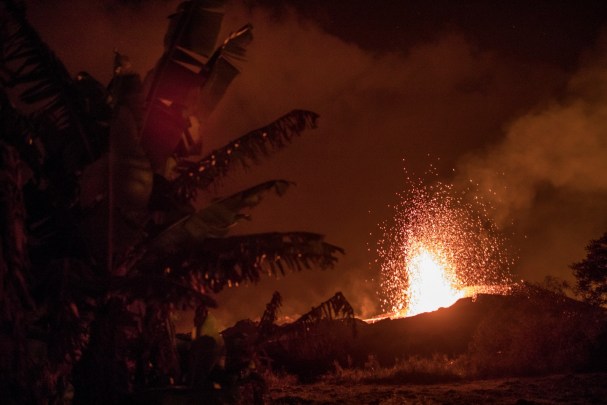 Lava flows from a Kilauea volcano fissure in Kapoho, Hawaii, May 18, 2018. Tamir Kalifa/The New York Times
Sticky, silica-rich magma, on the other hand, results in explosive, smoke- and ash-heavy eruptions.
“The explosive nature of any volcanic eruption indicates the accumulation of gas-rich volatiles and pressurisation that has reached the breaking point, leading to a sudden blast. In such cases, the fragmented magma (tephra) gets ejected instead of flowing lava,” Dr Sheth said.
Such eruptions are often more deadly and disruptive. The eruption of Hayli Gubbi, for instance, led to flight disruptions.The strong eastward-moving winds carried the ash and gaseous matter from Ethiopia to Yemen, Oman, Pakistan, India and even China by late Tuesday. Since this matter hovered at altitudes of 10 to 12 km, where commercial airlines operate, aviation services were partially disrupted.
Ethiopia has about 58 known volcanoes, according to global volcano eruption data maintained by the National Centres for Environmental Information of the United States’ National Oceanic and Atmospheric Administration (NOAA).
Of these, 43, including Hayli Gubbi, have not erupted during the Holocene period, which began some 11,700 years ago. (Four volcanoes — Alayta, Bora-Bericha-Tullu Moye, Dallol and Manda-Inakir — erupted between 1900 and 1963, and two — Kone and Fentale — erupted in the previous century. The Dama Ali volcano had erupted sometime during the 16th and 17th centuries.)
With no recorded eruption for many millennia, many volcanologists viewed Hayla Gubbi as an extinct volcano. As a result, monitoring was likely overlooked. Besides, with the region sparsely populated, the volcano did not pose much of a direct threat to humans.
That said, in the era of satellite technology, how the definitive indicators of the Hayli Gubbi’s impending eruption went undetected remains to be determined. These indicators include: the volcanic region’s rising heat levels, small variations observed in the local ground levels and ground uplift caused by accumulating magma pressure, heating up of groundwater, emergence of hot springs and steam near the volcano, and small magma-generated earthquakes, among others.
“These signs can guide in forecasting any possibility of volcano eruptions,” Dr Sheth added.
In the recent past, Iceland’s Eyjafjallajökull volcano erupted multiple times during March and June 2010. At the time, ash plumes had drifted over northern Europe and grounded flights for several weeks. Eyjafjallajökull had erupted after remaining dormant for nearly 187 years.