© The Indian Express Pvt Ltd
 5 min read


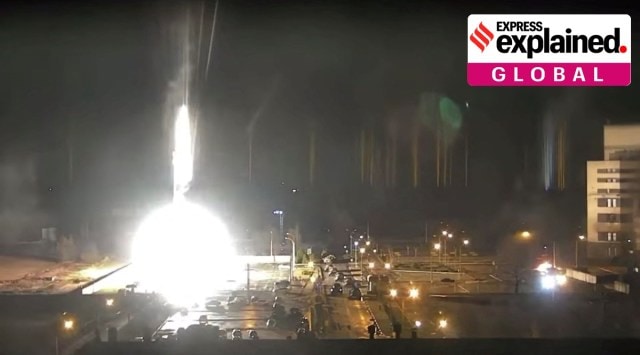 Surveillance camera footage shows Zaporizhzhia nuclear power plant during shelling in Enerhodar, Zaporizhia Oblast, Ukraine, on Friday. (Photo: Reuters)
A fire had broken out in Europe’s largest nuclear power plant located in Zaporizhzhia following fighting between Russian and Ukrainian forces, Ukraine’s state emergency service said Friday. News agency Reuters reported that a “training building” in the plant compound caught fire, and luckily, the reactors were not hit and there was no indication of elevated radiation levels so far. We take a look at how the events unfolded and the risks that the blaze posed.
🗞️ Subscribe Now: Get Express Premium to access the best Election reporting and analysis 🗞️
Zaporizhzhia in Enerhodar — a city in the north-western part of Ukraine, close to Kharkiv and about 550 km south-east of Kyiv — is the largest nuclear power plant in Europe and among the 10 largest in the world. It accounts for a fifth of the electricity generated in Ukraine. The plant has six VVER-1000 pressurised light water nuclear reactors (PWR), each generating 950 MWe (megawatt electric), for a total power output of 5,700 MWe. It’s nearly three times the size of the Kudankulam nuclear power station — which has a capacity of 2,000MWe, with two operational VVER-1000 units which are the same as the ones at Zaporizhzhia, but of an updated type.
Ukrainian President Volodymyr Zelenskiy called on Europe to prevent a ‘nuclear catastrophe’ after a fire broke out at the Zaporizhzhia nuclear power plant following a Russian attack https://t.co/UHPUHRcHY6 pic.twitter.com/aScHYzYTnX
— Reuters (@Reuters) March 4, 2022
A video feed from the plant verified by the Reuters showed shelling, and smoke rising near a building at the plant’s compound. “Russian army is firing from all sides upon Zaporizhzhia NPP, the largest nuclear power plant in Europe. Fire has already broke out. If it blows up, it will be 10 times larger than Chornobyl! Russians must IMMEDIATELY cease the fire, allow firefighters, establish a security zone!” Dmytro Kuleba, the Minister of Foreign Affairs of Ukraine, wrote on Twitter.
Russian army is firing from all sides upon Zaporizhzhia NPP, the largest nuclear power plant in Europe. Fire has already broke out. If it blows up, it will be 10 times larger than Chornobyl! Russians must IMMEDIATELY cease the fire, allow firefighters, establish a security zone!
— Dmytro Kuleba (@DmytroKuleba) March 4, 2022
The UN’s atomic watchdog IAEA has said that local officials have informed the agency that the “essential” equipment at the Zaporizhzhia nuclear power plant is unaffected by the fire there. “Ukraine tells IAEA that the fire at the site of #Zaporizhzhia Nuclear Power Plant has not affected ‘essential’ equipment, plant personnel taking migratory actions,” the International Atomic Energy Agency said in a tweet. Background radiation levels remain unchanged at the Zaporizhzhia nuclear power plant, the RIA news agency cited a plant spokesperson as saying.
US Energy Secretary Jennifer Granholm also said there was “no indication of elevated radiation levels” at the plant. US President Joe Biden, too, spoke with President Volodymyr Zelenskyy to receive an update on the fire, the White House has said. Biden joined Zelenskyy “in urging Russia to cease its military activities in the area and allow firefighters and emergency responders to access the site,” the statement quoted by Reuters said. Biden also received an update on the situation from the US Energy Department’s under-secretary for nuclear security, it added.

What are the dangers involved?
The problem is if the fire spreads. While the power plant itself is unlikely to generate the kind of radioactivity that Chernobyl did, but given that it’s a pre-Fukushima plant, the safety features and redundancies are not as robust as in the new VVER-based plants, such as the one at Kudankulam.
Experts say that the biggest problem is if the fuel pond were to be hit or impacted. It is generally in the vicinity of the nuclear plant’s compound, where the spent — or used — fuel is stored. The safety features for the fuel pond are typically not as robust as of the plant itself.
The IAEA has urged Russian forces to stop attacking the nuclear power plant, warning of “severe danger” if the reactors were hit. “IAEA Director General @RafaelMGrossi speaks with #Ukraine PM Denys Shmygal and with Ukrainian nuclear regulator and operator about serious situation at #Zaporizhzhia Nuclear Power Plant, appeals for halt of use of force and warns of severe danger if reactors hit,” the agency tweeted.
Newsletter | Click to get the day’s best explainers in your inbox