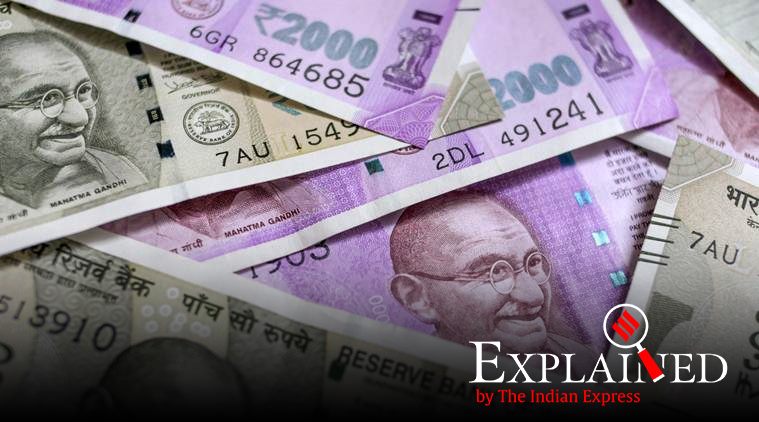
With the economy stalled, there isn’t enough money in the market for the government to borrow. Can it ask the RBI to print more money? How does this process work, and what are the arguments against it?
Indian one thousand and five hundred rupee banknotes are arranged for a photograph in Mumbai, India, on Sunday, Jan. 29, 2016. Photographer: Dhiraj Singh/Bloomberg The government’s finances were already overextended going into this crisis, with its fiscal deficit (the total amount of borrowings to bridge the gap between its spending and revenues) way over the permissible limit. (Source: Bloomberg)
The COVID-19 spread has meant that the Indian economy, which was already slowing down rapidly over the past couple of years, has completely stalled. Most estimates suggest that India’s GDP (gross domestic product) will barely grow in the current financial year — that is, if it does not contract as is likely to be the case in most major economies of the world.
What is the reason for this fall? With a nationwide lockdown, incomes have fallen and so have consumption levels. In other words, the demand for goods (say a pizza or a car) and services (say a haircut or a holiday) in the economy has gone down.
You’ve Read Your Free Stories For Now
Sign up and keep reading more stories that matter to you.
What can be done to boost demand? People need to have money. But, of course, who will give them money. From the highest-ranking CEOs to stranded workers, incomes have taken a huge hit, if not completely dried up.
Who is doing what?
For its part, the Reserve Bank of India (RBI) has been trying to boost the liquidity in the financial system. It has bought government bonds from the financial system and left it with money. Most banks, however, are unwilling to extend new loans as they are risk-averse. Moreover, this process could take time.
The government’s finances were already overextended going into this crisis, with its fiscal deficit (the total amount of borrowings to bridge the gap between its spending and revenues) way over the permissible limit.
Fluctuations in UK debt over three centuries. No ideal level of debt is set in stone. Click to enlarge
As things stand, under normal circumstances, just because the economy has stalled and the government will not be getting its revenues, the “general” government (that is, Centre plus states) fiscal deficit is expected to shoot up to around 15% of GDP when the permissible limit is only 6%.
On top of that, if the government was to provide some kind of a bailout or relief package, it would have to borrow a huge amount. The fiscal deficit will go through the roof.
Moreover, for the government to borrow the money, the market should have it as savings. Data show that savings of domestic households have been faltering and are barely enough to fund the government’s existing borrowing needs. Foreign investors, too, have been pulling out and rushing to “safer” economies like the US, and are unwilling to lend in times of such uncertainty.
So there isn’t enough money in the market for the government to borrow. Moreover, as the government borrows more from the market, it pushes up the interest rate.
As such, within the normal economic framework, things can only get worse before they get better, and the process of recovery could be painfully slow and full of hardships wherein children don’t get an education, the hungry don’t get adequate meals and so forth.
Story continues below this ad
But there is a solution — the “direct” monetisation of government deficit.
What is “direct” monetisation of deficit?
Imagine a scenario where the government deals with the RBI directly — bypassing the financial system — and asks it to print new currency in return for new bonds that the government gives to the RBI. Now, the government would have the cash to spend and alleviate the stress in the economy — via direct benefit transfers to the poor or starting construction of a hospital or providing wage subsidy to workers of small and medium enterprises etc.
In lieu of printing this cash, which is a liability for the RBI (recall that every currency note has the RBI Governor promising to pay the bearer the designated sum of rupees), it gets government bonds, which are an asset for the RBI since such bonds carry the government’s promise to pay back the designated sum at a specified date. And since the government is not expected to default, the RBI is sorted on its balance sheet even as the government can carry on rebooting the economy.
This is different from the “indirect” monetising that RBI does when it conducts the so-called Open Market Operations (OMOs) and/ or purchases bonds in the secondary market.
Story continues below this ad
Are other countries doing it to counter the economic crisis related to COVID-19?
Yes. In the UK on April 9, the Bank of England extended direct monetisation facility to the UK government even though Andrew Bailey, Governor of the Bank of England, opposed the move till the last moment.
Has India ever done this in the past?
Yes, until 1997, the RBI “automatically” monetised the government’s deficit. However, direct monetisation of government deficit has its downsides. In 1994, Manmohan Singh (former RBI Governor and then Finance Minister) and C Rangarajan, then RBI Governor, decided to end this facility by 1997.
Now, though, even Rangarajan believes that India would have to resort to monetising the deficit. “Monetisation of the deficit is inevitable. Such a large increase in expenditure cannot be managed without monetisation of government debt,” he said recently.
Then, why does the government not ask the RBI to print new money?
Direct monetisation of deficit is a highly contested issue. Another former RBI Governor, D Subbarao, recently cautioned against it. Subbarao wrote in the Financial Times: “There is no question that India must borrow and spend more in this crisis; that is a moral and a political imperative. But New Delhi should not forget that its bruising balance of payments crisis in 1991, and a near-crisis in 2013, were, at heart, a result of extended fiscal profligacy.”
Story continues below this ad
📣 Express Explained is now on Telegram. Click here to join our channel (@ieexplained) and stay updated with the latest
What are the main problems with direct monetisation of government deficit?
The main argument against it pertains not so much to its initiation as to its end. Ideally, this tool provides an opportunity for the government to boost overall demand at the time when private demand has fallen — like it has today. But if governments do not exit soon enough, this tool also sows the seeds for another crisis.
Here’s how: Government expenditure using this new money boosts incomes and raises private demand in the economy. Thus, it fuels inflation. A little increase in inflation is healthy as it encourages business activity. But if the government doesn’t stop in time, more and more money floods the market and creates high inflation. And since inflation is revealed with a lag, it is often too late before governments realise they have over-borrowed. Higher inflation and higher government debt provide grounds for macroeconomic instability, as mentioned by Subbarao.
To what level should government debt be ideally limited?
While no ideal level of debt is set in stone (see graph, showing how government debt in the UK has fluctuated over three centuries), most economists believe developing economies like India should not have debt higher than 80%-90% of the GDP. At present, it is around 70% of GDP in India.
“It should commit to a pre-determined amount of additional borrowing and to reversing the action once the crisis is over. Only such explicitly affirmed fiscal restraint can retain market confidence in an emerging economy,” Subbarao wrote.
The other argument against direct monetising is that governments are considered inefficient and corrupt in their spending choices — for example, whom to bail out and to what extent.
Udit Misra is Senior Associate Editor at The Indian Express. Misra has reported on the Indian economy and policy landscape for the past two decades. He holds a Master’s degree in Economics from the Delhi School of Economics and is a Chevening South Asia Journalism Fellow from the University of Westminster.
Misra is known for explanatory journalism and is a trusted voice among readers not just for simplifying complex economic concepts but also making sense of economic news both in India and abroad.
Professional Focus
He writes three regular columns for the publication.
ExplainSpeaking: A weekly explanatory column that answers the most important questions surrounding the economic and policy developments.
GDP (Graphs, Data, Perspectives): Another weekly column that uses interesting charts and data to provide perspective on an issue dominating the news during the week.
Book, Line & Thinker: A fortnightly column that for reviewing books, both new and old.
Recent Notable Articles (Late 2025)
His recent work focuses heavily on the weakening Indian Rupee, the global impact of U.S. economic policy under Donald Trump, and long-term domestic growth projections:
Currency and Macroeconomics:
"GDP: Anatomy of rupee weakness against the dollar" (Dec 19, 2025) — Investigating why the Rupee remains weak despite India's status as a fast-growing economy.
"GDP: Amid the rupee's fall, how investors are shunning the Indian economy" (Dec 5, 2025).
"Nobel Prize in Economic Sciences 2025: How the winners explained economic growth" (Oct 13, 2025).
Global Geopolitics and Trade:
"Has the US already lost to China? Trump's policies and the shifting global order" (Dec 8, 2025).
"The Great Sanctions Hack: Why economic sanctions don't work the way we expect" (Nov 23, 2025) — Based on former RBI Governor Urjit Patel's new book.
"ExplainSpeaking: How Trump's tariffs have run into an affordability crisis" (Nov 20, 2025).
Domestic Policy and Data:
"GDP: New labour codes and opportunity for India's weakest states" (Nov 28, 2025).
"ExplainSpeaking | Piyush Goyal says India will be a $30 trillion economy in 25 years: Decoding the projections" (Oct 30, 2025) — A critical look at the feasibility of high-growth targets.
"GDP: Examining latest GST collections, and where different states stand" (Nov 7, 2025).
International Economic Comparisons:
"GDP: What ails Germany, world's third-largest economy, and how it could grow" (Nov 14, 2025).
"On the loss of Europe's competitive edge" (Oct 17, 2025).
Signature Style
Udit Misra is known his calm, data-driven, explanation-first economics journalism. He avoids ideological posturing, and writes with the aim of raising the standard of public discourse by providing readers with clarity and understanding of the ground realities.
You can follow him on X (formerly Twitter) at @ieuditmisra
... Read More