Premium
This is an archive article published on September 26, 2021

Explained: 5 takeaways from new Punjab Cabinet under CM Charanjit Singh Channi

The rejig tries to take everyone along without providing ammunition to former Punjab Chief Minister Captain Amarinder Singh. Here are the five key takeaways.

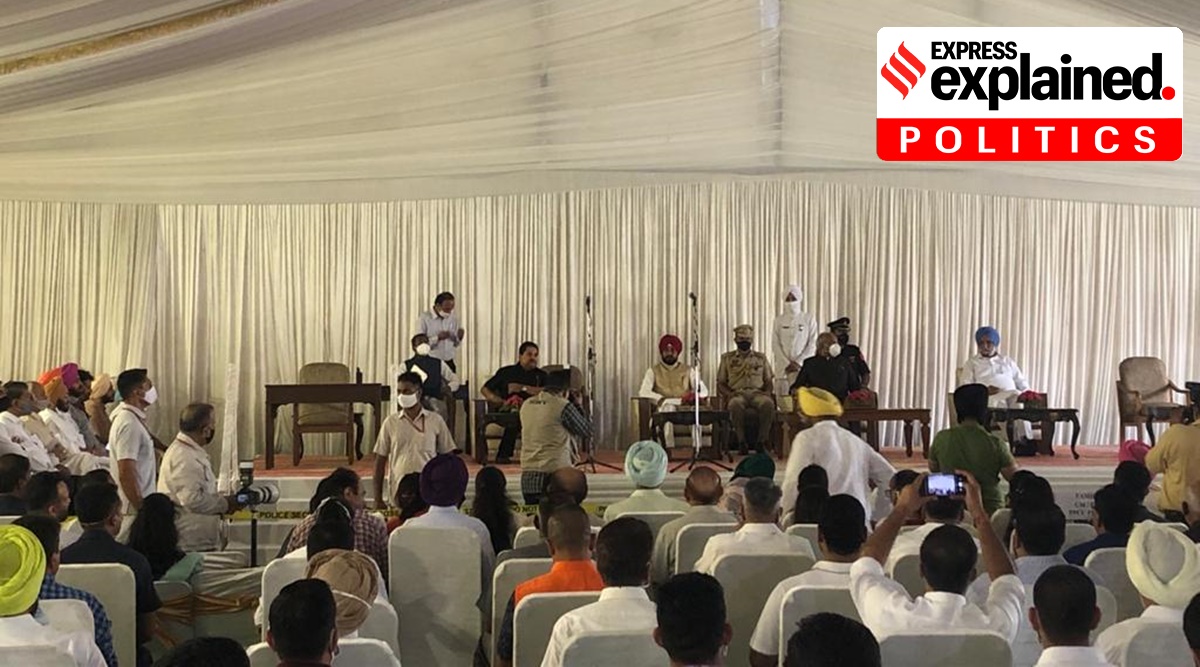
Governor, CM and Deputy CMs on stage during the oath taking ceremony at Punjab Raj BhawanGovernor, CM and Deputy CMs on stage during the oath taking ceremony at Punjab Raj Bhawan

Six days after Charanjit Singh Channi was enthroned the chief minister of Punjab along with two deputies, Sukhjinder S Randhawa and OP Soni, the Punjab Congress today (Sunday) introduced its new ministry with seven new faces.

The ministry, which has Rahul Gandhi’s stamp all over it, is an attempt to infuse fresh blood in the team, balance caste and regional considerations, and take everyone along without providing ammunition to former CM Capt Amarinder Singh.

Here are the five key takeaways from this rejig:

Rahul Gandhi holds the sway

The new Cabinet has the stamp of Rahul Gandhi all over it. Chief Minister Charanjit Singh Channi was summoned to Delhi twice, and a final video conference was held late on Saturday night to finalise the list. Six of the seven new ministers were informed by Congress about their imminent elevation on Saturday morning, even before party chief Sonia Gandhi could formally approve the list.

Rahul also played a role in placating Randeep S Nabha, 54, a four-time MLA, by dropping Kuljit Singh Nagra. Considered close to Rahul, Nagra, working president of PCC, was earlier party in-charge for Mizoram, Nagaland and Sikkim. When Nabha started complaining about being left out of the ministry despite his seniority, Rahul replaced Nagra with him, without any opposition.

Rahul also stood by the elevation of Raja Amrinder Warring, chief of Youth Congress from 2014 to 2018 despite opposition from within. Warring had contested against Manpreet Badal and defeated him.

Loyalty to the party/family pays

The three rebel ministers, namely Tripat Rajinder Singh Bajwa, Sukbinder Sarkaria and Sukhjinder Randhawa, also called the Majha brigade were not only retained but Randhawa, the most vocal of them all, was elevated to the rank of deputy chief minister. Sukhi is a second-generation Congressman and his father was one of the few legislators to stand by then prime minister Indira Gandhi after Operation Bluestar in 1984.

Story continues below this ad

Similarly, Beant Singh’s grandson Gurkirat Kotli has also been rewarded. Brahm Mohindra, though close to Capt Amarinder, has been retained due to his longstanding ties with the Gandhi family, and his stature as a tall Hindu leader.

Jagroop Singh Sekhon, a political observer, says the party has walked the tightrope to isolate Amarinder. “While it has left out his hardcore supporters such as Rana Gurmit Singh Sodhi, Balbir Sidhu and the tainted minister Sadhu Singh Dharamsot, who did not join the rebels, it decided to retain his loyalist Brahm Mohindra because it doesn’t want too many disgruntled leaders trying to join hands with the former CM.”

Baby steps to a generational shift

By elevating Pargat Singh, former captain of the Indian hockey team, Warring and Nabha and giving PPCC chief Navjot Singh Sidhu a say in the Cabinet, the party also signals a generational shift. Sidhu has managed to get a berth for all his men except Nagra who is a working president. There was talk about capping the age of the ministers at 70, but it was not carried through because it would have ended up excluding seasoned leaders like Tripat Bajwa and Brahm Mohindra.

At 43, Raja Warring is the youngest in the ministry, while Tripat Bajwa is the oldest at 78. Both had joined hands against Amarinder. Earlier the party had just one minister, Vijay Inder Singla, below fifty, now it has three. Of the seven new faces, only two are senior citizens.

Story continues below this ad

Regional balance

The curious re-entry of Rana Gurjit Singh, the minister who had to quit the Captain Amarinder Cabinet after being caught in a sand mining storm, may have something to do with his stature in the Doaba region. Ashutosh Kumar, a political scientist, says the party hopes that the well-heeled Jat Sikh industrialist along with Pargat Singh will be able to deal with any backlash from the Jat Sikhs in a region dominated by SCs. Rana is also known for his mastery over the electoral system. Much before the BJP started scripting booth-wise poll strategy, Rana was practising it.

With the present rejig, the party now has nine ministers from Malwa, which has 69 seats in the 117-member assembly, seven from the border belt of Majha (25 seats), and three from Doaba (23 seats). With this, the party has addressed the gripe of Majha politicians that despite winning 22 of the 25 seats in the region in 2017, the party had not adequately rewarded its legislators.

The caste card

Story continues below this ad

Well aware that SCs in the state are not a monolithic body, and the mere elevation of Channi as the chief minister may not be enough, the Cabinet has also inducted Raj Kumar Veka, a Valmiki, from Amritsar, and Sangat Singh Gilzian, a grassroots politician from the backward class Lubana community. Aruna Chaudhry, who’s been retained from the previous Cabinet, also belongs to the SC community.

The ministry now has four members from SC and BC communities against three in the previous government.

Newsletter | Click to get the day’s best explainers in your inbox

Manraj Grewal Sharma is a senior journalist and the Resident Editor of The Indian Express in Chandigarh, where she leads the newspaper’s coverage of north India’s most politically and institutionally significant regions. From Punjab and Haryana to Himachal Pradesh and the Union Territory of Chandigarh, she oversees reporting at the intersection of governance, law, politics and society. She also reports on the diaspora, especially in Canada and the US. With a career spanning journalism across several countries, academia and international development, Manraj brings a rare depth of perspective to regional reporting. She is widely regarded as a leading chronicler of Punjab’s contemporary history and socio-political evolution, particularly its long shadow of militancy, federal tensions and identity politics. Her book, Dreams after Darkness, remains a definitive account of the militancy years and their enduring aftermath. Professional Background & Expertise A gold medalist in mass communication and a post-graduate in English literature, Manraj has a multifaceted career spanning journalism, academia, and international development. She was also awarded a fellowship by National Foundation of India and did several in-depth pieces on Manipur. Internationally, she has reported from Israel, US, UK, Myanmar, and Mauritius Her key focus areas include: Regional Politics, History, Agriculture, Diaspora, and Security. Of late, she has started focusing on Legal & Judicial Affairs: Much of her recent work involves reporting on high-stakes cases in the Punjab and Haryana High Court, ranging from environmental policy to civil rights. International Consulting: She previously served as a consulting editor for the Asia Pacific Adaptation Network and a publishing consultant for the Asian Development Bank (ADB) in Manila. Academia: For five years, she was the managing editor of Gender, Technology and Development, a peer-reviewed international journal at the Asian Institute of Technology, Bangkok. Recent Notable Articles (Late 2025) Her recent reportage focuses heavily on judicial interventions and regional governance: 1. Environment & Governance "‘NGT can’t test legality of policy’: HC hears challenge to Punjab’s ‘Green Habitat’ plan" (Dec 22, 2025): Covering a critical legal battle over whether the National Green Tribunal has the authority to strike down a state policy regularizing farmhouses on delisted forest land. "High court pulls up Punjab poll panel over audio clip probe" (Dec 10, 2025): Reporting on judicial concerns regarding the transparency and fairness of local body elections. 2. Legal Rights & Social Welfare "HC issues notice to Punjab, Haryana over delay in building old age homes" (Dec 22, 2025): Reporting on a contempt petition against top officials for failing to establish government-run homes for the elderly as promised in 2019. "Victims can appeal acquittals in sessions court without seeking special leave" (Dec 19, 2025): Highlighting a significant procedural shift in criminal law following a Supreme Court ruling. "HC upholds benefits for Punjab FCI officer acquitted in 20-year-old bribery case" (Dec 19, 2025): A report on the concept of "honourable acquittal" and its impact on employee benefits. 3. Human Rights & Identity "As Punjab denies parole to MP Amritpal Singh, HC asks it to submit ‘foundational material’" (Dec 1, 2025): Covering the legal proceedings regarding the radical preacher and sitting MP's request to attend Parliament. "Protecting life paramount: HC backs Muslim woman in live-in after verbal divorce" (Nov 6, 2025): Analyzing judicial protections for personal liberty in the context of traditional practices. Signature Beats Manraj is recognized for her ability to decode complex judicial rulings and relate them to the everyday lives of citizens. Whether it is a 30-year-old land battle in Fazilka or the political implications of Kangana Ranaut’s candidacy in Mandi, her writing provides deep historical and regional context. Contact @grewal_sharma on X manrajgrewalsharma on Instagram ... Read More


 

Latest Comment
Post Comment
Read Comments
Advertisement
Advertisement
Advertisement
Advertisement