8 min read
© The Indian Express Pvt Ltd



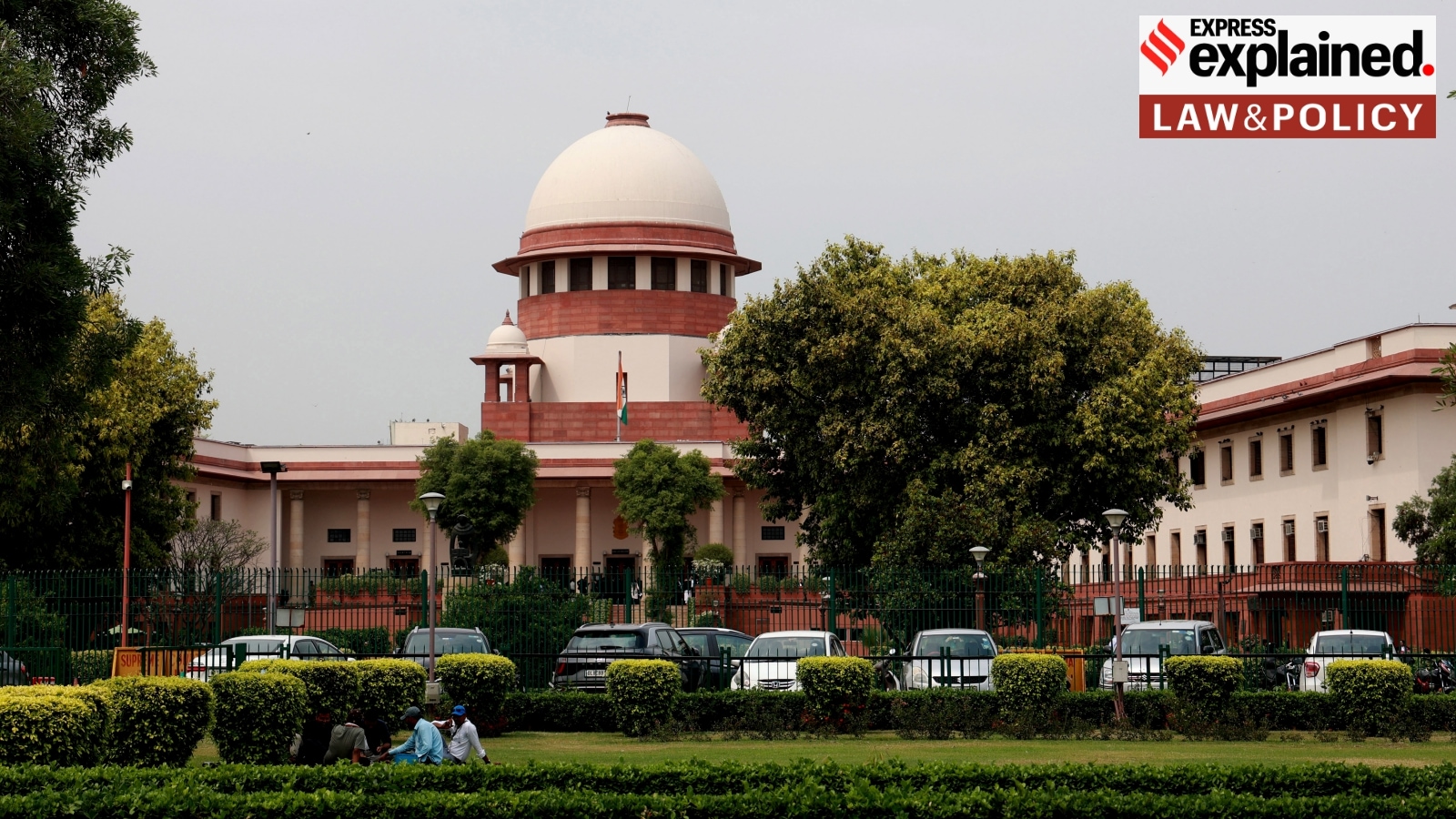 The Supreme Court of India, 2023. Amit Mehra
In a 2:1 ruling, the Supreme Court on Tuesday (November 18) recalled its judgment in May that struck down a 2017 notification and a 2021 office memorandum (OM) issued by the Ministry of Environment, Forest and Climate Change (MoEFCC). These instruments had created a pathway for projects that began work without prior approval to seek ex post facto environmental clearance.
Chief Justice of India B R Gavai and Justice K Vinod Chandran held that the May ruling, known as the Vanashakti judgment, was per incuriam, or delivered in ignorance of binding law. Justice Ujjal Bhuyan dissented, saying that the May decision reflected the correct position under environmental law. “[The] concept of ex post facto EC (environment clearance) is in derogation of the fundamental principles of environmental jurisprudence; rather, it is completely alien to environmental jurisprudence,” he noted.
At the centre of the issue is whether the environmental clearance system must operate through a strict prior-approval model, or whether retrospective clearance may be permitted in limited situations where rigid enforcement may produce outcomes that do not advance environmental protection.
The Environment (Protection) Act, 1986, gave the Centre powers to regulate pollution. The 1994 Environmental Impact Assessment (EIA) notification required clearance be obtained before new projects could begin, although the word “prior” was not explicitly used; courts later interpreted the rule as requiring pre-approval. A 2006 notification made this explicit by mandating “prior environmental clearance” before any construction, expansion or modernisation.
Despite this, many public and private projects proceeded without approval. Airports, hospitals, industrial facilities and road projects often began work while applications were pending. To address a growing backlog, the environment ministry issued a one-time “violation window” in 2017, allowing existing violators six months to apply for clearance. After the NGT held in the Tanaji Gambhire (2021) case that the process required a clearer procedure, the MoEFCC issued an OM setting out a Standard Operating Procedure (SOP) for such cases. Large public projects, including the AIIMS campus in Odisha and the greenfield airport in Karnataka, relied on these frameworks after beginning work without prior clearance.
In May 2025, a Bench of Justices Abhay Oka and Ujjal Bhuyan struck down both instruments. The Court said retrospective clearance contradicts the structure of the EIA process, which requires appraisal and public participation before work begins. The SC clarified that clearances already granted under the 2017 notification and the 2021 OM would remain valid.
Article 137 of the Constitution empowers the SC to review its own judgments through review petitions. Such petitions are ordinarily heard by the same Bench that delivered the initial verdict. In this case, with Justice Oka’s retirement, the matter was taken up by a special Bench of the CJI, Justice Chandran and Justice Bhuyan.
The SC rules state that the court may review a judgment only on narrow grounds that are recognised in the civil and criminal codes, especially when an error is apparent on the face of the record.
However, the court’s power to recall is rarely exercised. This is because cases go through multiple layers of hearings, a trial court, an appellate court, and then the Supreme Court. By the time the case reaches finality, it has usually survived multiple rounds of judicial examination. A review adds another round, only prolonging litigation, and judges are reluctant to let litigation become endless. A review is generally heard by the same Bench, and on narrow grounds such as error on record or evidence that genuinely could not have surfaced earlier. So, anything that could have persuaded them earlier would have been addressed then.
Justice Bhuyan’s position on environmental clearance comes from the right to live in a pollution-free environment, as enshrined under Article 21 of the Constitution; the duty of every citizen to “protect and improve the natural environment, including forests, lakes, rivers and wildlife, and to have compassion for living creatures”, as proscribed under Article 51A (g) of the Constitution; and the Environment (Protection) Act which requires every project to secure clearance before any work begins. This view treats ex post facto clearance as incompatible with the EIA framework.
The 2006 EIA notification lays down a three-level framework: major projects are cleared by the MoEFCC, mid-level projects by state authorities and smaller mining activity at the district level. Each proposal must go through screening, scoping, appraisal and, when needed, a public hearing so that environmental effects are considered before any harm occurs. The penalties under Section 15 of the Act cannot be used to validate projects that began work without approval, which makes measures like the 2017 notification or the 2021 SOP appear to be contrary to protecting the environment.
The other position, which prevailed in this case, accepts that the Act does not explicitly bar retrospective clearance, and in limited situations, achieving a balance may prevent greater loss. This idea reflects the “polluter pays principle”, and prefers penalties, and remediation rather than demolition. These instruments are viewed as means to bring violators into compliance.
The CJI and Justice Chandran recalled the May judgment, saying that the previous Bench had not considered coordinate Bench decisions that had upheld the validity of the 2017 notification and the 2021 OM. As a result, they said, the May ruling misread earlier precedents.
* In Common Cause (2018), the Court had criticised retrospective approval but still allowed mining operations to restart after compliance and payment of dues.
* In Alembic Pharmaceuticals (2020), the SC set aside the NGT’s closure directions after finding that shutting the industries “did not accord with the principle of proportionality”.
* In Electrosteel Steels (2025) a Bench of Justice Oka had held that the Environment (Protection) Act does not bar ex post facto clearance in appropriate cases.
On Tuesday, the majority said that if the earlier Bench disagreed with these rulings, it should have referred the matter to a larger bench.
A second concern flagged by the CJI and Justice Chandran was proportionality. The SC noted that rigid enforcement would lead to the “demolition of projects… of vital public importance constructed out of the public exchequer,” and that “thousands of crores of rupees would go in waste.” It noted that the 2017 Notification and 2021 OM already impose heavy penalties, which act as a “deterrent” while still bringing projects into compliance.
The Bench added that demolition would not help the environment because “it would result in creating even more pollution,” as many of these buildings would likely be rebuilt after securing clearance. The Court therefore said a “balanced approach” was required.
In his dissent, Justice Bhuyan noted that the May ruling correctly applied the basic structure of the EIA system, where “clearance must come first.” He grounded this view in Common Cause and Alembic, which he read as laying down the binding rule that retrospective approval has no place in the environmental clearance framework. He said decisions that allowed violators to continue operating did so under Article 142 and do not constitute binding law. On that basis, he said later rulings such as Electrosteel Steels, Pahwa Plastics (2022) and D Swamy (2022), relied on by the majority, were themselves “clearly hit by the principle of per incuriam”.
The dissent also extended to what the law should do once a violation has occurred. An entity that is responsible for damaging the environment must bear the costs of paying for the damage. The 2021 SOP outlines that the polluter must pay for the violation period, with the payment being proportionate to the scale of the project and the extent of commercial transactions. This is known as the polluter pays principle.
The majority applied proportionality, saying the law cannot ignore the consequences of demolition if projects can still be made compliant. Justice Bhuyan rejected this approach. He said the polluter pays principle addresses reparation, not validation of an unlawful start, and cannot dilute the basic rule that environmental clearance must precede construction.
With the May judgment recalled, the Court reopened the case. The notification and the OM will remain in place, but their validity will be decided afresh.