6 min read
© The Indian Express Pvt Ltd



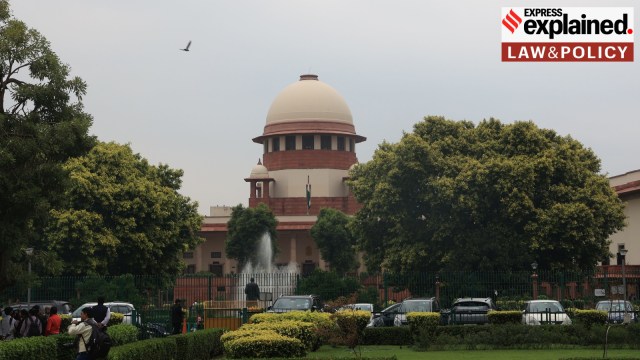 The Supreme Court of India. Express Photo by Amit Mehra
The Supreme Court on Tuesday (December 16) referred a Public Interest Litigation (PIL) to a three-judge Bench, signalling the need for a deeper constitutional examination of the rights of intersex persons.
The PIL was filed by Gopi Shankar M, the first openly intersex member of the National Council for Transgender Persons in 2024. At the time, the court had issued a notice to the Centre, but the matter never came up for hearing.
Following a mentioning of the case before the court by Gopi’s counsel on October 13 this year, the case was listed and heard on December 16 by a two-judge Bench headed by Chief Justice of India Surya Kanth.
The PIL highlights a fundamental distinction often overlooked in Indian law: the difference between “sex” and “gender”, and the physical and legal limbo faced by those who do not neatly fit into the binary categories of male or female.
Intersex people are born with sex characteristics — including genitals, gonads and chromosome patterns — that do not fit typical binary notions of male or female bodies. This is a matter of biological diversity, distinct from sexual orientation or gender identity.
Being intersex is different from being transgender. ‘Transgender’ is a term relating to gender identity, which is an individual’s internal sense of self. While a transgender person’s gender identity may differ from the sex assigned to them at birth, an intersex person is born with biological traits that are not exclusively male or female.
The current legal framework in India, largely shaped by the landmark NALSA v Union of India judgment of 2014, has carved out rights for the transgender community but inadvertently created confusion for intersex persons. By treating “sex” and “gender” as interchangeable concepts, the court effectively grouped all non-binary identities under the umbrella of “transgender” or “third gender”.
The PIL argues that this is a category error: an intersex person requires protection for their physical characteristics, which is distinct from the protection required for self-identified gender.
Perhaps the most pressing human rights violation highlighted in the PIL is the prevalence of “sex-selective” or “sex-assignment” surgeries performed on infants. These medical interventions are frequently carried out on newborns with ambiguous genitalia to cosmetically alter them to resemble a “standard” male or female body.
Although there is no consolidated nationwide data to identify the scale of the problem, the PIL claims that such surgeries were allegedly performed on 40 intersex newborns and children at the Government Rajaji Hospital in Madurai in 2022 and 2023.
Note that these surgeries are often performed long before the child can provide informed consent. Due to societal pressure to fit children into a binary mold, parents and doctors may opt for these procedures, which can be irreversible, medically unnecessary and physically and psychologically damaging.
Judicial and state interventions
While a central law is missing, there have been judicial and executive measures recognising intersex rights. The Madras High Court in Arunkumar v The Inspector General of Registration (2019) effectively banned sex-selective surgeries on intersex infants and children.
Following the court’s direction, the Tamil Nadu government issued a government order in August 2019, banning sex reassignment surgeries on intersex infants and children except in life-threatening situations. This made Tamil Nadu the first state in India to legally protect the bodily integrity of intersex minors.
The Delhi Commission for Protection of Child Rights, in 2021, recommended a similar ban on medically unnecessary sex-selective surgeries on intersex infants. In 2022, the Delhi High Court ordered the Delhi government to take a decision on this recommendation. The Delhi government is yet to put such a prohibition in place.
Administrative erasure & the Census
Beyond the medical sphere, intersex individuals face invisibility in government data. There is currently no official count of the intersex population in India. This is because they have never been counted as a distinct category. The 2011 Census, for example, recorded them under the “Transgender” category within the “Sex” column – an inaccurate conflation.
This administrative erasure can be seen to begin at birth. The Registration of Births and Deaths Act, 1969 operates on a strict binary, forcing parents to misidentify an intersex child as either male or female on their birth certificate. This initial misidentification creates a potential cascade of legal hurdles. If a child is registered as female at birth but develops male physiological traits during puberty, they face immense difficulties in education and employment.
The consequences of this policy vacuum are visible in cases like that of Indian athlete Santhi Soundarajan, who was stripped of her silver medal at the 2006 Asian Games following a “sex verification test”. Her case underscores the problem faced by individuals whose bodies do not conform to standard biological definitions in the absence of a legal framework that accounts for their existence.
The PIL’s primary demand is for a direction to the government to enact a legislative mechanism regulating medical interventions, thereby banning non-consensual sex-assignment surgeries on minors nationwide.
On the administrative front, the petition calls for the inclusion of “intersex” as a separate category in the upcoming Census. It also seeks a fundamental change in the format of official identity cards. Its argument is that documents should have separate columns for “sex”, which is biological, and “gender”, which is an identity, allowing individuals to accurately reflect their reality without being forced into a false binary.
The petition also seeks the establishment of a central regulatory commission specifically for the protection of rights of people with diverse sex characteristics. It demands the extension of reservation benefits to the intersex community, recognising them as a marginalised class that has historically been excluded from education and employment.
On Tuesday, the apex court referred the PIL to a three-judge Bench, recognising that it challenges the conflation of “gender” and “sex” in the NALSA judgement — delivered by a Bench of two judges.