Premium
This is an archive article published on April 3, 2021

Explained: How likely is Covid-19 reinfection? Here are findings of an ICMR study

Among 1,300 individuals who tested positive twice, an ICMR study has found that 4.5% could be reinfection cases. Why are the rest ruled out as such, and what are the implications of the findings?

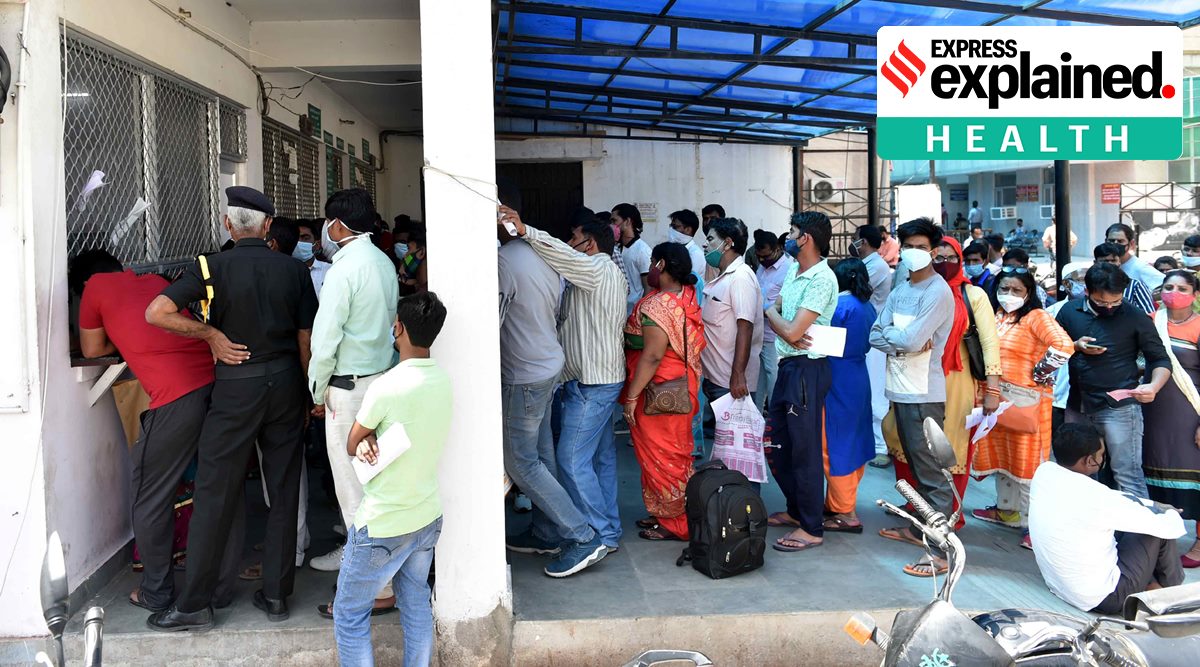
Queue for testing in Lucknow as Covid numbers rise. (Express Photo: Vishal Srivastav) Queue for testing in Lucknow as Covid numbers rise. (Express Photo: Vishal Srivastav)

In a first-of-its-kind exercise, a team of scientists from the Indian Council of Medical Research (ICMR) has identified a set of most plausible cases of reinfection of SARS-CoV2 virus in India. In a study that has been accepted for publication in the journal Epidemiology & Infection, the scientists examined the cases of 1,300 individuals who had tested positive for the virus twice, and had undergone tests even between the two positive results.

The study found that the cases of 58 of the 1,300 individuals, or 4.5%, could actually be classified as possible reinfections. In these 58, the two positive results had come at least 102 days apart, and they also had a negative test result in between.

Newsletter | Click to get the day’s best explainers in your inbox

Why is it significant?

Reinfection with SARS-CoV2 is the subject of an open scientific discussion. As of now, it is not clear whether a person who has been infected once develops permanent immunity against the disease, or can get reinfected after some time. An understanding of the possibility of reinfection is crucial to the fight against the pandemic. It will not only help decide the intervention strategies required to control the spread of the disease, but also help assess how long people would have to depend on masks and physical distancing. It will have implications on the vaccination drive as well.

As of now, very few cases of reinfection have been confirmed. The first confirmed case was reported from Hong Kong in August last year. After that, a couple of cases from the United States and Belgium also emerged. There have been several cases of people testing positive for the virus multiple times, even in India, but not all such cases are considered reinfections. That is because of what is called “persistent viral shedding”. Recovered patients can sometimes continue to carry low levels of virus within their system for up to three months. These levels are no longer enough to make the person sick or transmit the disease to others, but it can get detected in diagnostic tests.

How can reinfection be determined?

For a conclusive proof of reinfection, scientists rely only on genome analysis of the virus sample. Because the virus mutates continuously, the genome sequences of the two samples would have some differences.

Story continues below this ad

However, virus sample from every infected person is not being collected for genome analysis. That would be a herculean task, because genome analysis is a complicated procedure and takes time and effort. Samples from only a few randomly selected patients are sent for genome analysis to study the nature and behaviour of the virus. Therefore, when a person tests positive for a second time, and has to be checked for reinfection, there is usually no genome sequence from the previous infection to compare with.

In the case of the 33-year-old Hong Kong individual, scientists got lucky. His sample had been sent for genome sequencing the first time as well. So when he tested positive for the second time, the genome sequencing could be done again and the results compared.

How did the ICMR study approach the question of reinfection?

The group of scientists that carried out the study did not carry out genome analysis, because that data was not available. Instead, they looked at cases in which patients had reported positive results at least 102 days apart. That would take care of the problem of persistent viral shedding. According to the Centers for Disease Control (CDC) in the United States, viral shedding continues until only about 90 days.

Story continues below this ad

As an additional measure to rule out the possibility of viral shedding, the investigators looked at only those cases in which the individual had also taken another diagnostic test between the two positive results, and had a negative result during that 102-day period.

The scientists found 58 such cases, out of the 1,300 individuals who had got positive results at least two times, until October 7, the cut-off date for the study. In other cases, one criterion or the other was not being met.

📣 JOIN NOW 📣: The Express Explained Telegram Channel

What did the study find about these individuals?

Out of the 58 individuals who met the criteria set in the ICMR study, scientists could contact 38 individuals to obtain additional information, such as the symptoms experienced during the first and second infections. The remaining 20 people did not participate in the study, either because they could not be contacted due to incorrect contact details in the registry, or because they did not want to.

Story continues below this ad

Out of the 38 cases of suspected reinfection who could be conducted, 29 were male and were in the 20-40 age group. Twelve of the 38 individuals were healthcare workers. The duration between the two instances of infection ranged from 102 to 160 days.

The majority of the participants (27 out of 38) said they had remained asymptomatic during the intervening period, while eight reported mild symptoms. The remaining three participants said they had symptoms such as intermittent fever, cough, or shortness of breath.

Twenty of the 38 participants said they were symptomatic both times, with six reporting the second infection as more severe than the first. Another six said the first infection was more severe, while the remaining eight said the severity was the same in both infections.

What are the implications?

In the absence of genome analysis, these 58 cases would still not count as confirmed reinfections. But as the scientists point out, the study shows that permanent immunity cannot be assumed. Reinfection might very well be happening, and could be confirmed if it was possible to do genome analysis of every infected person.

Story continues below this ad

However, because such large-scale genome analysis is not feasible, the scientists have called for a consensus on an epidemiological definition of reinfection. They say that the criteria that they themselves used for this study — a gap of at least 102 days between two reinfections, and at least one negative test result in between — could become one candidate for the definition, if more such studies corroborated the findings.

Anuradha Mascarenhas is a Senior Editor at The Indian Express, based in Pune. With a career spanning three decades, she is one of the most respected voices in Indian journalism regarding healthcare, science and environment and research developments. She also takes a keen interest in covering women's issues . Professional Background Education: A gold medalist in Communication and Journalism from Savitribai Phule Pune University and a Master’s degree in Literature. Author: She authored the biography At The Wheel Of Research, which chronicles the life and work of Dr. Soumya Swaminathan, the former Chief Scientist at the WHO. Key Focus: She combines scientific accuracy with storytelling, translating complex medical research into compelling public and human-interest narratives. Awards and Recognition Anuradha has won several awards including the Press Council of India's national award for excellence in journalism under the gender based reporting category in 2019 and the Laadli Media award (gender sensitivity -2024). A recipient of the Lokmat journalism award (gender category-2022), she was also shortlisted for the RedInk awards for excellence in journalism-2021. Her debut book At The Wheel Of Research, an exclusive biography of Dr Soumya Swaminathan the inaugural chief scientist of World Health Organisation was also nominated in the Popular Choice Category of JK Paper AUTHER awards. She has also secured competitive fellowships including the Laadli Media Fellowship (2022), the Survivors Against TB – New Research in TB Media Fellowship (2023) and is part of the prestigious 2025 India Cohort of the WomenLift Health Leadership Journey.” Recent Notable Articles (Late 2025) 1. Cancer & Specialized Medical Care "Tata Memorial finds way to kill drug-resistant cancer cells" (Nov 26, 2025): Reporting on a breakthrough for triple-negative breast cancer, one of the most aggressive forms of the disease. Discipline, diet and purpose; How a 97-year-old professor defies ageing'' (Nov 15, 2025) Report about Prof Gururaj Mutalik, the first Head of Department at Pune's B J Government Medical College who at 97 credits his longevity to healthy habits and a strong sense of purpose. 2. Environmental Health (The "Breathless Pune" Series) Long-term exposure even to 'moderate' air leads to chronic heart, lung, kidney issues" (Nov 26, 2025): Part of an investigative series highlighting that even "safe" pollution levels are damaging to vital organs. "For every 10 µg/m3 increase in PM2.5 level, there was 6-8% jump in medicine sales" (Nov 23, 2025): Using commercial data to prove the direct link between air quality and respiratory illnesses in Pune. 3. Lifestyle & Wellness News "They didn't let cancer, diabetes and heart disease stop them from travelling" (Dec 22, 2025): A collaborative piece featuring survivors who share practical tips for traveling with chronic conditions. At 17, his BP shot up to 200/120 mmHG; Lancet study flags why child and teen hypertension doubled between 2000 and 2020'' (Nov 12,2025)--A report that focusses on 17-year-old-boy's hypertensive crisis and reflects the rising global trend of high blood pressure among children and adolescents. 4. Scientific Recognition & Infrastructure For promoting sci-comm, gender diversity: IUCAA woman prof highlighted in Nature" (Nov 25, 2025): Covering the global recognition of Indian women scientists in gender studies and physics. Pune researchers find a spiral galaxy like the Milky Way from early universe'' (December 3, 2025)- A report on how Indian researchers discovered a massive galaxy that existed when the universe was just 1.5 billion years old , one of the earliest to have been observed so far. Signature Beat: Health, Science & Women in Leadership Anuradha is known for her COVID-19 reportage, where she was one of the first journalists to provide detailed insights into the Covishield and Covaxin trials. She has a dedicated interest in gender diversity in health and science, often profiling women researchers who are breaking the "leaky pipeline" in STEM fields. Her writing style is scrupulous, often featuring interviews with top-tier scientists and health experts from various institutions.   ... Read More


Latest Comment
Post Comment
Read Comments
Advertisement
Advertisement
Advertisement
Advertisement