6 min read

© IE Online Media Services Pvt Ltd



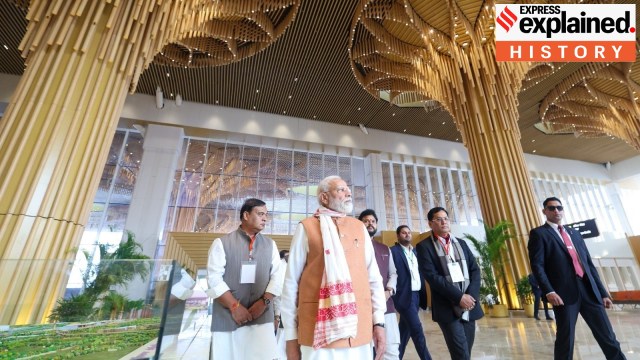 Assam East Pakistan Plan: PM Modi unveiled a statue of Assam’s first chief minister and Congress leader Gopinath Bardoloi at the airport, and then a new terminal building developed by Adani Airport Holdings Limited. (Photo: X/@narendramodi)
Cabinet mission plan 1946 news: Prime Minister Narendra Modi recently praised Assam’s first chief minister Gopinath Bordoloi for “standing up to his own party” and “saving Assam from being separated from the country.”
Speaking in Guwahati on December 20, PM Modi said, “Congress had conspired to erase the identity of this place… since before Independence. When the Muslim League and British powers got together and were preparing the ground for dividing India, at that time there was a plan to make Assam too a part of East Pakistan. Congress was going to become a part of that conspiracy, too. Then Bordoloi ji stood against his own party. He opposed this move to erase Assam’s identity and saved Assam from being separated from the country.”
What was this plan that Modi referred to, and what happened back in 1946? How did Mahatma Gandhi and Jawaharlal Nehru react to the plan? We explain.
By the 1940s, especially after World War II ended and Winston Churchill lost power, the withdrawal of the British from India was seen as more or less inevitable, with the modalities of independence and the creation of a new government to be worked out.
In line with this, on March 24, 1946, three British Cabinet ministers under Prime Minister Clement Attlee were sent to India. The three were Lord Pethick-Lawrence, Secretary of State for India; Sir Stafford Cripps, President of the Board of Trade; and A V Alexander, First Lord of the Admiralty. The Viceroy of India was then Lord Archibald Wavell.
The Cabinet Mission came up with a plan outlining the contours of the nation moving towards self governance. While pitched as a last-ditch attempt to keep India united, the plan had inherent contradictions which would make its implementation very difficult.
The basic premise of the Cabinet Mission Plan of 1946 was this: there would be a three-tier constitutional framework for British India, comprising a Federal Union at the top, autonomous provinces at the base, and an intermediate level of provincial groupings. These groupings were organised into three Groups — the north-western provinces Punjab, Sindh, and Baluchistan; the eastern provinces of Assam and Bengal; and the remaining central regions of India. It was in this Group system that Assam and Bengal were clubbed.
Although it never agreed to the specifics, the Congress was, in principle, in favour of the tiered federal framework proposed by the Cabinet Mission as it provided a vision for an independent and undivided India. The Muslim League also accepted it.
Gopinath Bordoloi (also spelt Bardoloi), the CM of Assam, was against the lumping together of Assam with Bengal. Sagar Boruah in a paper published in the Proceedings of the Indian History Congress, Vol. 63 (‘Nation building in North-East India: Role of the National Movement), writes, “The Assam Provincial Congress Committee totally rejected this grouping in the plan. The leaders of the Assam Provincial Congress feared that under this ‘grouping’ Assam might be sacrificed and tagged to Muslim dominated zone to appease the League.”
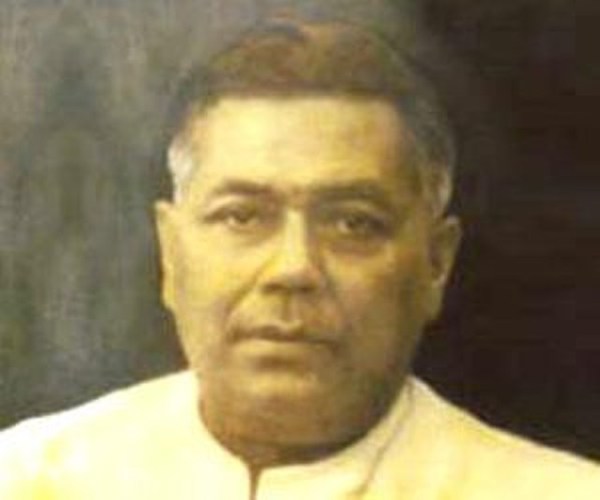 Gopinath Bordoloi, the first CM of Assam, was against the lumping together of Assam with Bengal. (Photo: Wikimedia Commons)
Bordoloi vowed to oppose this, but wanted to consult Gandhi before going ahead. He thus dispatched two Assam Congress leaders, Bijaychandra Bhagawati and Mahendra Mohan Choudhury, to meet Gandhi, who told them in unequivocal terms to reject the plan, and that Assam “should lodge its protest and retire from the Constituent Assembly.”
The Collected Works of Mahatma Gandhi has a detailed description of the meeting, an account of which was published in the December 29, 1946 issue of Harijan under the title ‘Gandhiji’s Advice to Assam’.
Telling the two leaders not to worry about “rebelling against the Congress”, Gandhi said, “If you do not act correctly and now, Assam will be finished. Tell Bardoloi I do not feel the least uneasiness. My mind is made up. Assam must not lose its soul. It must uphold it against the whole world. Else I will say that Assam had only manikins and no men. It is an impertinent suggestion that Bengal should dominate Assam in any way… Tell the people even if Gandhiji tries to dissuade us, we won’t listen.”
Nehru felt that the Cabinet Mission Plan had been devised because the British wanted to “save the face of Jinnah” and not push him into an “impossible corner”. He opposed Assam being forced into anything.
On July 22, 1946, he wrote to Bordoloi, “I feel that to decide against the Group was right and proper..”. On September 23, 1946, he wrote again to the Assam leader, “But in no event are we going to agree to a province like Assam being forced against its will to do anything.” [both letters on The Nehru Archive].
In an interview to BBC in April 1946, Nehru said about Assam, “In the North West Frontier Province, the people, though predominantly Muslim, have voted for the Congress Party. They have shown by a huge majority that they are opposed to a separate Pakistan state… Assam also is obviously opposed to Pakistan….Thus, even on the principle of self-determination to which the Muslim League appeals, four important areas, which Mr. Jinnah claims — the Frontier Province, Assam, west Bengal and southern Punjab — cannot form part of Pakistan.”
Then on July 10, 1946, Nehru famously addressed a press conference in Bombay, which essentially sealed the fate of the Cabinet Mission Plan as it was seen as Congress’s rejection of the Plan. Here, about Assam, Nehru said, “It is highly likely that Assam will decide against grouping with Bengal… I can say, with every assurance and conviction, that there is going to be, finally, no grouping there, because Assam will not tolerate it under any circumstances whatever.”