7 min read

Journalism of Courage



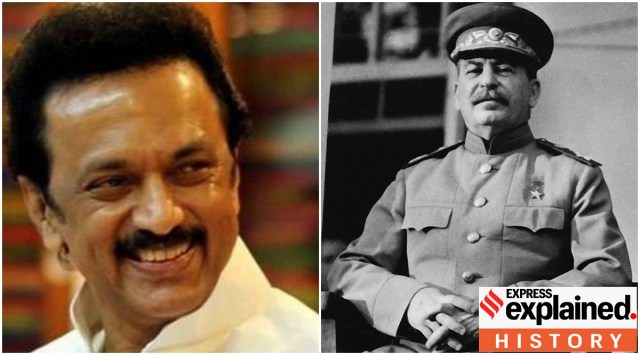 Rajnath said he wondered if the DMK president “took the name (Stalin) too seriously and is putting the spirit of democracy in danger". (File/Wikimedia Commons)
Union Defence Minister Rajnath Singh last week targeted Tamil Nadu Chief Minister MK Stalin, saying he wondered if the DMK president “took the name (Stalin) too seriously and is putting the spirit of democracy in danger”.
This was a reference to former Soviet President Josef Stalin (1878-1953), after whom the DMK supremo is named.
Responding to Rajnath Singh’s jibe, DMK’s mouthpiece ‘Murasoli’ in its editorial said the “very name Stalin evoked fear” in the Defence Minister.
It listed a slew of ‘accomplishments’ of Joseph Stalin, including making the Soviet Union an industrialised superpower, fighting capitalism, opposing imperialism, guarding the ideals of Marxism-Leninism, and providing job guarantees and social security to all Soviet citizens.
Stalin’s legacy has always been deeply polarising. For many, he is the prototypical dictator, responsible for millions of deaths and untold miseries.
However, others hail him as the protector of the communist dream in the Soviet Union amid threats from across the Western world, an enduring bulwark against the injustice of capitalism and imperialism.
Who was Josef Stalin?
Josef Stalin was a Soviet politician, political theorist, and revolutionary who led the Soviet Union from 1924 until his death in 1953. He took over the reins of the USSR after the death of revolutionary leader Vladimir Lenin by quickly eliminating his rivals, most notably, Leon Trotsky.
Once in power, Stalin removed Lenin’s “quasi-capitalist” New Economic Policy and replaced it with state-organised industrialisation with five-year plans.
At the forefront of Stalin’s economic policy was the collectivisation of agriculture — peasants were forced to give up their individual farms and join large collective farms or newly established industrial works. Those who refused were termed kulaks and arrested en masse before being killed, sent on exile, or sent to concentration camps or gulags.
In the 1930s, he undertook a campaign of political terror against members of his own party he suspected were not loyal to him. These “purges” also targeted Soviet intellectuals critical of his regime and furthered Stalin’s personal authority.
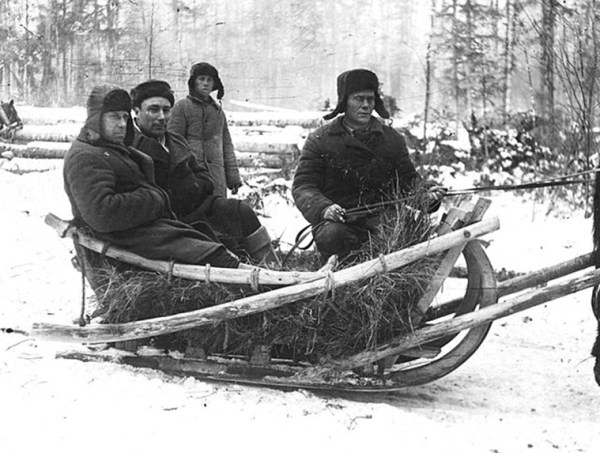 Gulag inmates at work. (Photo: Wikimedia Commons)
However, they also devastated the Soviet military and bureaucracy, so much so that upon Hitler’s 1941 invasion, the Soviet machinery came to the brink of collapse. However, under Stalin’s leadership, the USSR fought back and by 1943 decisively turned the tide of the war in favour of the Allies.
After the War, Stalin consolidated the communist hold of eastern Europe, becoming the patron of a number of satellite states which were independent on paper but, for all intents and purposes, subservient to the Soviet Union.
He passed away in 1953, at the age of 75. By this time, his cult of personality and personal authority had permeated all institutions of the Soviet state. He had also grown increasingly paranoid, constantly finding conspiracies to undermine him and the “great communist ideals” of the USSR.
What do critics of Stalin say?
Critics of Stalin have accused him of all kinds of totalitarian excesses.
Right from his ascent to power, his authoritarian tendencies were clearly visible. He consolidated his personal authority by removing all opposition and striking fear into the hearts of everyone living in his regime. As per some scholarly estimates, the Great Purge (1936-38) killed at least 700,000 people, with many more imprisoned or sent on exile.
“Stalin came to realise that there was no such thing as absolute security [of the USSR, Stalin’s own authority] unless he destroyed the entire nation,” historian Hiroaki Kuromiya wrote in ‘Accounting for the Great Terror’, adding that “Blanket terror … was Stalin’s answer to the prospect of internal opposition combining, in the case of war, with external enemies to pose a deadly threat.”
His economic policies too were brutal for much of the Soviet population. As peasants were dispossessed of their land, many were killed for resisting. Those who survived, often found themselves in the horrid gulags.
“Philosophers, psychologists, doctors, writers could have observed in our camps more than in anywhere else… the specific process of narrowing of man’s mental and intellectual horizon,” Nobel prize winner Alexander Solzhenyetsin wrote in The Gulag Archipelago (1973).
All major grain-producing regions of the USSR suffered from what is remembered as the Great Famine from 1930-33, directly caused due to collectivisation of agriculture and economic mismanagement under Stalin. Anywhere between 6 and 9 million people perished during this famine, with some, especially in Ukraine where the famine was the most damaging, terming it as a “genocide”.
What have those defending Stalin said?
Russia, at the time of the Revolution, was one of the most backward economies in the world, primarily dependent on agriculture. In fact, when Marx was originally writing on historical materialism, he felt that the material conditions in Russia were such that it would not see a proletariat revolution any time soon.
One of Stalin’s biggest achievements was to industrialise this backward nation, much faster than any other western country. Brutal as his economic policies were, in the nearly three decades of Stalinist rule, the Soviet Union became one of the world’s largest economies, surpassed only by the United States. Especially in the Global South, this made Stalin an inspirational figure to many left-leaning intellectuals.
As Jawaharlal Nehru wrote all the way back in 1928, “Russia thus interests us … because conditions there have not been, and are not even now, very dissimilar to conditions in India. Both are vast agricultural countries with only the beginnings of industrialisation, and both have to face poverty and illiteracy. If Russia finds a satisfactory solution for these, our work in India is made easier.”
Moreover, Stalin’s contribution towards the defeat of Adolf Hitler and Nazi Germany has always been praised, even by western commentators.
While Stalin himself had initially flirted with Hitler, signing the Nazi-Soviet Pact in 1939, his wartime leadership was instrumental for the eventual Soviet victory.
Lastly, defenders of Stalin emphasise that his excesses must be seen in the larger context of a nascent Soviet republic surrounded on all sides by countries which despised its very existence. In many ways, this pushed Stalin to the right, compelling him to stir up national sentiments, become increasingly authoritarian and eliminate anyone he felt would make the Soviet Union weak for capitalist countries to take advantage of.
How to judge Stalin today?
Today, most conversations about Stalin lack nuance with the two sides outdoing each other to praise or criticise the man.
Josef Stalin was a complicated figure ruling under extremely complicated circumstances. While this does not pardon any of his excesses, simply using Stalin’s name as a punching bag misses out historical context, as does providing a listicle of his achievements to defend him.