7 min read
© The Indian Express Pvt Ltd



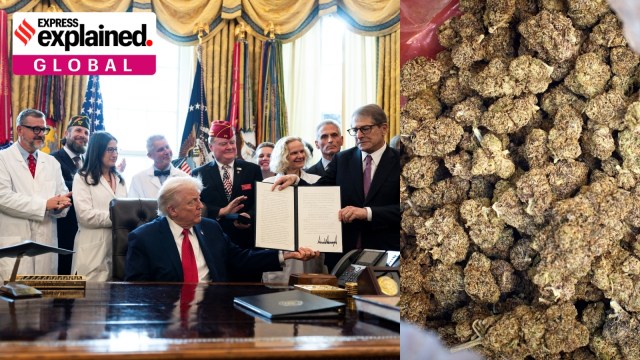 Donald Trump has signed an executive order to reclassify marijuana. NYT
US President Donald Trump signed an executive order on Thursday reclassifying marijuana from a Schedule I (most dangerous, comprising heroin, LSD and ecstasy) to a Schedule III (comprising prescription painkillers like hydrocodone) drug.
This is a major milestone in a decades-long push to decriminalise and eventually legalise cannabis, undo the damage done by the war on drugs, and move toward a narcotics regulatory framework that focuses on public health and treatment over enforcement and interdiction.
The Controlled Substances Act (CSA) of 1970 placed all regulated substances into one of five schedules, based on their medical use, potential for abuse, and safety or dependence liability.
The Act was introduced at a time when there was mounting alarm in the US over drugs and drug-related crime, particularly in the wake of thousands of Vietnam veterans returning stateside with severe heroin and amphetamine addictions.
Cannabis had already been heavily regulated as a part of 1930s prohibitionist push, but the CSA put it in the same class of drugs as heroin or LSD, despite cannabis not only being far safer but also less addictive (multiple studies have attested to this fact).
On June 17, 1971, US President Richard Nixon declared drugs as “public enemy number 1”. “In order to fight and defeat this enemy,” he said, “it is necessary to wage a new all-out offensive.”
This date is recognised as the official start of America’s war on drugs, a federal crackdown on narcotics that involved strict prohibition (many laws regarding which had already been passed), law enforcement, and foreign diplomatic and military intervention.
Over the next decades, US administrations, most notably of President Ronald Reagan, tightened laws and doubled down on enforcement while also funding influential anti-drug advertisement campaigns that resorted to moralising and fear-mongering.
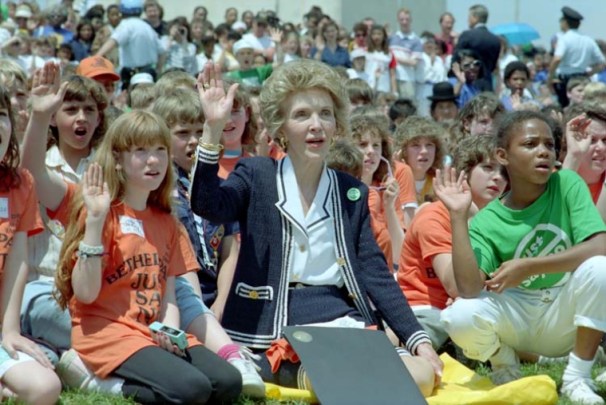 Nancy Reagan with children taking part in a “Just Say No” (to drugs) walk at the Washington Monument in 1988. Nancy Reagan was the torchbearer of Reagan-era anti-drug fear-mongering.
Today there is scholarly consensus that this tough-on-crime anti-narcotics agenda, which by some estimates cost the exchequer more than a trillion dollars (Center for American Progress, ‘Ending the War on Drugs: By the Numbers’, 2018), has not only failed, and led to mass incarceration at an unprecedented scale.
According to data published by the US Department of Justice (DoJ) in 2016, one-fifth of the country’s incarcerated population — some 456,000 individuals — were serving time for a drug charge, with another 1.15 million people on probation and parole for drug-related offenses. This is despite very strong evidence showing incarceration has next to no impact on substance abuse rates.
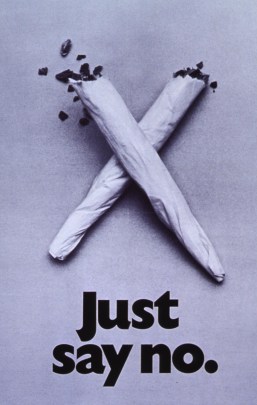 A “Just Say No” campaign poster from the 1980s. National Library of Medicine
Stark racial bias
The war on drugs disproportionately affected communities of colour: from the very outset, drug laws were implemented with a stark racial bias.
The treatment of cannabis exemplifies this bias. As recently as 2016, 92% of all arrests for marijuana possession by the New York City Police were of Black and Latinx persons, despite recent surveys pointing to roughly similar levels of cannabis consumption across racial lines, data compiled in the Drug Policy Alliance and Marijuana Arrest Research Project 2017 show.
Beyond biased enforcement, racial animus was at the heart of American narcotics policy itself, as influential policymakers later admitted.
“We knew we couldn’t make it illegal to be either against the [Vietnam] War or [be] Black,” John Ehrlichman, one of Nixon’s closest advisers, said in a 1994 interview to Harper’s Magazine.
“But by getting the public to associate the hippies with marijuana and Blacks with heroin, and then criminalising both heavily, we could disrupt those communities. We could arrest their leaders, raid their homes, break up their meetings, and vilify them night after night on the evening news. Did we know we were lying about the drugs? Of course we did.”
As of 2018, Black men were nearly six times more likely than white men to be locked up in state or federal correctional facilities, according to DoJ data, very often on minor, non-violent drug offences.
Kassandra Frederique, with the Drug Policy Alliance, told NPR that the Black Lives Matter movement was inspired in part by cases like the murder of George Floyd and Breonna Taylor that revealed a dangerous attitude toward drugs among police.
“We need to end the drug war not just for our loved ones that are struggling with addiction, but we need to remove the excuse that that is why law enforcement gets to invade our space … or kill us,” she said.
Winds of change
Even in the 1970s, there was a recognition in certain quarters that criminalisation of drug use, especially cannabis, was counterproductive, expensive, and a drain on resources. In 1973, Oregon became the first US state to decriminalise minor possession, even as federal law banned possession, use, purchase, sale, or cultivation of cannabis in all jurisdictions.
By the 1990s-2000s, several states had moved to decriminalise cannabis. In 1996, California became the first state to legalise the drug for medicinal use; in 2012, Colorado and Washington became the first states to legalise recreational use.
At the moment, 24 states, two territories and the District of Columbia have legalised small amounts of cannabis for adult recreational use, with 48 states, three territories, and DC having approved medical use. Possession of small amounts has been decriminalised in 31 states and DC.
But federal policy remains at odds with progress made by the states, leaving individuals and businesses in what has been called a “legal black hole”. This has affected (legal) marijuana businesses — who are set to bring in annual revenue of more than $100 billion by the 2030s — as well as individuals, who remain at the mercy of the whims of law enforcement.
Trump’s decision to reclassify marijuana is a step toward harmonising federal policy with state laws, and aligning it with growing public opinion in favour of cannabis. (A Pew Research Centre survey from July 2025 found that 87% of Americans were for legalising marijuana in some form).
That said, cannabis will remain illegal at the federal level. Reclassification, however, would allow expanded research into potential medical benefits, which in turn could bolster the case for federal legalisation.
“The President is very focused on the potential medical benefits, and he has directed a commonsense approach that will automatically start working to improve the medical marijuana and CBD research to better inform patients and doctors. That’s the primary goal,” a senior White House official told ABC News.
Trump’s order is the first at the federal level to formally recognise that marijuana could have medical value.