


Tags:


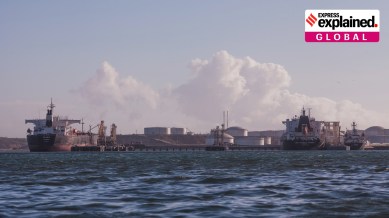
President Donald Trump on Tuesday ordered a “complete blockade” on sanctioned oil tankers going to and from Venezuela, an escalation of his administration’s monthslong pressure campaign against Nicolás Maduro, the leader of Venezuela.
“Venezuela is completely surrounded by the largest Armada ever assembled in the History of South America,” Trump wrote on social media. “It will only get bigger, and the shock to them will be like nothing they have ever seen before.”


Last Wednesday, the United States seized a tanker in the Caribbean Sea that was carrying Venezuelan oil for Cuba and China. A federal judge had issued a warrant for the seizure based on the fact that the tanker had recently transported oil from Iran.
The U.S. military has been building up a large naval force in the Caribbean in recent months, and Trump has threatened strikes inside Venezuela. Since September, the U.S. military has been carrying out airstrikes on boats in the Caribbean and eastern Pacific Ocean, many of them near Venezuela, in a campaign that has killed at least 95 people in 25 attacks.
Trump has said those attacks are aimed at stopping drug trafficking to the United States. But Venezuela is not a drug producer, and the cocaine that transits through the country and the waters around it is generally bound for Europe. Many legal experts say that the attacks are illegal and that the military is killing civilians.
Behind the scenes, Trump administration officials have also focused intently on Venezuela’s oil reserves, the largest in the world.
In his social media announcement Tuesday, Trump wrote in all capital letters that he was ordering a “a total and complete blockade,” which by itself would have been a substantial step. In international law, a blockade prevents all vessels from entering and leaving the ports of an enemy country during an armed conflict. But Trump added the qualifier “of all sanctioned oil vessels,” which changed the meaning.
Trump appeared to be threatening to enforce existing sanctions against some of the tankers exporting oil. If the U.S. Navy continues to allow most vessels to freely enter and leave Venezuelan ports, it is not a real blockade.
Still, any threat of seizure may be enough to scare off many companies that transport Venezuelan oil.
Trump also wrote that the U.S. operation would continue until Venezuela returned to the United States “all of the Oil, Land, and other Assets that they previously stole from us.”
Trump did not define what he meant by those assets. He might have been referring to the changes in Venezuela’s oil industry after leaders there put it under state control in the 1970s.
American oil companies had been prominent players in the industry for decades before that. During nationalization, Exxon, Mobil, Shell and Gulf Oil lost $5 billion in assets and were compensated only $1 billion, according to a New York Times article from that time. Until then, foreign companies accounted for 70% of the oil production in Venezuela.
Some American companies reentered the industry in the 1990s during a period of loosening by Caracas. But they were later forced by Hugo Chávez, who became leader of Venezuela in 1999, to limit their investments to minority shares in joint ventures with the main state-owned enterprise, Petróleos de Venezuela, S.A., or PDVSA.
Chevron is the one American company that stayed in Venezuela through all those decades and through the recent era of U.S. sanctions, and it continues to operate there with a newly extended confidential license from the U.S. government. Trump’s announcement of a blockade is not expected to have an effect on Chevron, the company said.
“Chevron’s operations in Venezuela continue without disruption and in full compliance with laws and regulations applicable to its business, as well as the sanctions frameworks provided for by the U.S. government,” Bill Turenne, a spokesperson for Chevron, said in a statement. “Any questions about the security situation in Venezuela should be directed to the appropriate authorities in the U.S. government.”
After the tanker seizure last Wednesday, Trump said he planned to keep the oil, though it is unclear what legal authority gives him the right to do so.
Since at least 2019, when Trump supported an effort to oust Maduro, he has said both privately and publicly that the United States should take Venezuela’s oil. This year, Trump sent an envoy to negotiate with Maduro over access to Venezuela’s oil. And the main opposition leader in Venezuela, María Corina Machado, has promised Trump’s aides and allies that if she were to take power, she would open up the industry to American investment.
Even before Trump’s announcement of a blockade, a U.S. official said the administration had made plans to seize more tankers that were carrying Venezuelan oil or going to pick it up.
The Treasury Department generally puts a tanker on a sanctions list when U.S. officials conclude the vessel has violated sanctions that the United States has imposed on a country’s oil industry.
In recent years, the United States has seized only a handful of oil tankers in international waters. In all those cases, the tankers had a history of carrying Iranian oil, which the U.S. government considers to be a resource that helps finance the Revolutionary Guard, an arm of the Iranian military designated by the United States as a foreign terrorist organization.
China buys about 80% of Venezuela’s oil. Those purchases are made by Chinese private companies, said Francisco Rodríguez, a professor at Denver University who studies Venezuela’s political economy. The other 20% of the country’s oil exports go to a variety of other nations, including Cuba, which relies on some of the Venezuelan oil for energy needs but sells most of it to China.


