8 min read
© The Indian Express Pvt Ltd



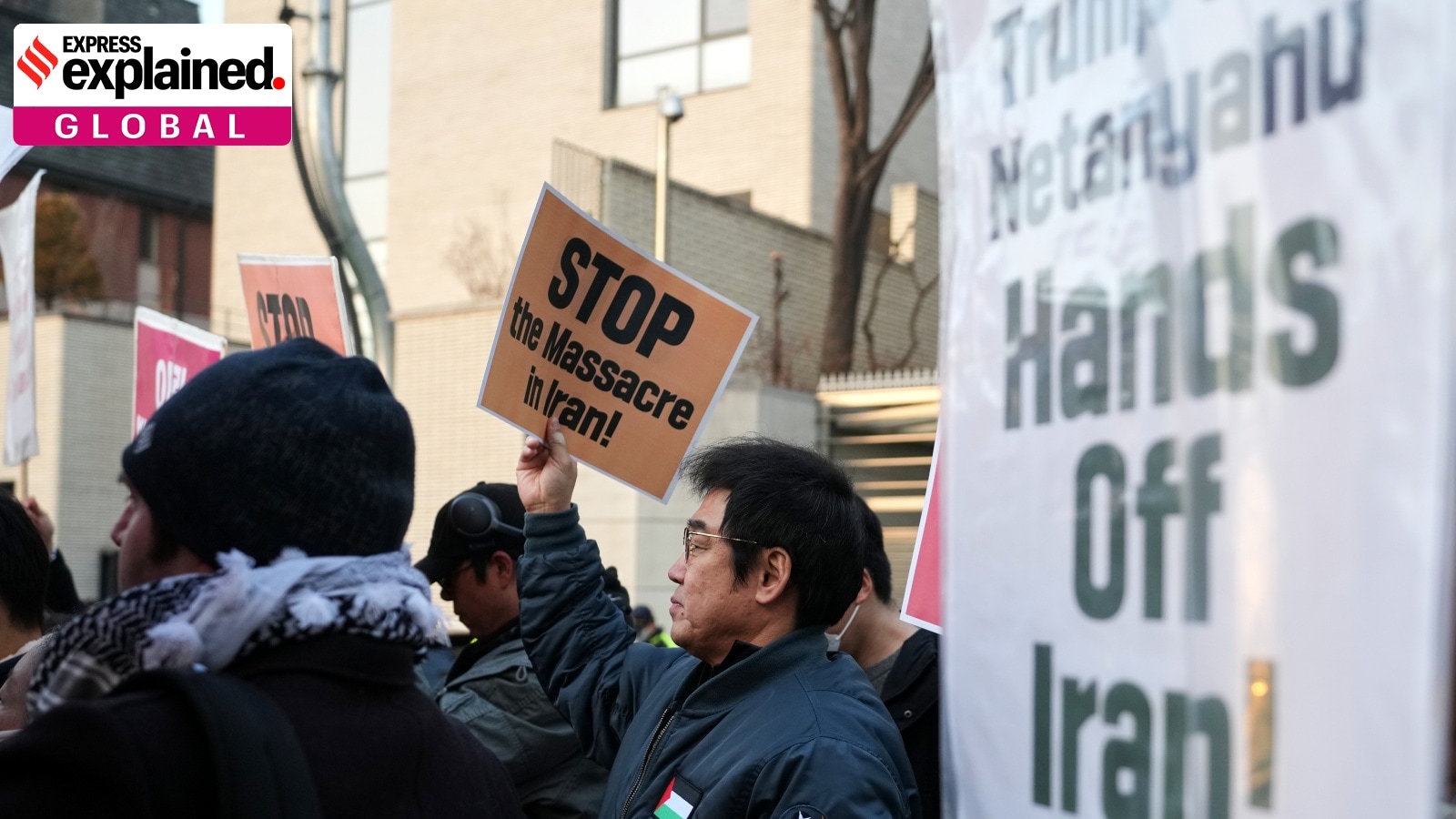 Protesters hold signs as members of civic groups gather in front of Iran Embassy in Seoul, South Korea, in support of Iran's anti-government protests, on January 16. (Photo: AP)
On January 12, the Iranian government announced that it had secured total control over the unrest in the country after a communications blackout imposed on January 8. Since then, internecine protests have continued but without reports of significant anti-regime demonstrations.
The global focus, however, has shifted to the possibility of American attacks on Iran following a series of dizzyingly oscillating assertions by US President Donald Trump.
Trump posted on January 2 that the US stood “locked and ready” to help protestors if the Iranian regime shot or executed any demonstrators. On January 12, he said that “Iran called, they want to negotiate” and that “a meeting is being set up”.
Soon after, he said all meetings were cancelled, urged Iranians “to keep protesting”, and declared that “help is on its way”.
By January 14, the US began moving troops out of the Al Udeid airbase in Qatar to secure them from a potential Iranian retaliation to an attack. US missions in Saudi Arabia called on personnel to “exercise caution”, while Iran closed its airspace.
On January 15, Trump announced that the Iranian regime had “stopped killing protestors” and halted “some planned executions”, signaling an offramp (as Iran also reopened its airspace).
Yet, on January 16, the White House declared that “all options remain on the table”.
What explains this fluctuating stand? How has the Iranian regime approached the US threat? And where do the protests fit in the US rationale?
America’s options in Iran
America’s initial hesitations could well be explained by insufficient military preparedness in West Asia, especially with one carrier strike group redeployed to the Caribbean (for Venezuela), and another in the South China Sea.
If it does attack, Washington would have to deploy standoff methods to prevent committing boots on the ground in a fresh war. But even as the USS Abraham Lincoln sails towards the Gulf with its carrier strike group, Washington is likely aware that it cannot afford involvement in a messy Iranian transition, even if it targets key government and Revolutionary Guards’ strongholds.
The inevitable violence also does not guarantee a stable pro-US Tehran in the future. There is no coherent set of US policy objectives that an attack could meet.
President Trump has also consistently refused to meet Reza Pahlavi, despite rhetorical support online. Pahlavi, the son of Iran’s deposed Shah who is strongly backed by Israel, has lived in the US for 47 years and has attempted to assume leadership of the demonstrations in Iran with little success.
In any case, there is no precedent for an external, principally aerial intervention to support peaceful protests and topple a regime in a country with a large population (second largest in West Asia), a cohesive military and paramilitary, and no civil war.
Similarly, Arab anxieties have pushed Gulf states to strongly advocate against an American war on Iran. While the UAE is Iran’s second-largest trading partner, Saudi Arabia is keen to avoid a larger, uncertainty-ridden regional crisis that could upset Riyadh’s focus on securing regional stability for economic diversification. Collectively, these factors restrain Washington’s hand. However, the simple need for a spectacle, to show US threats are credible, could still lead to an American attack followed by limited Iranian retaliation.
Iran’s abiding US problem
For Iran, a significant part of the solution to its economic malaise is external — relief from the Western sanctions. This is an absolute necessity, especially in the wake of the currency collapse and clear signs of a potential economic catastrophe.
So, engagement with the US is inevitable. But it is also the US that has been making the most pointed military threats (with proven credentials of following through, as seen in June 2025) towards it. This means Tehran needs to prepare for hostile engagement as well.
This has led to Tehran projecting a dual position, similar to Washington. Iranian Foreign Minister Abbas Araghchi said on January 12 that Iran was ready for war, but also for dialogue. The country has consistently maintained that any American attack will invite attacks on both American and Israeli regional targets.
Iran has also ensured that communications remain open with Washington. This was evident on January 10, as Araghchi hosted Oman’s Foreign Minister in Tehran for talks. Oman has long served as a trusted messenger between Washington and Tehran.
Should an American attack occur, Iran has sufficient reasons to choose de-escalatory and symbolic options — motivated both by abject economic need as well as confidence in its ability to raise the cost of any US-led war.
US military action’s links to protests
Trump’s threats to attack Iran using a “range of options”, has been linked to the need for the US to help catalyse regime change brought about by legitimate protestors.
However, such views have long been premised on two assumptions. The first is that a critical mass of the protestors are against the governing system and the nature of the state itself, rather than those calling for reform within the system. The second is that these protests will be sufficiently aided by external military action against Iranian military, political and strategic targets. There is little evidence to suggest that either of these assumptions are strong and true enough to give the US a categorical victory.
Iran, too, has been quick to admit to a high death toll (at least 2,000) and has since focused on dominating the narrative. Araghchi has stated that the country witnessed peaceful demonstrations since December 28, but violent rioting on January 7 and 8 that was evidently organised by external elements. This triggered a harsher crackdown on “rioters”, which also fit with the timeline of Supreme Leader Ali Khamenei’s January 9 Friday sermon where he vowed a strong response to rioters. Moreover, sizeable pro-regime demonstrations as well as the government’s amplification of attacks on mosques, public institutions and transport infrastructure have helped Tehran project balance in how developments are perceived.
This logic was evident when Iran summoned the British, German, French, and Italian Ambassadors on January 12, to view footage of destruction and killings perpetrated by rioters.
The Iranian regime has also closed its ranks, rather than splintering, with reformists and conservatives aligned on the government’s approach to rioters. This, along with continued organisational cohesion among the rank-and-file of the Islamic Revolutionary Guard Corps, has worked as a guarantee against regime collapse.
President Trump, himself, asserted on January 15 that the Iranians “were shooting back”, implicitly acknowledging Tehran’s allegations of organised and armed rioters fighting the state.
Notwithstanding the regime’s own authoritarianism, it is also true that Tehran has long been a counter-intelligence nightmare, with the Israeli Mossad having successfully penetrated government, military and private sectors. Even as Iran arrested or executed a number of alleged spies recently, its leaders have also highlighted former US Secretary of State Mike Pompeo’s January 3 post on X: “Happy New Year to every Iranian in the streets. Also, to every Mossad agent walking beside them” as evidence of foreign conspiracy.
Ultimately, Iranian protestors angry with the regime also have a long sense of history, going back to the American-British coup of 1953 which deposed Prime Minister Mohammad Mosaddegh after he nationalised Iranian oil. Hence, it remains uncertain if US military action against Iran will trigger fresh anti-regime actions, instead of nationalism-fueled solidarity. What is clear, however, is that just like the protests themselves, the success of any US military action is also mired in doubt.
Bashir Ali Abbas is a Senior Research Associate at the Council for Strategic and Defense Research, New Delhi.