5 min read
© The Indian Express Pvt Ltd



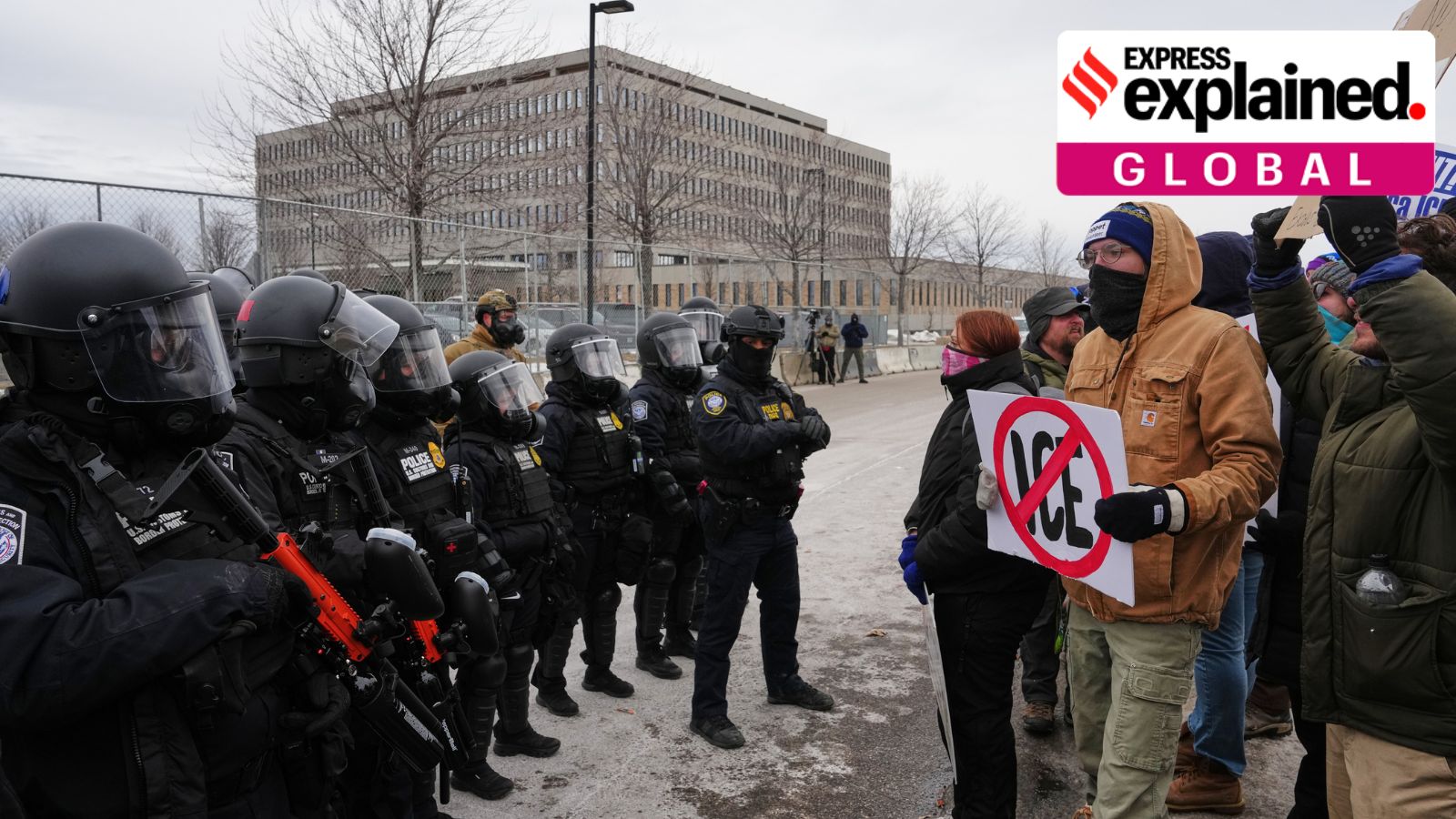 Federal immigration officers confront protesters outside Bishop Henry Whipple Federal Building on January 15, 2026, n Minneapolis. (AP)
Last week, US President Donald Trump announced he would end federal funding to states with sanctuary city jurisdictions, a move that could have a larger impact amidst his continued immigration crackdown.
“EFFECTIVE FEBRUARY FIRST, NO MORE PAYMENTS WILL BE MADE BY THE FEDERAL GOVERNMENT TO STATES FOR THEIR CORRUPT CRIMINAL PROTECTION CENTERS KNOWN AS SANCTUARY CITIES,” he wrote in a social media post.
Trump first made these remarks at a speech in Detroit Economic Club on January 13. “It breeds fraud and crime and all of the other problems that come, so we’re not making any payment to anybody that supports sanctuary cities,” he said.
Last year, the Department of Justice (DoJ) identified 11 states as sanctuary jurisdictions, including Minnesota, California and New York.
The latest announcement accompanies the administration’s targeted immigration crackdown in Minnesota, where Minneapolis resident Renee Good was fatally shot in her car by an ICE officer on January 7. Violence has escalated in the city in the following weeks, with residents using orange whistles and booing at armed ICE officers patrolling the streets. Over the weekend, the Pentagon placed 1,500 active-duty soldiers on standby to prepare for active deployment in the state.
While there is no single legal definition for what constitutes a sanctuary jurisdiction, the term typically refers to jurisdictions – states, cities or even counties – that limit the extent of their cooperation with federal agencies seeking to deport illegal immigrants in the US.
The practice dates back to the 1970s, with Berkeley becoming the first city to pass a sanctuary resolution in November 1971. In the ‘80s, the practice picked up as local governments began offering sanctuary policies after a mass exodus due to the civil war in El Salvador. With immigration becoming a major issue over the past decade, this practice has only grown.
The DoJ published a list of 36 sanctuary cities, states and counties last August, comprising overwhelmingly Democrat-controlled governments. This list replaced an initial longer list, which received pushback from several cities for the vague criteria used for their inclusion.
If the current order withstands court challenges, the August 2025 DoJ order has identified 13 states, namely California, Colorado, Connecticut, Delaware, District of Columbia, Illinois, Minnesota, Nevada, New York, Oregon, Rhode Island, Vermont, and Washington. The order also identified Baltimore (Maryland), Cook (Illinois), San Diego (California), and San Francisco (California) counties, and the cities of New York City, Los Angeles, Chicago, Philadelphia, Boston, Denver, Seattle, Portland (Oregon), Albuquerque, and Minneapolis.
Are sanctuary cities legal? Do they improve safety?
Sanctuary cities are protected under the 10th Amendment of the US Constitution, which governs powers not explicitly delegated to the federal government, and not prohibited to the states. The US Supreme Court has interpreted this amendment so that the federal government may not “issue directives requiring the States to address particular problems, nor command the States’ officers, or those of their political subdivisions, to administer or enforce a federal regulatory program.”
The New York Times reported that crime rates tend to be lower in sanctuary jurisdictions than in other jurisdictions, according to local leaders and police chiefs who testified before Congress. They have said that cooperating with ICE tends to lower trust between immigrants and local law enforcement. On the other hand, non-cooperation with federal immigration agents does not impact immigrants who are found guilty or arrested on federal criminal charges, imprisoned and then deported. The non-cooperation does not otherwise impede the work of federal agents tasked with enforcing federal immigration policy across the country, the NYT report said.
Many ways to not cooperate
A city, state or other jurisdiction may choose to prohibit the sharing of information in any of the following manners to earn the designation of a sanctuary city or jurisdiction:
Some jurisdictions may adopt policies that limit the ability of local police to arrest people for immigration violations or on civil immigration warrants. The federal government may issue “immigration detainers”, requests to hold someone in criminal custody until the Immigration and Customs Enforcement (ICE) agency can detain and potentially deport the person.
Some jurisdictions may adopt policies prohibiting agreements under Section 287(g) of the Immigration and Nationality Act (INA), under which ICE may deputise local law enforcement to enforce federal immigration law.
Some jurisdictions may pass legislation barring local governments from entering into contracts with the federal government to detaining immigrants, while others may enact laws banning federal detention centres from being constructed in their jurisdiction.
Some communities may prohibit their local law enforcement from sharing information about undocumented immigrants in their community.
Previous attempts and court challenges
This is not the first time Trump has threatened to withhold funding to sanctuary cities. In 2018, during his first term, federal courts blocked an effort to block the California Values Act, California’s sanctuary law.
After returning to the White House last year, Trump passed a series of executive orders to withhold federal funding to sanctuary cities. However, a California-based federal judge struck the orders down.
Trump 2.0’s larger push against immigration, spending
The pronouncement aligns with larger decisions made by the Trump administration to curtail “wasteful” spending, as outlined in the Project 2025 wishlist, which was widely shared as part of Trump’s re-election campaign in 2024. Thus far, the president has introduced cuts to social security programmes such as Medicaid and SNAP, the federal food assistance programme.