7 min read
© The Indian Express Pvt Ltd



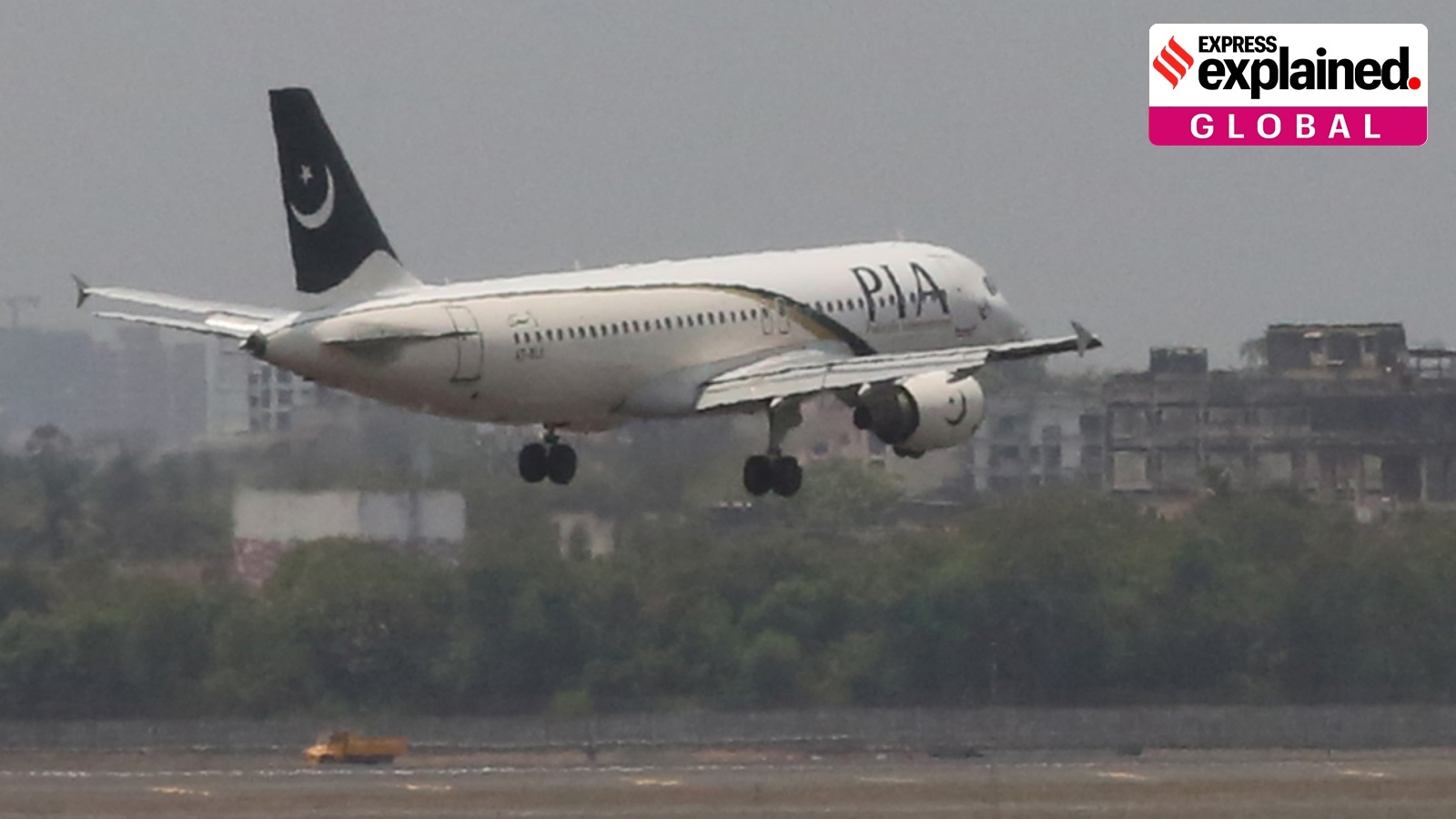 A PIA flight lands in Mumbai in 2017. Express Photo: Amit Chakravarty
Pakistan’s beleaguered flag carrier, Pakistan International Airlines (PIA), may finally be going private in the country’s biggest such exercise — but there’s a catch.
On Thursday, the Pakistan Army-owned Fauji Fertilisers (FFC) announced it was joining the private Arif Habib consortium (AHC) — which made the $480-million (13,500 crore Pakistani rupees) winning bid for a 75% PIA stake on Tuesday.
Regardless of the size of the Pakistan Army-owned firm’s participation, its presence in the consortium is a sign that what has happened with PIA is an “unconventional privatisation given continuing state-owned stakes”, wrote commentator Khurram Hussain in Dawn.
“The new consortium gearing up to take ownership of the airline could well usher in a new period of state and business partnerships in the years to come,” he wrote.
This is unlike the Indian government’s complete transfer of Air India to the Tata Group for Rs 18,000 crore.
That’s not the only difference from the 2021 Air India deal. PIA’s challenges are many, and different from those that Air India faced when it was being sold. The new consortium faces a major challenge in turning around a carrier weighed down by debt, an ageing, dwindling fleet, and a bloated staff count.
This is also the first privatisation exercise in Pakistan since attempts to take Pakistan Steel Mills private were quashed by the country’s Supreme Court, according to Dawn. And it is a litmus test for more disinvestments, including that of steel mills and power distribution companies.
The debt-ridden carrier has been struggling for a lifeline since a 2020 plane crash killed 97 people. A government probe into the crash revealed that 262 out of 860 of the PIA’s pilots had “fake licences”, a sensational announcement made by then Pakistan aviation minister Ghulam Sarwar Khan. On Wednesday, Pakistan’s defence minister, Khawaja Muhammad Asif called Khan’s remarks “baseless”, Al Jazeera reported.
PIA’s problems were compounded when flight safety regulators in the UK and EU banned the air carrier’s flights following the 2020 Karachi crash. The European Union Aviation Safety Agency and the UK Air Safety Committee lifted the ban this year.
“Instead of being run as a commercial organisation, the airline was often used to serve political interests,” Pakistani journalist Tarique Khaliq wrote in Business Recorder, pointing to “continued political interference” as one of the main reasons behind PIA’s decline.
Air India moment for PIA?
Air India, founded in 1932 by J R D Tata, was nationalised in 1953. After years of loss-making, the government finally sold it to the Tatas in 2021.
As part of the agreement, Air India took on more than Rs 15,000 crore of the carrier’s debt with the remainder being absorbed by the Indian government. Air India’s debt stood at Rs 43,000 crore as of 2021.
According to the deal, 15% of the Rs 18,000-crore bid amount would go to the government and the remaining amount would be used to cut the airline’s existing debt.
While there may have been similarities between Air India and PIA in terms of political control and burgeoning debt, there are differences in terms of fleet size as well as problems related to pilot training.
The PIA stake sale was also prompted by the International Monetary Fund’s pressure on the Pakistan government to cut holdings in loss-making enterprises as part of a funding requirement.
The financials of the PIA stake sale
AHC has an option to buy the remaining 25% stake within 12 months at a 12% premium, Business Recorder Pakistan reported. FFC had earlier backed out of the bidding process, with Reuters reporting that it may join AHC, given that the winning consortium had an option to add an investor and an airline operator to the grouping.
AHC’s winning bid entails the airline and its staff, while PIA’s debt burden worth PKR 65,000 crore has been housed in a holding company along with assets such as The Roosevelt Hotel and Scribe Hotels, according to Khurram Hussain.
“As a result of this rearrangement, PIA reported its first net profit in almost two decades. From a loss of Rs 104 billion (PKR 10,400 crore) in 2023, it went to a profit of Rs 26 billion (PKR 2,600 crore) in 2024,” he wrote, shedding light on how the airline was made more lucrative for private investors.
Out of the total bid price, 72.5% will be allocated to PIA, and the remaining 7.5% will go to Pakistan’s national exchequer, Dawn reported.
Key challenges for the consortium
The Arif Habib Consortium faces a big challenge with respect to personnel management at PIA since it cannot restructure the airline staff before 12 months, under the terms of the acquisition.
PIA also has an unwieldy staff-to-fleet ratio of 397. As of 2025, the airline’s staff headcount stood at 7,547, wrote Adeel Ahmed, Research Editor, Akseer Research brokerage.
The airline is also struggling with an ageing fleet. Its average fleet age is 17.8 years, according to Ahmed.
Another issue that plagues PIA is its outdated fleet of 38 aircraft of which only 18 are operational, according to a Business Recorder research article.
The consortium also faces challenges with respect to personnel management since it cannot restructure staff before 12 months, under the terms of the acquisition.
“What has actually been sold, therefore, is a running business with a clean balance sheet, and the prospect of running this business into profitability in the years to come. There is nothing the investor can do with what they have purchased, other than operate it as an airline. They cannot strip down its assets (it hardly has any),” Hussain wrote in Dawn.
Pakistan-based brokerage Topline Securities cited PIA’s landing rights for 78 destinations and 170 slots as key factors behind its turnaround potential. PIA’s privatisation is also expected to drive up the benchmark KSE100 index to touch 203,000-levels, according to the brokerage note.
The publicly televised PIA auction was clinched by the AHC, a consortium comprising unlikely partners: a brokerage firm, a fertiliser company, a company that operates a chain of schools, and a real estate developer.
Here’s a look at the consortium and its members:
Arif Habib Corp Ltd: The flagship company of Arif Habib Group, it is focused on financial services and brokerages functions. The larger group has interest in fertilisers, cement, steel, renewable energy and real estate development.
Fatima Fertilizer Corp: The company is a joint venture between Arif Habib Group and commodity trading conglomerate Fatima Group.
Lake City Holdings Pvt Ltd: A Lahore-based real estate project developer.
AKD Group Holdings Pvt Ltd: The company, with interests in finance, real estate, oil and gas, and technology, joined the consortium in November
City Schools Pvt Ltd: Founded in the port city of Karachi, the group has over 500 schools with over 150,000 students, according to its official website. It operates branches abroad in the UAE and Oman among other countries.
The other bidders in the fray included Lucky Cement Consortium and airline operator Airblue consortium. While Airblue backed out after the first round of bids with an offer of PKR 2,650 crore, Lucky Cement went into the second round with a bid of PKR 10,550 crore.
And while the Pakistan Army-run FFC dropped out of the bid process, it said Thursday that it would join the winning consortium, according to a Pakistan Stock Exchange filing.