6 min read


© The Indian Express Pvt Ltd



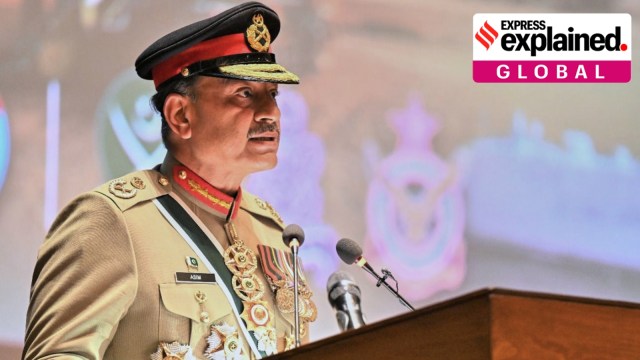 Pakistan IMF report: Field Marshal Asim Munir has effectively taken charge of Pakistan (AP)
Pakistan IMF report news: Concerns about Pakistan’s business and reputational risks have reduced as tensions with India have waned after peaking in May, the International Monetary Fund (IMF) noted in its latest review report for the country released Thursday.
The IMF, however, imposed 11 new structural benchmarks for Pakistan to avail its loan, out of which three conditions related to tax reforms, asset declarations of government officials, and private sector participation in the energy sector have to be met by the country by end-December.
“Strong ownership, as demonstrated through continued program performance and ongoing reforms, serves as a key mitigant to business risks, notwithstanding residual risks to program implementation as well as heightened global risks. After peaking in May, tensions with India have waned, also reducing related concerns about business risks (e.g., a prolonged military conflict compromising fiscal, external, and reform goals) and reputational risks (e.g., perceived misuse of Fund disbursements),” the IMF said.
The IMF released the country report for Pakistan on Thursday (December 11) after agreeing in October to process the second $1-billion tranche for the country as part of its $7-billion Extended Fund Facility (EFF) lending program, and conducting the first review of the arrangement under the Resilience and Sustainability Facility (RSF), allowing Islamabad to draw $200 million.
With these tranches, the IMF said it has provided about $3.3 billion under the two arrangements to Pakistan. In May, the IMF had cleared a $1-billion tranche for Pakistan as part of the EFF lending program and access to around $1.4 billion under the climate-focussed RSF.
In a bid to enhance transparency and accountability, the IMF has imposed a condition for Pakistan to publish the asset declarations of high-level federal civil servants, in line with the June 2025 legislative amendments, on a government website. This comes after the IMF in its ‘Governance and Corruption-Diagnostic (GCD) Assessment’ in November had said that corruption is a “persistent feature” of Pakistan’s governance landscape, its enforcement action in prosecuting money-laundering is “weak”, “judicial institutions” are perceived as “corrupt” and anti-corruption institutions have a “history of political influence”.
The GCD was conducted at the request and with the support of the Pakistan Government to identify and analyse governance weaknesses and corruption vulnerabilities that undermine economic performance. An interdepartmental IMF team, joined by experts from the World Bank, had initiated the GCD in January 2025. This assumed significance as Pakistan carried out its controversial 27th constitutional amendment, which increases the powers of Pakistan Army chief Field Marshal Asim Munir and curtails the powers of the Supreme Court by establishing another court above it.
As part of the fresh conditions, the IMF has also asked Pakistan to develop and publish a comprehensive medium-term (3 to 5 years) tax reform strategy that includes at least: a sequenced roadmap of tax policy, administration, and legal reforms; clear governance arrangements; and a resource plan for implementation. This condition also has to be met by end-December.
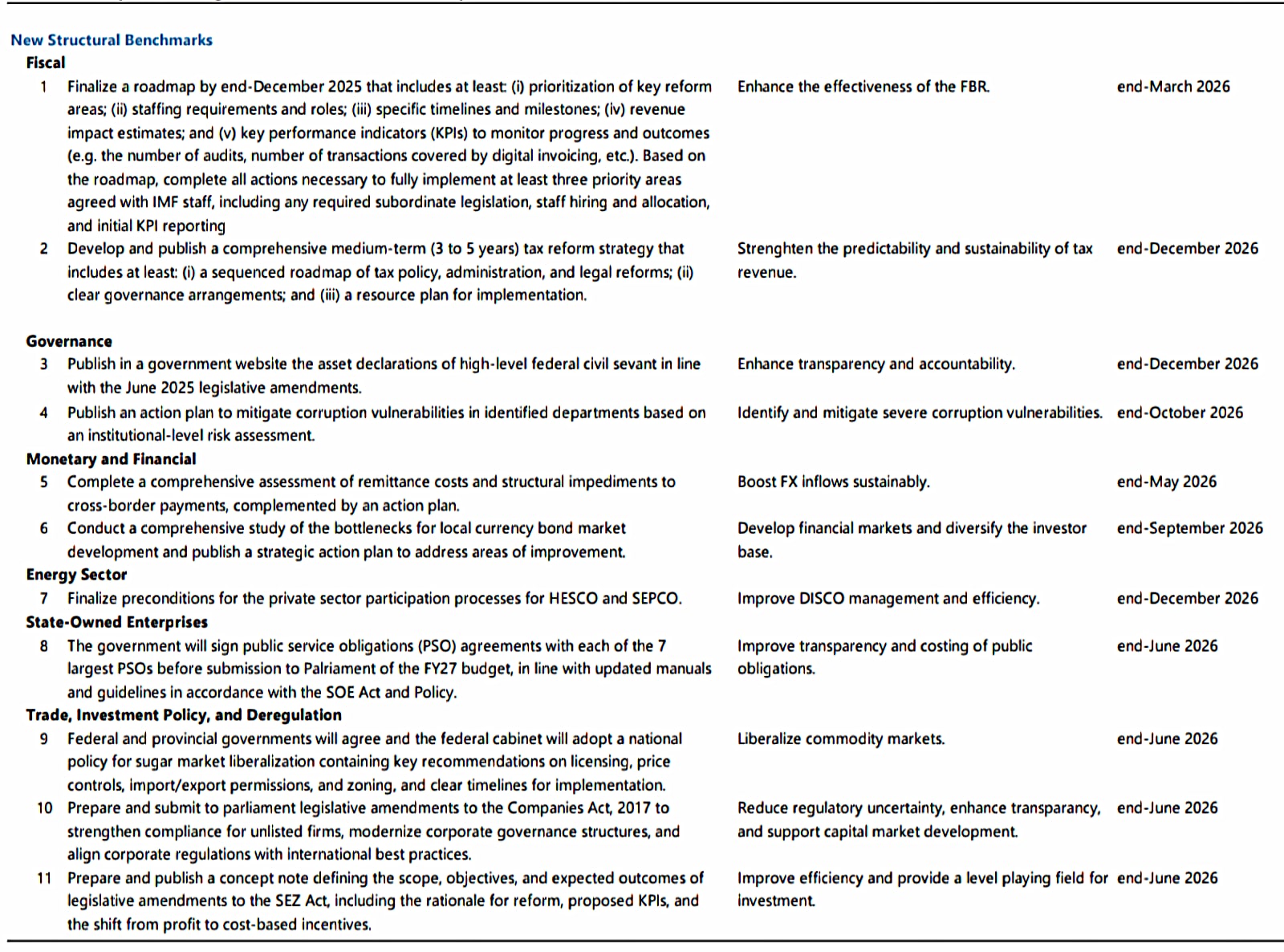 The 11 conditions.
In addition, the IMF has asked Islamabad to finalise preconditions for the private sector participation processes for its public sector utilities Hyderabad Electric Supply Company (HESCO) and Sukkur Electric Power Company (SEPCO) by the end of December.
Other conditions include finalising a fiscal roadmap that includes at least: prioritisation of key reform areas; staffing requirements and roles; specific timelines and milestones; revenue impact estimates; and key performance indicators by March.
To boost FX inflows, the IMF said Pakistan will also have to complete a comprehensive assessment of remittance costs and structural impediments to cross-border payments, along with an action plan, by end-May next year.
By end-June, federal and provincial governments need to agree and the federal cabinet will have to adopt a national policy for sugar market liberalisation with key recommendations on licensing, price controls, import/export permissions, and zoning, and clear timelines for implementation, the IMF said.
In May, in the aftermath of the terror attack in Pahalgam and Operation Sindoor, India had abstained from voting in the IMF board meeting over concerns of the efficacy of IMF programs for Pakistan given its “poor track record” and also on the possibility of “misuse of debt financing funds for state-sponsored cross-border terrorism”. Before the meeting, India’s Foreign Secretary Vikram Misri had said that the Fund’s Board should look “deep within” and take into account the facts before generously bailing out the country.
Two days before its board met on May 9 in Washington DC to approve $2.4 billion-worth loan facilities to Pakistan, the IMF staff had flagged “reputational risks” over perceived misuse of its lending and the increase in “enterprise risks” due to rising tensions with India. “The rising tensions between India and Pakistan, if sustained or deteriorate further, could heighten enterprise risks to the fiscal, external and reform goals of the program,” it had then said.
The IMF’s $7-billion aid package to Islamabad was approved in September 2024. The ongoing 37-month long EFF program of the IMF consists of six reviews over the span of the bailout. Under the EFF, the IMF provides financial assistance to countries facing “serious medium-term balance of payments problems because of structural weaknesses that require time to address”. The EFF offers longer repayment period to help countries implement structural reforms. Meanwhile, the RSF aims to reduce Pakistan’s balance of payments risks from climate vulnerabilities.
An IMF team visited Karachi and Islamabad from September 24 to October 8 to hold discussions on the second review under the EFF and the first review under the RSF. The IMF had then noted that Pakistan’s economic program is “entrenching macroeconomic stability and rebuilding market confidence”.