Premium

H-1B $100,000 entry fee explained: Who pays, who’s exempt, and what’s still unclear?

$100,000 entry fee on H-1B visa holders: The Indian Express speaks to US immigration lawyers on how the fine print of the White House move may play out.

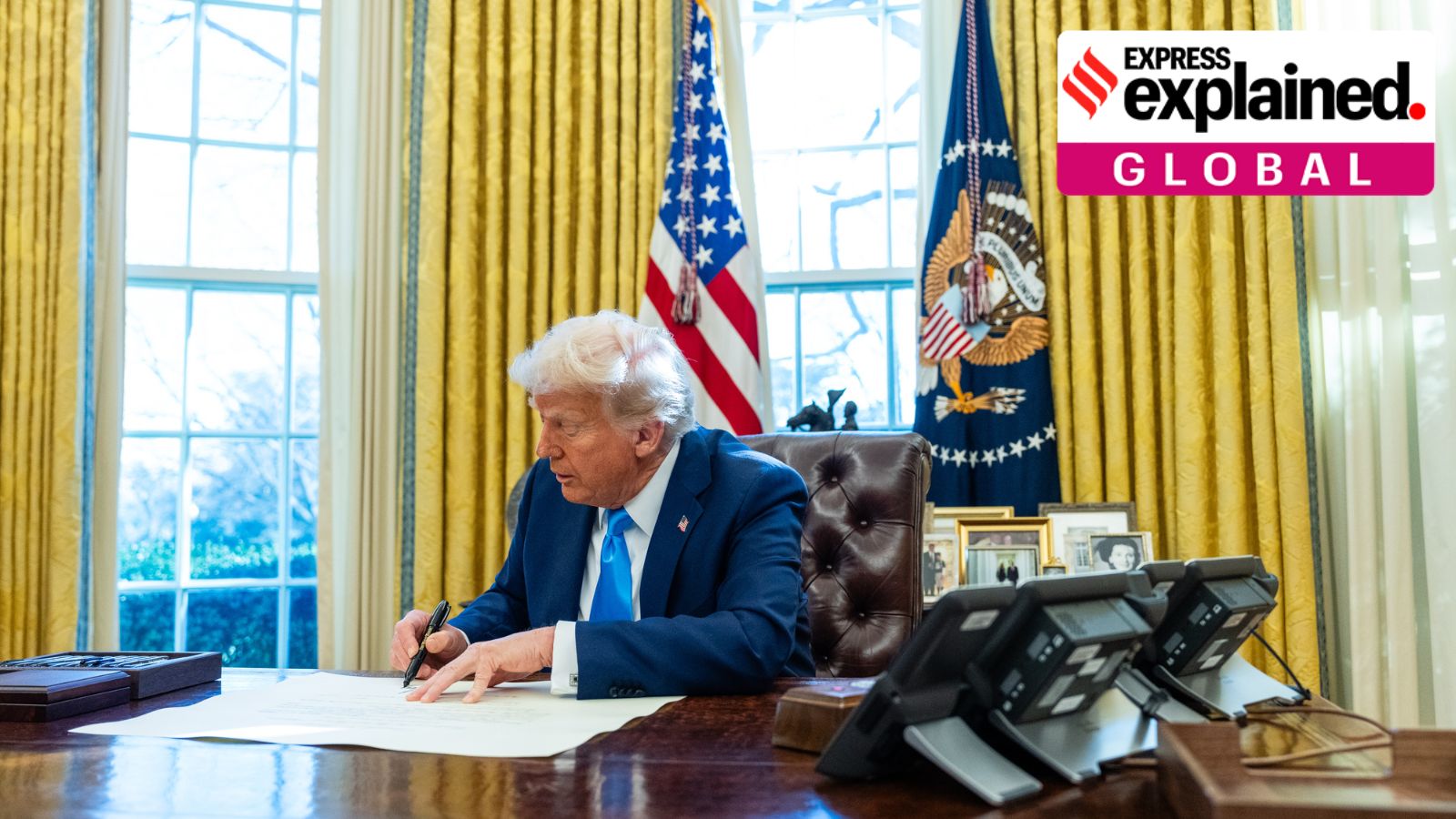
trump h1-b visas, h-1bPresident Donald Trump signing executive orders (NYT)

A White House decision to impose a $100,000 entry fee on H-1B visa holders has alarmed Indian tech workers and students, the largest group using this route to the US.

The measure, effective midnight September 21, applies to those entering America on H-1B visas, but exempts individuals already in the country who are extending or changing their status.

Following the panic, on Saturday, the official White House Rapid Response team put out a clarification on X which stated that the announced proclamation “ does not apply to anyone who has a current visa”

It further said : “The Proclamation only applies to future applicants in the February lottery who are currently outside the U.S. It does not apply to anyone who participated in the 2025 lottery.” It added that the “Proclamation does not impact the ability of any current visa holder to travel to/from the US.”

The Indian Express spoke to immigration attorneys in the US to unpack its implications.

For those who already hold an H-1B visa stamp, will the $100,000 fee apply if they travel abroad and re-enter the US?

This will not impact the individuals who are already on a valid H-1B visa.

A US Citizenship and Immigration Service Memorandum dated September 20 stated, “This proclamation only applies prospectively to petitions that have not yet been filed. The proclamation does not apply to aliens: who are the beneficiaries of petitions that were filed prior to the effective date of the proclamation, are the beneficiaries of currently approved petitions, or are in possession of a validly issue H1B non-immigrant visas”

Story continues below this ad

“There is news coming in that it might not impact people who are already having an H-1B visa, but there is confusion. In our attorney groups, there is a lot of debate on the way the language is worded, and a lot depends on how the government wants to interpret this,” Texas-based attorney Chand Parvathaneni told The Indian Express in the early hours of Sunday.

Echoing this, Houston-based immigration lawyer Rahul Reddy said, “We will come to know on Sunday when people try to enter, because it’s going into effect on Sunday at midnight, 12:01.” He added that major tech companies have already sounded the alarm: “Amazon, Microsoft, they’ve all warned their employees not to travel.”

For individuals who get their H-1B visa stamped after September 21, will the $100,000 be a one-time fee at the time of stamping, or will they be required to pay it annually?”

Reddy recalled, “When Trump was signing this executive order, they said that it was going to be every year. But when we look into the present proclamation, it says anytime a person is trying to enter into the United States, it is applicable.”

Parvathaneni added, “It is a $100,000 annual payment, but again, this is only applicable when somebody travels out of the country and travels back in.” He also emphasised the lack of clarity: “How are they going to pay the Secretary of State? How are they going to pay the US government? Things are not clear at this point yet.”

Story continues below this ad

For those already on an H-1B in the US who only need an extension, does the $100,000 fee apply?

No. The fee does not apply to in-country status changes, extensions, or transfers.

Parvathaneni explained: “If anybody is in the US and either they want to go through an H-1B transfer, they want to change their companies or they’re going through an extension process… as long as all these things are happening while somebody is in the U.S., these people are not impacted.”

Reddy elaborated that the proclamation was carefully crafted to avoid areas where presidential authority is limited. “The administration does not have authority to change the rules of the H-1B. Only the Congress… has the authority. What the administration has authority over…anytime a person is entering into the country, it is a security issue.”

For F-1 students planning to change to H-1B while staying in the US, does the $100,000 fee apply?

“As long as all these things are happening while somebody is in the US, these people are not impacted,” said Parvathaneni. Reddy echoed: “If you’re an F-1 student trying to convert into H-1B within the U.S., it’s not applicable.”

Story continues below this ad

What if an F-1 student outside the US gets selected in the H-1B lottery?

In that case, yes — the $100,000 fee will likely apply. Parvathaneni said, “If somebody is outside the US and the company is filing for a H-1B, they are supposed to pay a $100,000 fee right away.”

Reddy contextualised the policy as one designed keeping specific recruitment models in mind. “This seems to be more targeted to Indian companies because mostly Indian companies recruit new people from India or outside the country.”

Is there any exemption?

Very few and the language is vague. Reddy explained, “They said if there is any national interest… they may exempt those individuals from this $100,000.” But what qualifies as ‘national interest’ remains undefined. “They could exempt healthcare people, like, for example, a physical therapist,” he added.

Could this push demand toward O-1, L-1 or other US visa categories?

Story continues below this ad

“If somebody is contemplating on going on L-1 as compared to the H-1B… definitely, they will not contemplate on H-1B because companies won’t be willing to pay that $100,000,” Reddy said.

He explained the trade-offs: “If you go on an L-1 visa with a company X, and you want to change that to a different company, you can’t. However, if you go on H-1B… you can change from company A to company B.” He also flagged a compliance risk: “The Department of Labor regulations say that any money that the company paid to the government as fees cannot be collected from the individual.”

What are the long-term implications for international students hoping to build careers in the US?

This could reshape the entire STEM immigration pipeline. “If this gets implemented in the current fashion, it is going to impact the technology industry and also the opportunities for students,” warned Parvathaneni.

Story continues below this ad

Reddy agreed, but noted a short-term upside for current OPT students: “Now the pool is smaller… they probably will be celebrating right now.” However, he also acknowledged the broader cost: “A lot of these people, they work for years… with the hope that, okay, my company is going to take me to the United States on H-1B. Now, of course, they are not going to spend $100,000.”

What legal challenges are expected?

Attorneys are already preparing cases. “This is what will happen,” said Parvathaneni. “More than likely, lawsuits are going to get filed because that’s already in progress. If courts issue a temporary restraining order, people will have some breathing space.”

Reddy compared it to the 2017 Muslim travel ban: “They made it sound like a travel restriction. That way, they can argue that the presidential proclamation is good enough for this purpose, not a Bill.”

“They exactly tried to copy it in such a way because it’s going to be tested… It will be tested in the courts.” he added.

Story continues below this ad

What is a proclamation, legally? Is it a final law?

No, it is not legislation, but it does carry legal authority — until challenged. “A presidential proclamation is not a law,” explained Parvathaneni. “It is an order to federal agencies… As long as it is not an overreach of his powers, it is valid.”

Reddy clarified further: “Only Congress has the authority to change the rules of H-1B… But they [Trump administration] are saying, ‘this is about security,’ which is where the president has authority.” Until courts weigh in, the proclamation stands, and students, workers, and companies will have to plan around it.

Vidheesha Kuntamalla is a Senior Correspondent at The Indian Express, based in New Delhi. She is known for her investigative reporting on higher education policy, international student immigration, and academic freedom on university campuses. Her work consistently connects policy decisions with lived realities, foregrounding how administrative actions, political pressure, and global shifts affect students, faculty, and institutions. Professional Profile Core Beat: Vidheesha covers education in Delhi and nationally, reporting on major public institutions including the University of Delhi (DU), Jawaharlal Nehru University (JNU), Jamia Millia Islamia, the IITs, and the IIMs. She also reports extensively on private and government schools in the National Capital Region. Prior to joining The Indian Express, she worked as a freelance journalist in Telangana and Andhra Pradesh for over a year, covering politics, rural issues, women-centric issues, and social justice. Specialisation: She has developed a strong niche in reporting on the Indian student diaspora, particularly the challenges faced by Indian students and H-1B holders in the United States. Her work examines how geopolitical shifts, immigration policy changes, and campus politics impact global education mobility. She has also reported widely on: * Mental health crises and student suicides at IITs * Policy responses to campus mental health * Academic freedom and institutional clampdowns at JNU, South Asian University (SAU), and Delhi University * Curriculum and syllabus changes under the National Education Policy Her recent reporting has included deeply reported human stories on policy changes during the Trump administration and their consequences for Indian students and researchers in the US. Reporting Style Vidheesha is recognised for a human-centric approach to policy reporting, combining investigative depth with intimate storytelling. Her work often highlights the anxieties of students and faculty navigating bureaucratic uncertainty, legal precarity, and institutional pressure. She regularly works with court records, internal documents, official data, and disciplinary frameworks to expose structural challenges to academic freedom. Recent Notable Articles (Late 2024 & 2025) 1. Express Investigation Series JNU’s fault lines move from campus to court: University fights students and faculty (November 2025) An Indian Express investigation found that since 2011, JNU has appeared in over 600 cases before the Delhi High Court, filed by the administration, faculty, staff, students, and contractual workers across the tenures of three Vice-Chancellors. JNU’s legal wars with students and faculty pile up under 3 V-Cs | Rs 30-lakh fines chill campus dissent (November 2025) The report traced how steep monetary penalties — now codified in the Chief Proctor’s Office Manual — are reshaping dissent and disciplinary action on campus. 2. International Education & Immigration ‘Free for a day. Then came ICE’: Acquitted after 43 years, Indian-origin man faces deportation — to a country he has never known (October 2025) H-1B $100,000 entry fee explained: Who pays, who’s exempt, and what’s still unclear? (September 2025) Khammam to Dallas, Jhansi to Seattle — audacious journeys in pursuit of the American dream after H-1B visa fee hike (September 2025) What a proposed 15% cap on foreign admissions in the US could mean for Indian students (October 2025) Anxiety on campus after Trump says visas of pro-Palestinian protesters will be cancelled (January 2025) ‘I couldn’t believe it’: F-1 status of some Indian students restored after US reverses abrupt visa terminations (April 2025) 3. Academic Freedom & Policy Exclusive: South Asian University fires professor for ‘inciting students’ during stipend protests (September 2025) Exclusive: Ministry seeks explanation from JNU V-C for skipping Centre’s meet, views absence ‘seriously’ (July 2025) SAU rows after Noam Chomsky mentions PM Modi, Lankan scholar resigns, PhD student exits SAU A series of five stories examining shrinking academic freedom at South Asian University after global scholar Noam Chomsky referenced Prime Minister Narendra Modi during an academic interaction, triggering administrative unease and renewed debate over political speech, surveillance, and institutional autonomy on Indian campuses. 4. Mental Health on Campuses In post-pandemic years, counselling rooms at IITs are busier than ever; IIT-wise data shows why (August 2025) Campus suicides: IIT-Delhi panel flags toxic competition, caste bias, burnout (April 2025) 5. Delhi Schools These Delhi government school grads are now success stories. Here’s what worked — and what didn’t (February 2025) ‘Ma’am… may I share something?’ Growing up online and alone, why Delhi’s teens are reaching out (December 2025) ... Read More

 

Latest Comment
Post Comment
Read Comments
Advertisement
Advertisement
Advertisement
Advertisement