5 min read
© The Indian Express Pvt Ltd



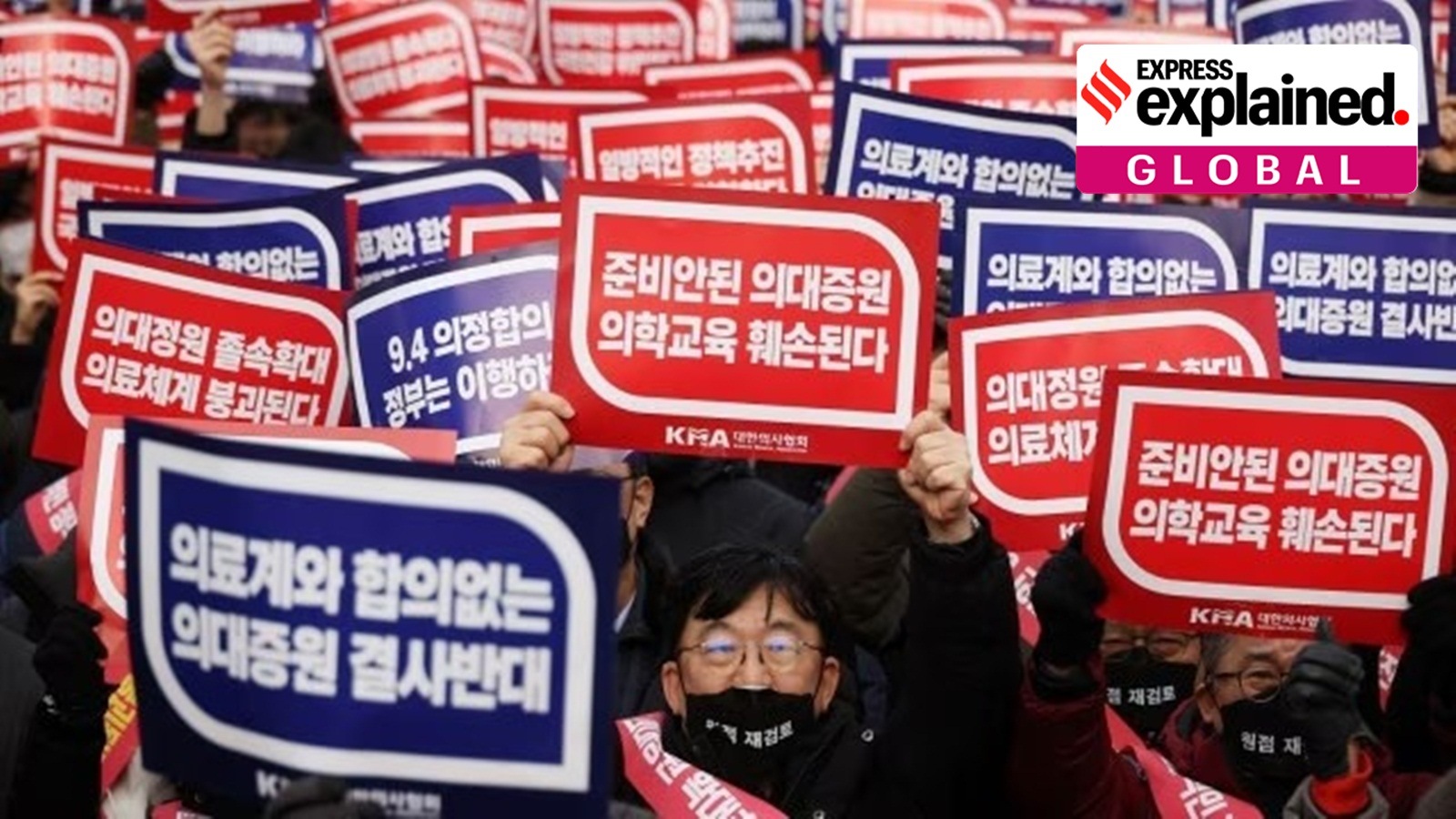 Doctors chant slogans during a rally to protest against government plans to increase medical school admissions in Seoul, South Korea, March 3, 2024. (REUTERS: Photo)
For around six weeks now, thousands of junior doctors have walked off their jobs in South Korea and refused to see patients. They have been protesting against a government plan that intends to sharply increase medical school admissions and the number of physicians in the country.
More and more doctors are joining the agitation. In the latest escalation, senior doctors at major hospitals have come out in support, going as far as submitting their resignation letters in protest. What are the issues here? We explain.
The junior doctors said their protests are rooted in the present working conditions and the existing pay. They demand that the government should first address these issues before attempting to increase the number of working physicians in South Korea.
The South Korean government, however, argued that the country needs more working doctors to address the needs of residents in rural parts of the country and meet healthcare demands.
With junior doctors sitting in protest, the functioning of hospitals has also been impacted across the country. A shortage of working doctors has meant that surgical procedures are being cancelled and even emergency rooms have had to turn back patients.
However, doctors have said these issues highlight the workload they have to deal with and that the current system is broken.
According to a Korea Times report, the five biggest hospitals in Seoul — Seoul National University Hospital, Seoul Asan Medical Center, Samsung Medical Center, Severance Hospital and Seoul St. Mary’s Hospital — play a key role in providing medical care for patients in critical conditions. Junior doctors account for 39 per cent of their staff.
Keeping the number of junior doctors high is intentional, mainly because of their lower labour costs, The Korea Times reported.
According to a Reuters report, junior doctors or trainees typically work 80 to 100 hours, five days a week – meaning up to 20 hours a day. Protesting doctors said these working conditions need to be addressed by hiring more senior staff and not increasing the number of trainees or junior doctors.
What has the government said?
The South Korean government has said the increase in the number of doctors is intended to fill an expected shortfall of some 15,000 doctors by 2035. These are significant numbers for a country like South Korea, with a smaller population than India. Following the protests, the government issued a back-to-work order to doctors who walked off the job and vowed to prosecute those who did not comply.
This week, however, the government shifted from its stance and said that it would be “open to dialogue and welcome suggestions to improve its plan,” a report in The Korea Times said. Additionally, the government has also asked the country’s military hospitals and police hospitals to accept civilian patients to prevent further continued disruption of medical services.
But in February, when the protests first started, South Korea’s President Yoon Suk-yeol had said the protesting doctors were holding patients “hostage” by their actions. A Korea Times report quoted him as saying: “The government is pushing to reform the country’s health care system”.
He added, “The decision is not negotiable, as adding 2,000 slots (to the number of medical school seats) is deemed a minimal increase to implement the constitutional responsibility of the state to provide timely and proper medical treatment to sick people.”
Despite a softening of the government’s stance, senior doctors at major hospitals in South Korea began submitting their resignations this week in support of medical interns and residents, although they have promised to continue working despite the resignations.
The Korea Times reported that senior doctors have “demanded the government first scrap the decision to increase the medical school quota by 2,000 from the current 3,058, saying it would sit down for talks with the government only if the plan is abolished.”
What the medical community has said
Healthcare in South Korea is among the best in the world, analysts said. Many in the country’s medical community said that the number of doctors is not a problem. According to a Reuters report, South Korea’s medical community believes that the number cited by the government that it wants to use to boost medical admissions is arbitrary and the authorities have not made the basis for that figure open to the public.
The Reuters report quoted the medical community in South Korea as saying that without addressing underlying problems of pay and overwork among junior doctors, there is no incentive for the increased number of doctors to practise the essential discipline.