


© The Indian Express Pvt Ltd
Tags:


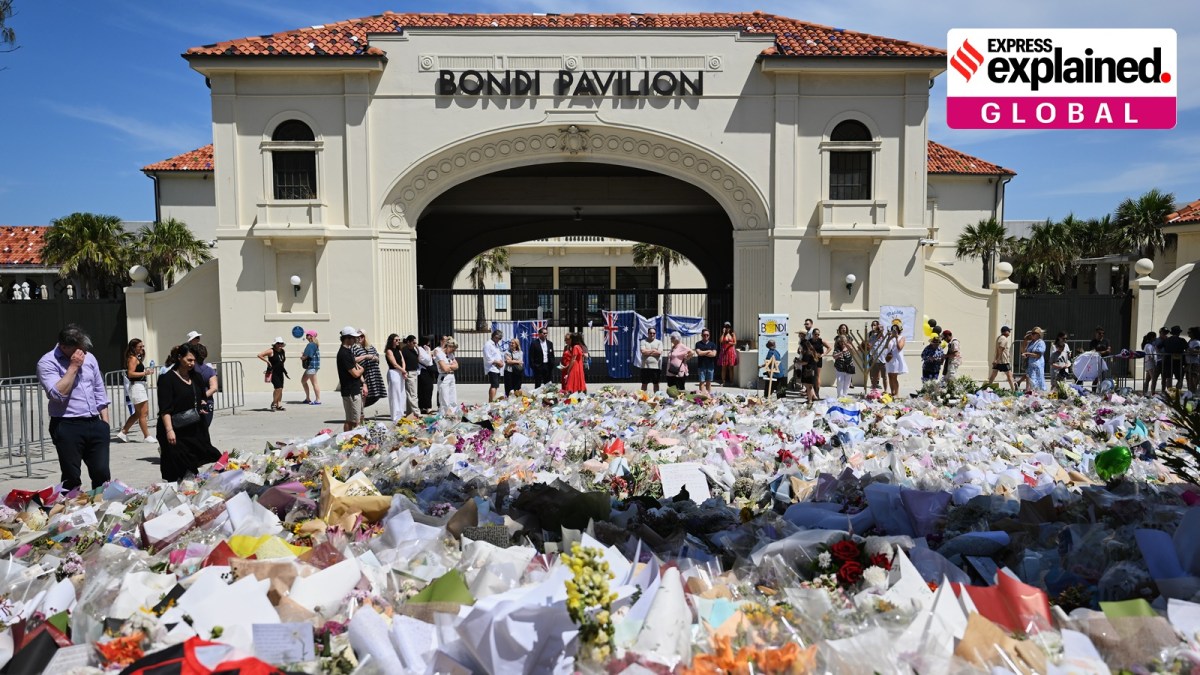
Australia Bondi beach terror attack: Australian authorities have confirmed that the Bondi Beach attack on Sunday, which targeted a Hanukkah gathering and killed 15 people, was inspired by the ideology of the Islamic State (IS). The attackers — Sajid Akram and his son Naveed Akram — were found to possess IS flags, had recently travelled to the Philippines, and had consumed extremist material, according to New South Wales Police.
Prime Minister Anthony Albanese said on Tuesday: “It would appear that there is evidence that this was inspired by a terrorist organisation, by ISIS.” The presence of IS symbols, he added, was “part of that evidence”.

The case has once again revived a difficult question for Australia: how did Islamic State ideology take root in a country where Muslims constitute just 3.2% of the population. Also, people of Indian origin have repeatedly surfaced in terror-related investigations, sometimes as perpetrators, and sometimes as the wrongly accused.
For much of the post-9/11 period, Australia remained on the periphery of jihadist violence. Terrorism scholar Bruce Hoffman, who testified at the inquest into the 2014 Sydney Lindt Café siege, later noted that Australia’s early exposure to jihadism was largely indirect — through Bali (2002), Afghanistan, and Iraq — rather than domestic.
That changed decisively with the rise of the Islamic State.
Between 2014 and 2020, Australia experienced nine Islamic State–inspired incidents, including shootings, stabbings and sieges. This was a sharp break from the pre-2014 period, when Australia had not recorded a single jihadist attack on its soil. Levi J West, director of Terrorism Studies at the Australian Graduate School of Policing and Security, writes in his paper on the outfit’s influence in his country that IS “fundamentally altered the dynamics of jihadist activity in Australia” .
What distinguished these attacks was not organisational sophistication but ideological alignment. Most were lone-actor or micro-cell operations, driven by IS propaganda urging supporters to strike locally using whatever means available.
Hoffman described this model as “leaderless but not leaderless in ideology” — a characterisation that fits many Australian cases.
A surprisingly large foreign fighter pipeline
Perhaps the most striking indicator of IS influence was the scale of Australian mobilisation to Syria and Iraq.
According to Australian Security Intelligence Organisation (ASIO) estimates cited across multiple studies — including the Lowy Institute and the CTC Sentinel — around 230 Australians successfully travelled to join jihadist groups in the Middle East, while another 250 were prevented from doing so. That puts the total at nearly 500 individuals willing to fight for IS or allied groups.
By comparison, India — despite having over 200 million Muslims — sent only a few dozen confirmed recruits.
Scholars point to three reasons for Australia’s outsized numbers: Language and propaganda access, where IS’s English-language media arm (al-Hayat) targeted Western audiences aggressively; charismatic local figures who acted as amplifiers; and social alienation and identity crises among small pockets of second-generation migrants.
The role of ‘homegrown influencers’
Australia produced several globally visible IS figures, whose propaganda value far exceeded their battlefield importance.
The most notorious was Khaled Sharrouf, whose 2014 image of his seven-year-old son holding a severed head in Raqqa became one of the defining images of IS brutality. The photograph was cited by then US Secretary of State John Kerry as “stomach-turning” and triggered a political reset in Australia’s counterterrorism posture.
Another was Jake Bilardi, an 18-year-old Melbourne teenager dubbed “Jihadi Jake”, whose journey — from suburban atheist to IS suicide bomber — fascinated and horrified the Australian media.
But the most operationally dangerous figure was Neil Prakash, an Australian of Indian-Fijian and Cambodian descent.
Prakash, also known as Abu Khaled al-Cambodi, became one of IS’s most prominent English-speaking recruiters. According to Australian authorities, he was “reaching back” from Syria to radical networks in Melbourne and Sydney, and was linked to plots in Australia and the US. He appeared in IS videos, featured in its magazine Dabiq, and worked closely with British hacker-jihadist Junaid Hussain.
Terrorism analysts at the Jamestown Foundation and CTC West Point described Prakash as a textbook example of IS’s “virtual planner” — someone who never needed to return home to remain dangerous.
The Bondi attackers’ Indian origin — with Sajid Akram reportedly hailing from Hyderabad — has renewed scrutiny of Indian-origin Muslims in Australian terror cases. But history suggests caution.
The most important precedent is the Dr Mohammed Haneef case.
In 2007, Haneef, an Indian doctor working in Australia, was arrested over the Glasgow airport bombing attempt in the UK because he had once given a SIM card to a cousin later involved in the attack. He was detained, charged, had his visa cancelled — and then exonerated when the case collapsed.
The episode is now widely regarded as a counterterrorism failure driven by panic rather than proof, and is frequently cited by legal scholars as an example of how expansive terror laws can misfire against minorities.
The contrast is stark: while figures like Prakash were deeply embedded in IS networks, others like Haneef were never radicalised at all.
Experts broadly agree that demography alone does not explain radicalisation.
Australia’s Muslim population is small but highly urbanised, concentrated in parts of Sydney and Melbourne, and exposed early to global online ecosystems. The Lowy Institute has noted that IS recruiters exploited identity struggles rather than poverty, often targeting educated, digitally fluent youth.
India’s experience was different. Despite sporadic IS-linked arrests, Indian Muslims showed little appetite for foreign jihad. Analysts attribute this to strong family oversight, plural religious traditions, and early intervention by security agencies.
As one former Indian intelligence official told The Indian Express: “The idea of abandoning home for a distant caliphate never acquired social legitimacy here.”
IS-linked violence prompted Australia to adopt one of the toughest counterterror regimes in the democratic world. Since 2001, Parliament has passed over 80 anti-terror laws, including citizenship revocation for dual nationals; preventive detention and control orders; passport cancellations; and expanded surveillance powers.
These measures significantly reduced IS activity after the caliphate’s collapse. But they also generated civil liberties concerns — particularly after cases like Haneef.
ASIO now warns that while IS has weakened, ideological inspiration remains potent, and lone actors pose the greatest risk.
The unfinished story
The Bondi Beach attack is a reminder that Islamic State’s territorial defeat did not end its influence. Its ideas continue to circulate — mutating, decentralised, and capable of motivating violence far from former battlefields.
For Australia, the challenge is to counter that ideology without repeating past mistakes. For India, the contrast remains instructive: size and diversity do not automatically translate into radicalisation.
As the Bondi case shows, the afterlife of Islamic State is not about geography — it is about ideas, grievances, and how societies respond to both.


