6 min read


© The Indian Express Pvt Ltd



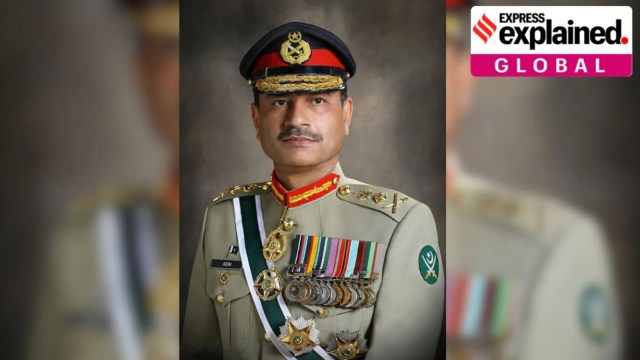 Asim Munir was in Tripoli as part of an official visit to the North African nation. (Wikimedia Commons)
Pakistani media organisations reported a meeting between Pakistani Field Marshal Syed Asim Munir and his Libyan counterpart, Field Marshal Khalifa Belqasim Haftar, in the Libyan capital on Friday (December 19).
Munir was in Tripoli as part of an official visit to the North African nation, and according to a report from Pakistan’s Dawn newspaper, “Munir has reaffirmed Pakistan’s commitment to strengthening defence ties with Libya”.
Earlier in July, Haftar had visited Pakistan, and the leaders discussed defence cooperation and addressing security challenges. But what drives the relationship between the countries, which do not seem to have obvious shared interests at first glance? We explain.
Religious ties, post-colonial commonalities
In the 1993 book Islamic Co-operation and Unity, Indian author Ranjit Kaur wrote that with religion as the basis of the demand for Pakistan’s creation, the country sought to support other Muslim nations under colonial rule soon after 1947. This support spanned geographically distant and varied countries, such as Indonesia, Eritrea and Algeria.
Bilateral ties between Pakistan and Libya were established in 1951, the year Libya gained independence from Italy. In international forums, including the United Nations, Pakistan batted for economic assistance for countries like Libya, and agreed to train Libyan army officers.
However, Kaur wrote, “no support emanated from Libya either on Kashmir issue or on Pakistan’s efforts for Pan-Islamism because it was too occupied with its problem of economic backwardness.” Even during the 1965 war with India, Libya maintained a neutral stance. Concerns about a lack of support from the United States led Pakistan to intensify its efforts to seek cooperation from the Muslim world. In this regard, Muammar Gaddafi, who assumed power via a coup in Libya in 1969, was a key figure.
Notably, 1969 was also when the Organisation of Islamic Countries (OIC) was formed in reaction to an arson attack on the Al-Aqsa Mosque in Jerusalem. Both Libya and Pakistan are its members.
Pakistan’s loss of territory and defeat in the 1971 war with India further led to a turn towards countries like Libya. What aided the ties at this stage was the relationship between Gaddafi and then Pakistani Prime Minister Zulfikar Ali Bhutto of the Pakistan Peoples Party (PPP).
The late Dawn editor Murtaza Razvi wrote for The Indian Express in 2011 that it was Bhutto, “who embarked on the policy of looking west to the Arab world for bonding and the obvious financial benefits that would accrue to Pakistan by being a player in the petrodollar economy of the Arab states, even if they were run by despotic autocrats.”
In 1974, Gaddafi visited Pakistan for an OIC summit. The event became an occasion “to elicit support for Pakistan’s nuclear programme, as India was all set to go nuclear, and Gaddafi fitted the bill. In a grand ceremony at the Lahore Stadium, Bhutto announced the renaming of the cricket ground after the man whom he came to call one of his best friends.”
“Lahoris cherished the grand mela… It was in such spirited bonhomie that they lost their stadium to the man called Gaddafi, although they have a long history of resisting any change of names… Pre-Partition names are still the currency in a city that celebrates history, and so Dhani Ram and Chet Ram roads, Krishan Nagar and Bharat Nagar,” Razvi wrote.
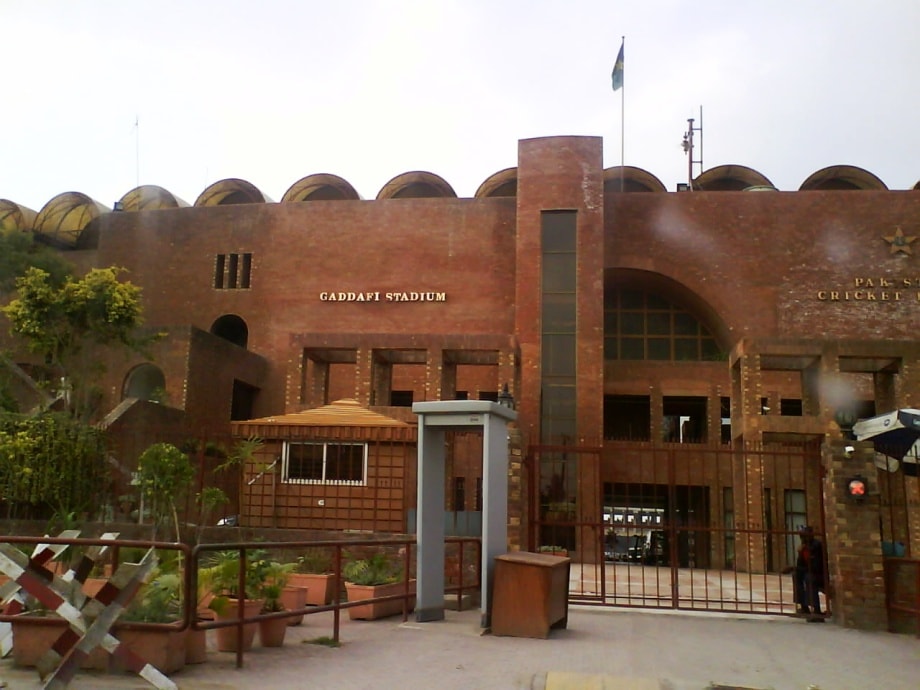 The Gaddafi Stadium in Lahore. (Wikimedia Commons)
There was also a military and security angle to the relationship. TIME Magazine noted in a 1985 report that in the late 1970s, uranium oxide, “the basic feedstock in producing enriched uranium, was secretly obtained from Niger, with the connivance of Libya.” Pakistan reportedly received hundreds of millions of dollars from Gaddafi for Project 706, which was the codename of the plan for developing nuclear weapons. In turn, Libyan scientists travelled to Pakistan to study its enrichment advances.
But the change of regime in Pakistan impacted the relationship. General Zia-ul-Haq did not share the same positive view of Gaddafi.
Razvi recalled, “Gaddafi has in the past extended support to acts of terrorism in Pakistan itself after the overthrow of the Bhutto regime in 1977 by General Zia-ul-Haq. He allegedly funded terrorists belonging to Al Zulfikar, a pro-PPP terrorist outfit that hijacked a PIA airliner in March 1981… The 13-day-long hostage drama saw a Pakistani diplomat travelling in the plane shot dead, and some 55 PPP political prisoners released by the Zia regime in the final settlement. The hijackers named Tripoli as the destination of the released prisoners.”
He added, “Later, through much of the 1980s, Libyan diplomatic and trade missions in Islamabad and Karachi were consistently linked with anti-Zia regime terrorist activities, and Pakistan-Libya relations were at their lowest ebb… Perhaps the centrality in the Pakistan foreign policy of the principle of avoiding conflict with a Muslim country was the major factor behind the restraint.”
Pakistan’s outreach
The Arab Spring protests of 2011 led to the fall of several longstanding regimes, including Gaddafi’s after more than 42 years in power.
While Gaddafi was not the only factor for it, Pakistan-Libya ties no longer enjoy the same level of importance for either country. Both countries are also dealing with significant economic challenges at home. The volume of bilateral trade between Pakistan and Libya stood at a mere $19 million for 2022-2023.
Munir’s visit can be seen as part of Pakistan’s more recent push to engage with countries such as Saudi Arabia, the US, China and others. He has undertaken several trips this year to secure Pakistan’s strategic interests, and it follows his elevation as the Field Marshal in May, after the Pulwama attacks and Operation Sindoor.
Reuters has reported that Munir may soon meet US President Donald Trump in Washington for a third meeting in six months that will likely focus on the country contributing troops for the Trump-proposed International Stabilisation Force (ISF) in Gaza.