Premium
This is an archive article published on February 3, 2024

Multidimensional poverty: meaning, numbers

25 cr Indians have been raised from poverty since 2013-14, says Govt. MPI uses indicators covering three main areas: health, education, and standard of living.

Multidimensional poverty, poverty, poverty line, nirmala sitharaman, interim Union budget, Union budget, Budget, Budget 2024, finance ministry, indian economy, interim budget 2024, Indian express news, current affairsTraditionally, poverty is calculated based either on income levels or, if income data are not available, on expenditure levels. The so-called “poverty lines” are actually expenditure levels that are considered minimum enough for someone to be called poor.

In her Interim Budget speech, Finance Minister Nirmala Sitharaman said 25 crore Indians had been pulled out of poverty over the past decade. “With the pursuit of ‘Sabka ka Saath’ in these 10 years, the Government has assisted 25 crore people to get freedom from multidimensional poverty,” she said.

What is the basis for this assessment?

This number appeared in a discussion paper, Multidimensional Poverty in India Since 2005-06, published by NITI Aayog on Jan 15.

The paper, written by Ramesh Chand, Member, NITI Aayog, and Yogesh Suri, Senior Adviser, NITI Aayog, with technical inputs from the United Nations Development Programme (UNDP) and the Oxford Policy and Human Development Initiative (OPHI), says:

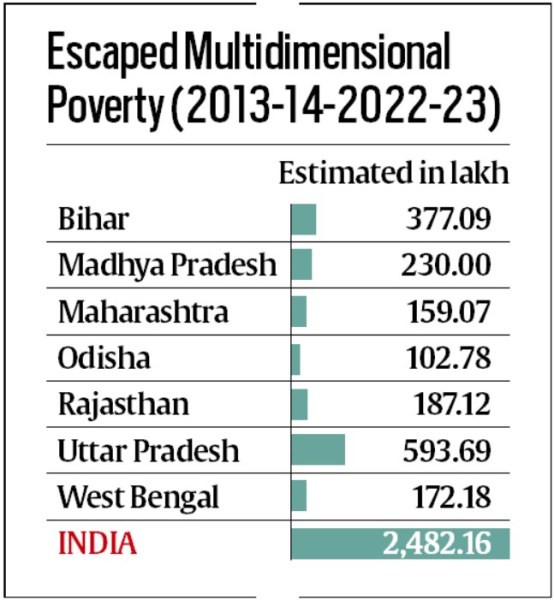
“Multidimensional poverty in India was found to decline from 29.17% in 2013-14 to 11.28% in 2022-23 with about 24.82 crore people escaping poverty during this period. At the States’ level, Uttar Pradesh topped the list with 5.94 crore people escaping poverty followed by Bihar at 3.77 crore and Madhya Pradesh at 2.30 crore.”

The table on the right, sourced from the same paper, shows poverty estimates for selected states in the last nine years (from 2013-14 to 2022-23). This period broadly coincides with the 10 years of the BJP-led government. The table on the right, sourced from the same paper, shows poverty estimates for selected states in the last nine years (from 2013-14 to 2022-23). This period broadly coincides with the 10 years of the BJP-led government.

What is the Multidimensional Poverty Index (MPI)?

Traditionally, poverty is calculated based either on income levels or, if income data are not available, on expenditure levels. The so-called “poverty lines” are actually expenditure levels that are considered minimum enough for someone to be called poor.

The MPI approaches poverty differently. Globally, the MPI uses 10 indicators covering three main areas: (i) health, (ii) education, and (iii) standard of living. These three dimensions have one-third weight each in the final index.

The health dimension includes nutrition and child & adolescent mortality indicators. The education dimension includes years of schooling and school attendance indicators. The standard of living dimension includes six household-specific indicators: housing, household assets, type of cooking fuel, access to sanitation, drinking water, and electricity.

Story continues below this ad

The Indian MPI has two additional indicators: maternal health (under the health dimension) and bank accounts (under the standard of living dimension). This has been done, according to the NITI Aayog, to align the MPI with India’s national priorities.

How is MPI calculated?

According to the MPI method, if a person is deprived in a third or more of 10 (weighted) indicators, they are identified as “MPI poor”.

However, to calculate the index value, three separate calculations are needed.

  • The first calculation involves finding out the “incidence of multidimensional poverty” (denoted by the symbol H). The incidence essentially refers to the proportion of multidimensionally poor in the population, and it is arrived at by dividing the number of multidimensionally poor persons by total population. More simply, it answers the question: How many are poor?
  • The second calculation involves finding out the “intensity” of poverty (it is demoted by the symbol A). This answers the question: How poor are they?

More technically, this refers to the average proportion of deprivation that is experienced by multidimensionally poor individuals. To compute intensity, the weighted deprivation scores of all poor people are summed and then divided by the total number of poor people.

Story continues below this ad
  • Finally, the MPI is arrived at by multiplying the incidence of multidimensional poverty (H) and the intensity of poverty (A).

“The MPI value for a given population, therefore, is the share of weighted deprivations faced by multidimensionally poor individuals divided by the total population,” states the paper.

How were the data for 2013-14 and 2022-23 arrived at?

Typically, the health metrics depend on data from the different rounds of the National Family Health Survey (NFHS). The NFHS is conducted every five years; the last round refers to the 2019-21 period.

How then were the MPI for 2012-13 and 2022-23 calculated?

According to the paper, this required interpolation of estimates for the year 2013-14, and extrapolation for the year 2022-23.

“A better understanding of the impact of various initiatives launched during the previous decade on poverty and deprivation can be obtained by comparing the estimates of poverty and deprivation in year 2013-14 with year 2022-23 even though the actual estimates for 2015-16 and 2019-21 clearly point to acceleration in rate of reduction in MPI after 2015-16 compared to 2005-06 to 2015-16,” it states.

Udit Misra is Senior Associate Editor at The Indian Express. Misra has reported on the Indian economy and policy landscape for the past two decades. He holds a Master’s degree in Economics from the Delhi School of Economics and is a Chevening South Asia Journalism Fellow from the University of Westminster. Misra is known for explanatory journalism and is a trusted voice among readers not just for simplifying complex economic concepts but also making sense of economic news both in India and abroad. Professional Focus He writes three regular columns for the publication. ExplainSpeaking: A weekly explanatory column that answers the most important questions surrounding the economic and policy developments. GDP (Graphs, Data, Perspectives): Another weekly column that uses interesting charts and data to provide perspective on an issue dominating the news during the week. Book, Line & Thinker: A fortnightly column that for reviewing books, both new and old. Recent Notable Articles (Late 2025) His recent work focuses heavily on the weakening Indian Rupee, the global impact of U.S. economic policy under Donald Trump, and long-term domestic growth projections: Currency and Macroeconomics: "GDP: Anatomy of rupee weakness against the dollar" (Dec 19, 2025) — Investigating why the Rupee remains weak despite India's status as a fast-growing economy. "GDP: Amid the rupee's fall, how investors are shunning the Indian economy" (Dec 5, 2025). "Nobel Prize in Economic Sciences 2025: How the winners explained economic growth" (Oct 13, 2025). Global Geopolitics and Trade: "Has the US already lost to China? Trump's policies and the shifting global order" (Dec 8, 2025). "The Great Sanctions Hack: Why economic sanctions don't work the way we expect" (Nov 23, 2025) — Based on former RBI Governor Urjit Patel's new book. "ExplainSpeaking: How Trump's tariffs have run into an affordability crisis" (Nov 20, 2025). Domestic Policy and Data: "GDP: New labour codes and opportunity for India's weakest states" (Nov 28, 2025). "ExplainSpeaking | Piyush Goyal says India will be a $30 trillion economy in 25 years: Decoding the projections" (Oct 30, 2025) — A critical look at the feasibility of high-growth targets. "GDP: Examining latest GST collections, and where different states stand" (Nov 7, 2025). International Economic Comparisons: "GDP: What ails Germany, world's third-largest economy, and how it could grow" (Nov 14, 2025). "On the loss of Europe's competitive edge" (Oct 17, 2025). Signature Style Udit Misra is known his calm, data-driven, explanation-first economics journalism. He avoids ideological posturing, and writes with the aim of raising the standard of public discourse by providing readers with clarity and understanding of the ground realities. You can follow him on X (formerly Twitter) at @ieuditmisra           ... Read More


Latest Comment
Post Comment
Read Comments
Advertisement
Advertisement
Advertisement
Advertisement