How Donald Trump’s tariffs are hurting the US the most
In Explained’s weekly column, titled ‘GDP: Graphs, Data, Perspectives’, Udit Misra breaks down how US tariffs have increasingly impacted the domestic economy, and that of countries like China. This is also likely why their leaders recently met to manage their trade issues.
A cartoon depicting U.S. President Donald Trump is seen to oppose a planned his visit near the U.S. Embassy in Seoul, South Korea, Tuesday, Oct. 28, 2025. (AP Photo/Ahn Young-joon)
Since taking office, US President Donald Trump has been slapping tariffs as the central policy tool to “Make America Great Again”. But have they helped matters? Far from it.
The latest analysis from researchers at the Yale Budget Lab, which has been closely tracking the Trump tariffs and their impacts on different aspects of the United States’ economy as well as the rest of the world, suggests that, as things stand, the US may be the worst affected by the Trump tariffs.
Tariffs are a tax levied by the domestic government, in this case the US government, on its own citizens for importing goods from the rest of the world. Even though tariffs are often put up on the pretext of making the domestic economy stronger, traditional economic wisdom suggests that putting up tariffs often hurts the domestic economy.
However, President Trump has openly defied the traditional caution under the mistaken notion that tariffs are paid by the citizens of foreign countries. He points to the billions of dollars collected in tariff revenues as proof that this policy is working without realising that bulk of this money is essentially paid by US consumers and US companies that are importing goods from the rest of the world.
The YBL data summarised in the CHARTalongside shows how Trump’s tariffs have affected some of the major economies in the world.
CHART.
The first big takeaway is that the US is the worst affected. US real GDP growth is half a percentage point lower than what it could have been both in 2025 and 2026. Moreover, as things stand, over the longer term, YBL calculates that in any given year, the US GDP would be 0.35 percentage points lower than what it would have been without the effects of tariffs.
In hard money terms, 0.35% of US GDP is around $105 billion — that’s around 30% of Pakistan’s total GDP. In Indian rupees that’s a loss of Rs 9.3 lakh crore — pretty close to all the money the Indian government spends on capital expenditure to boost the productive capacity of the country.
The other country that will take a big hit — albeit only half as bad as the US — is China. Trump’s tariffs will persistently shave off 0.18 percentage points from China’s long run GDP. So, the biggest two economies in the world will be the worst affected, and perhaps this recognition has driven their increased engagement even in the middle of the tariff wars. Just yesterday, Trump and Chinese President met in South Korea to discuss trade issues, among other things.
On aggregate, the rest of the world will also be adversely affected but the damage is lower if one takes away the US from the equation.
There are some winners in this process: the UK and European Union. It is noteworthy that while these two regions are trade competitors of the US, they are also strong military allies.
Amongst its neighbours with whom the US has a free trade agreement, it is Mexico that has been able to turn the tariffs tsunami in its favour, while Canada has suffered. The fact that US and Canada leaders are often quarrelling with each other, often leading to diplomatic rows while very little is heard from the Mexico-US diplomatic front, could be a signal why the fortunes differ.
Udit Misra is Senior Associate Editor at The Indian Express. Misra has reported on the Indian economy and policy landscape for the past two decades. He holds a Master’s degree in Economics from the Delhi School of Economics and is a Chevening South Asia Journalism Fellow from the University of Westminster.
Misra is known for explanatory journalism and is a trusted voice among readers not just for simplifying complex economic concepts but also making sense of economic news both in India and abroad.
Professional Focus
He writes three regular columns for the publication.
ExplainSpeaking: A weekly explanatory column that answers the most important questions surrounding the economic and policy developments.
GDP (Graphs, Data, Perspectives): Another weekly column that uses interesting charts and data to provide perspective on an issue dominating the news during the week.
Book, Line & Thinker: A fortnightly column that for reviewing books, both new and old.
Recent Notable Articles (Late 2025)
His recent work focuses heavily on the weakening Indian Rupee, the global impact of U.S. economic policy under Donald Trump, and long-term domestic growth projections:
Currency and Macroeconomics:
"GDP: Anatomy of rupee weakness against the dollar" (Dec 19, 2025) — Investigating why the Rupee remains weak despite India's status as a fast-growing economy.
"GDP: Amid the rupee's fall, how investors are shunning the Indian economy" (Dec 5, 2025).
"Nobel Prize in Economic Sciences 2025: How the winners explained economic growth" (Oct 13, 2025).
Global Geopolitics and Trade:
"Has the US already lost to China? Trump's policies and the shifting global order" (Dec 8, 2025).
"The Great Sanctions Hack: Why economic sanctions don't work the way we expect" (Nov 23, 2025) — Based on former RBI Governor Urjit Patel's new book.
"ExplainSpeaking: How Trump's tariffs have run into an affordability crisis" (Nov 20, 2025).
Domestic Policy and Data:
"GDP: New labour codes and opportunity for India's weakest states" (Nov 28, 2025).
"ExplainSpeaking | Piyush Goyal says India will be a $30 trillion economy in 25 years: Decoding the projections" (Oct 30, 2025) — A critical look at the feasibility of high-growth targets.
"GDP: Examining latest GST collections, and where different states stand" (Nov 7, 2025).
International Economic Comparisons:
"GDP: What ails Germany, world's third-largest economy, and how it could grow" (Nov 14, 2025).
"On the loss of Europe's competitive edge" (Oct 17, 2025).
Signature Style
Udit Misra is known his calm, data-driven, explanation-first economics journalism. He avoids ideological posturing, and writes with the aim of raising the standard of public discourse by providing readers with clarity and understanding of the ground realities.
You can follow him on X (formerly Twitter) at @ieuditmisra
... Read More


 4 min read


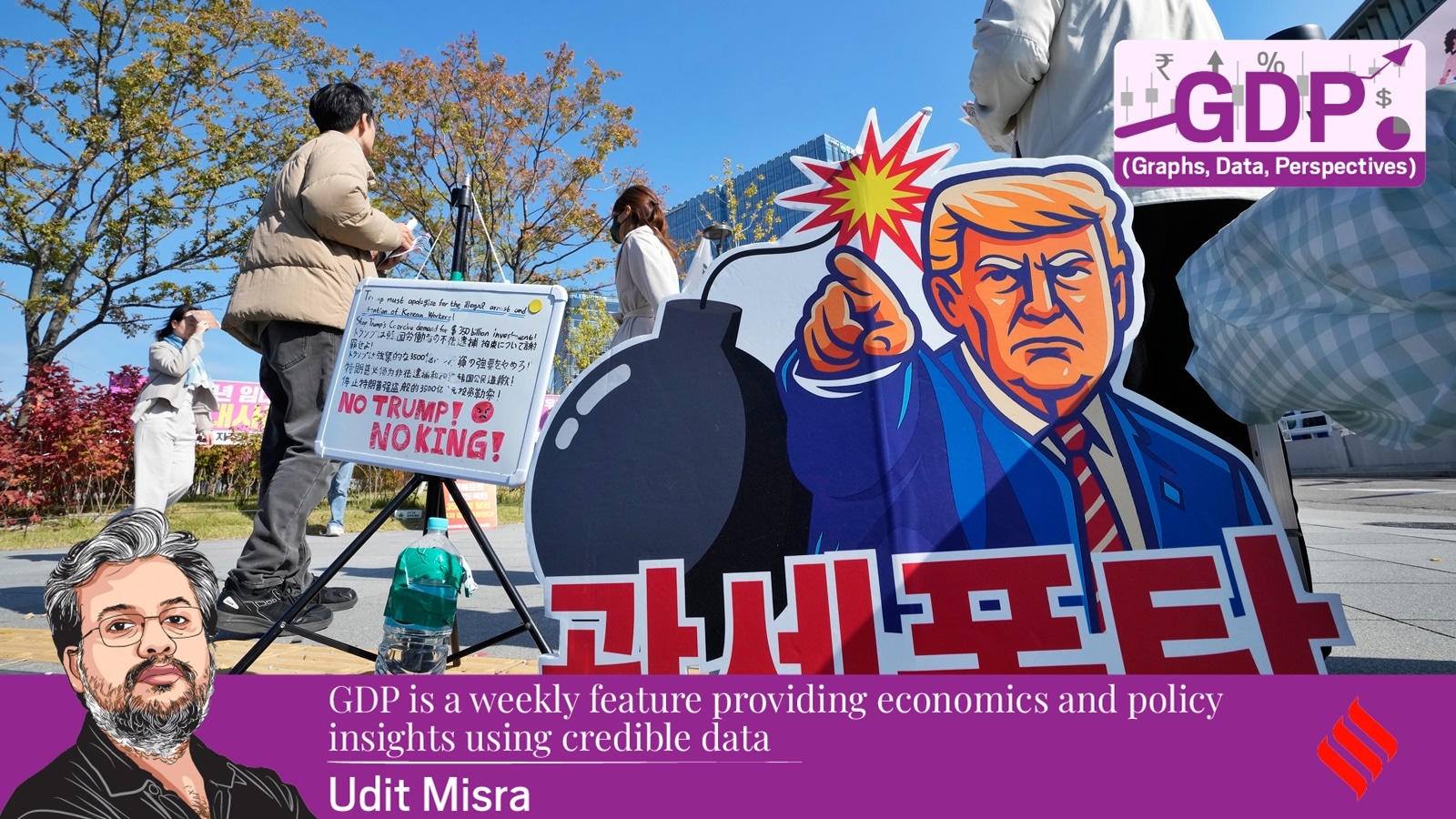

 CHART.