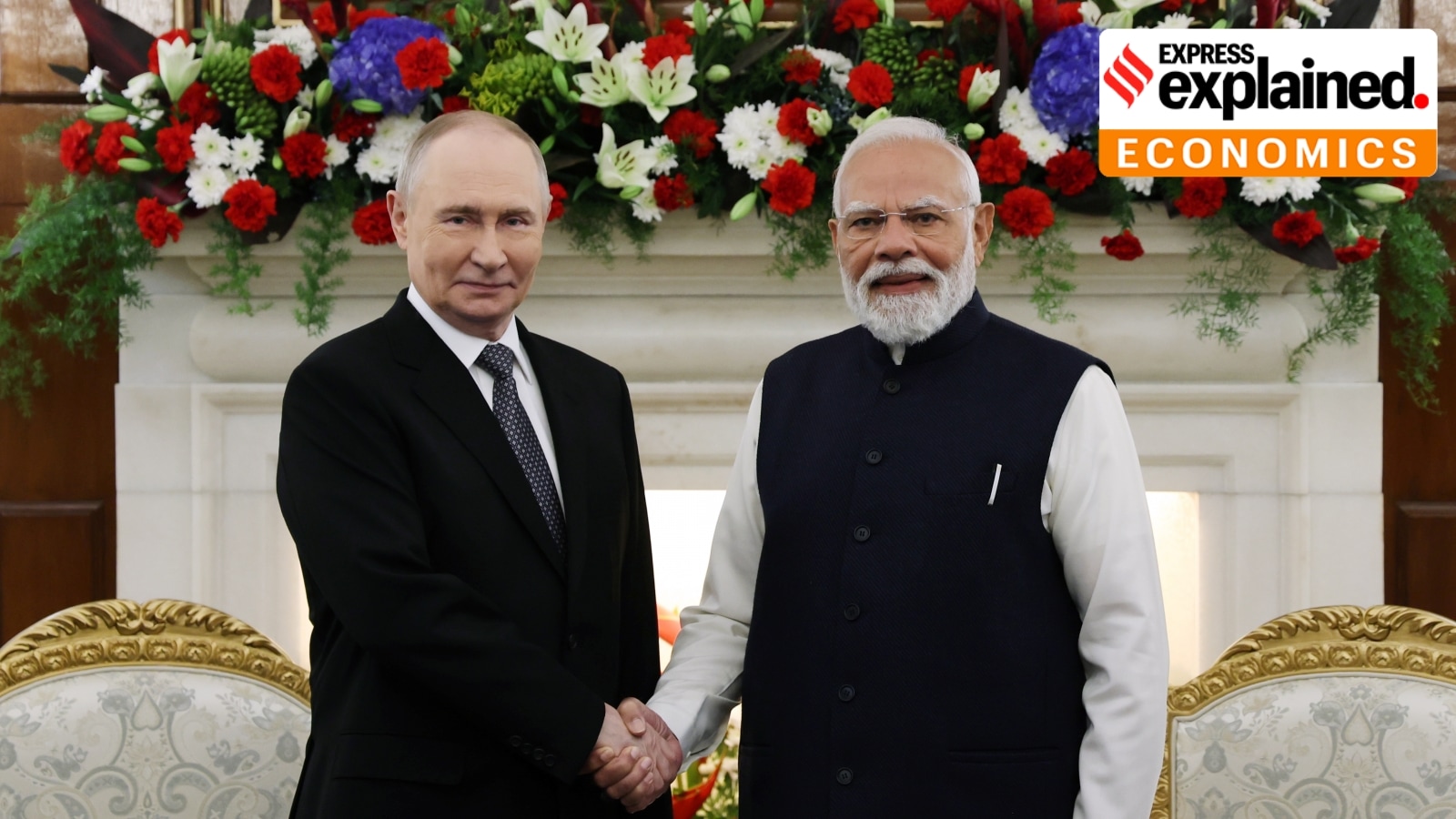
As American tariffs hurt Indian goods exports and trigger investment-related uncertainty, Russia President Vladimir Putin’s visit to New Delhi could offer India an opportunity to diversify its exports further, and also bridge the widening trade gap with Russia, which is largely driven by higher crude oil imports following the Ukraine war.

Trade talks with EAEU have gathered pace at a time when India’s goods exports have come under pressure due to steep 50 per cent US tariffs, which have resulted in two consecutive months of export decline to the US, manufacturing growth hitting a 9-month low in November, and the Indian rupee crossing the all-time low of 90 against the dollar. While negotiations with the US are on, New Delhi has begun pushing for securing more and more markets. Russia is one of the key markets being targeted by New Delhi, alongside the European Union, the UK, Japan and China.
Russia is aiming to balance the trade ties with India by increasing the imports of goods and services from India, Deputy Kremlin Chief of Staff Maxim Oreshkin said at an industry event Thursday, adding that closer trade ties between India and Russia are “a strategic choice in developing relations”. Russian Agriculture Minister Oksana Lut has also said that Russia was prepared to increase imports of shrimp, rice, and tropical fruits from India. She mentioned that Russian firms were also interested in Indian food processing equipment, Reuters reported.
India is the world’s largest exporter of shrimp, and Lut said that it was possible to increase India’s share in Russian imports of shrimp, currently at 20 per cent. India was the biggest supplier of shrimp to the US, but Trump’s tariffs have hit exports, causing a decline in shipments and forcing companies to seek alternative markets.
Commerce Minister Piyush Goyal said Thursday that Russia has a huge demand for a wide range of Indian industrial goods, consumer products, presenting multiple untapped opportunities for Indian businesses. “We need to bring more diversity in our trade basket. We need to make it more balanced between Russia and India. We need to add more variety,” Goyal said.
His comments come at a time when New Delhi is pushing for security in more and more markets, with negotiations with the European Union nearing conclusion and talks gathering pace with New Zealand, Canada, Israel, Chile and Peru to push for broad diversification of exports.
Story continues below this ad
Skewed nature of India-Russia trade ties
When the Ukraine war began in February 2022, Moscow’s share in New Delhi’s oil imports was less than 2 per cent, but it now accounts for 35-40 per cent of India’s total oil imports by volume. However, India’s exports to Russia have only doubled from $2.39 billion in FY19 to $4.88 billion in FY25, widening the trade deficit to over $60 billion.
During Prime Minister Narendra Modi’s visit last year, both countries had decided to eliminate non-tariff and tariff barriers in trade and to initiate negotiations for a trade deal with the EAEU, which could ease the flow of Indian products into the bloc. India and Russia had also agreed to cooperate in manufacturing sectors such as transport engineering, metallurgy, and chemicals.
Both countries had also planned the implementation of joint projects in priority areas and emphasised the importance of expanding reciprocal trade flows of industrial products to increase their share in bilateral trade.
Challenges in India-Russia trade
The biggest challenge has been the reluctance of private banks to facilitate trade with Russia due to fears of Western sanctions. Most private banks have significant business interests in Western countries and multiple branches that could face sanctions imposed by the European Union and the US.
Story continues below this ad
Exporters initially complained that although the RBI had launched the mechanism, they were unable to use it due to the absence of a Standard Operating Procedure (SOP) for banks. Moreover, the ruble and rupee, unlike the yuan, have experienced considerable volatility, complicating trade in domestic currency.
However, several measures are being taken to help Russian purchasing companies increase imports from India, expand cooperation with partners, and reduce risks when working with Indian suppliers
Measures to fix payment mechanism
Moscow-headquartered Sberbank, which operates a branch in India, said that it has marketed a rupee-denominated letter of credit with deferred payment for purchases in India, a new financial product for importers to facilitate trade between the two countries.
“The solution is unique in that Sber will settle payments with Indian suppliers in rupees immediately upon submission of supporting documents for the delivery of goods to the bank, while providing the Russian buyer with the option to reimburse the payment later when the deferral period ends,” the bank said on Tuesday.
Story continues below this ad
The structure of the transaction using a letter of credit will reduce potential risks, while the use of deferred payment will increase the attractiveness of the deal terms for all participants, the bank said in a statement.


 6 min read