5 min read
© The Indian Express Pvt Ltd



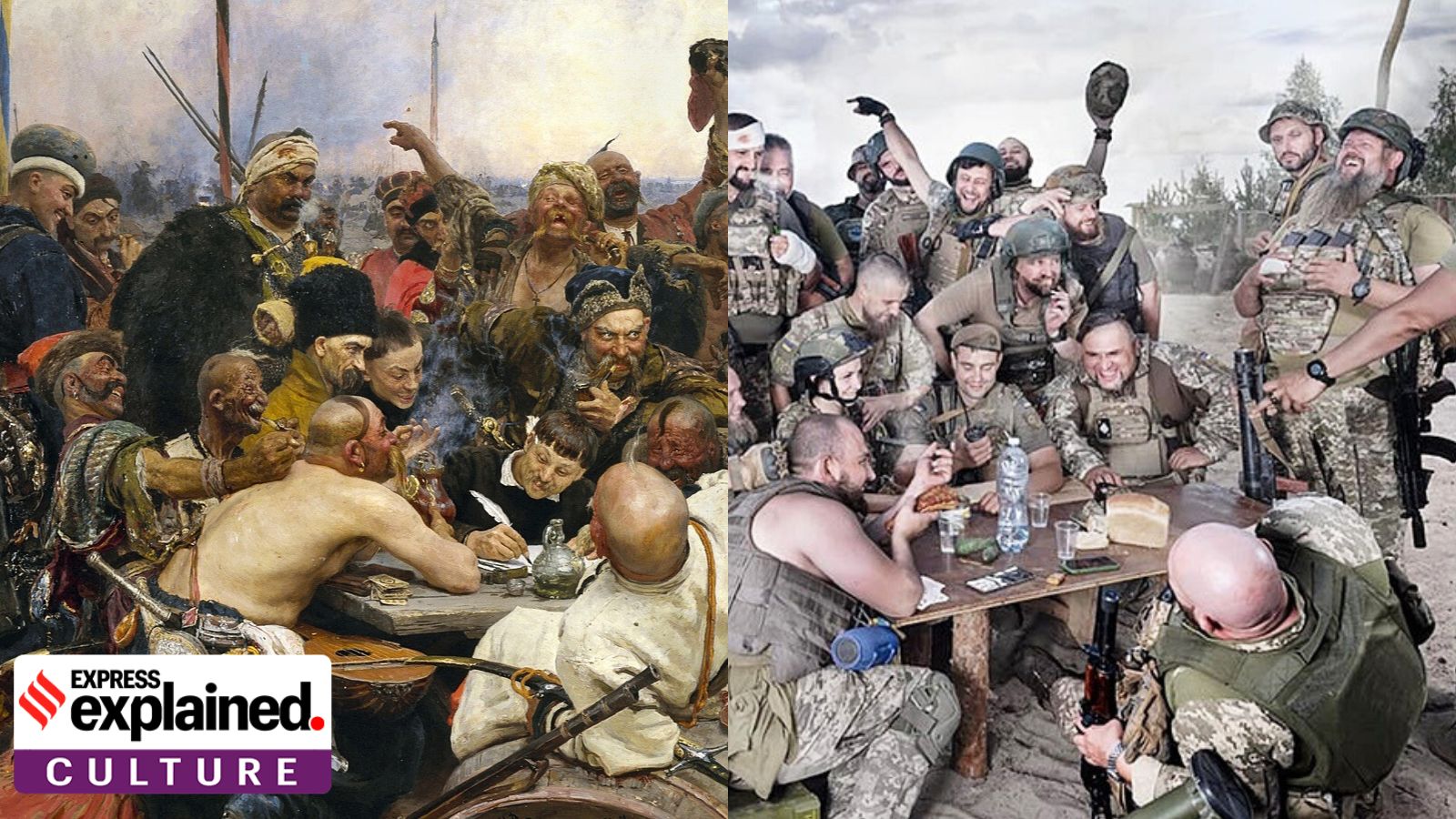 Ilya Repin's 'Reply of the Zaporozhian Cossacks' (left) and photographer Emeric Lhuisset's recreation. (Wikimedia Commons, FB)
A photographic re-creation of a 19th-century painting has become an unlikely source of inspiration for the Ukrainians fighting against Russian troops in the ongoing war. French photographer Émeric Lhuisset staged and clicked the photo featuring Ukrainian soldiers, sharing it on his Instagram account in September 2023.
According to a report this month from The New York Times, “For the past year, the image has been widely shared online by Ukrainians and praised by government officials, who displayed it recently in the capital’s leading exhibition center because it has struck at the heart of the Ukrainian identity struggle caused by Russia’s full-scale invasion.”
That struggle is also reflected in discussions around the original painting’s artist – the Ukraine-born Ilya Repin. He also did a significant amount of work in Russia and has been claimed by both countries as part of their cultural heritage. We explain.
What is the original painting?
Painted between 1880-91, Ilya Repin’s Reply of the Zaporozhian Cossacks depicts Cossack warriors drafting a letter to the Turkish Sultan. The men belonging to the semi-nomadic militaristic group – revered in Ukraine for their bravery and rebellious spirit – are mocking the Ottoman sultan’s ultimatum demanding their submission in 1676.
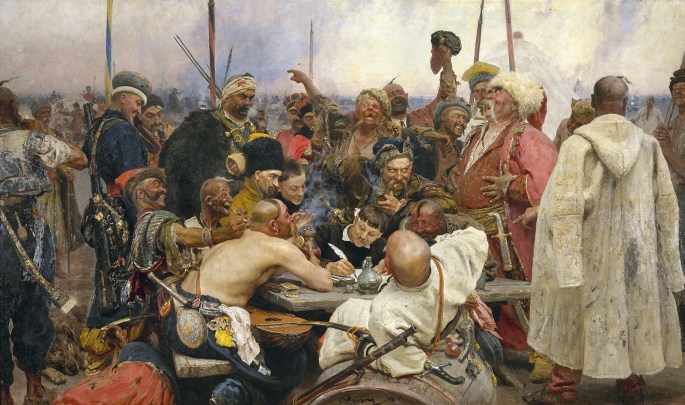 Ilya Repin’s ‘Reply of the Zaporozhian Cossacks’. (Wikimedia Commons)
Depicting a scene of laughter from what appears to be the battlefield, the painting celebrated the Cossack spirit of freedom and resistance against oppression. It is presently in the collection of the State Russian Museum in Saint Petersburg.
What does Lhuisset’s recreation show?
Reportedly spending over a year on the project, Lhuisset shot the photo with over 40 uniformed soldiers of the Ukrainian 112th Territorial Defence Brigade in 2023. The expressions are replicated in the painting but the details differ, including the replacement of swords with guns and some modern imprints – one sunglass-wearing soldier is seen scrolling on his phone.
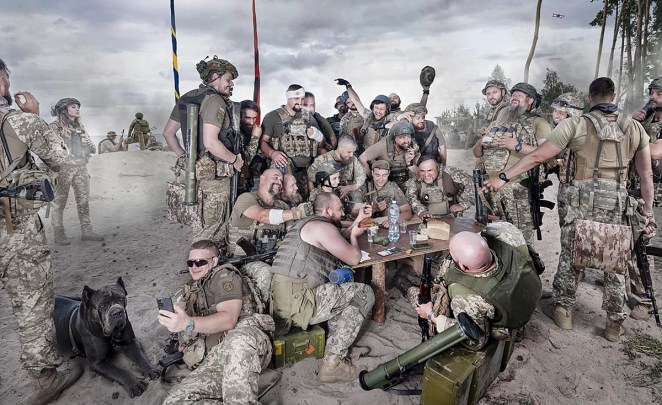 Emeric Lhuisset’s recreation, showing Ukrainian soldiers. (FB/Emeric Lhuisset)
Lhuisset wrote on Instagram, “February 24, 2022, beginning of the global invasion… I immediately think of the response of the Zaporozhian Cossacks to the Ottoman Sultan ordering them to submit, immortalized by Ilya Repin”. He said the painting, “so important in the Ukrainian national narrative”, is in Saint Petersburg and part of the “appropriation of Ukrainian history by Russia.”
Three days before he invaded Ukraine, Russian President Vladimir Putin described the country as having no “stable traditions of real statehood”. He claimed modern Ukraine was “entirely and fully created by Russia, more specifically the Bolshevik, communist Russia… This process began practically immediately after the 1917 revolution, and moreover Lenin and his associates did it in the sloppiest way in relation to Russia — by dividing, tearing from her pieces of her own historical territory”. Ukrainians have pushed back against this rhetoric by asserting its history and culture.
He added, “While the war intended to conquer the Ukrainian territory is visible to all and its condemnation relatively consensual in Europe, the much more insidious war which is being played out around the control of history and culture remains very much unknown and many Europeans participate, often unconsciously, to the diffusion of this Russian colonial construction… Culture is a weapon in a vast battlefield, let’s try not to forget it.”
Repin was born in 1844 in Chuhuiv, a small town in present-day Ukraine. Initially a student at the School of Military Topography in Chuguyev, he later travelled to Saint Petersburg, where he studied at the Imperial Academy of Arts. He became widely celebrated as a leading figure of the Russian realist school (called the Peredvizhniki), which advocated for art to depict the ordinary man. They also depicted nature vividly.
Several of Repin’s paintings depict Ukrainian history and customs. Described as both Russian and Ukrainian, his nationality is contested. Last year, several museums globally – including the Metropolitan Museum of Art in New York and Ateneum Museum in Helsinki – reclassified Repin as Ukrainian, altering it from Russian amid the war.
A print of the photograph gifted to the Kherson Regional Art Museum in southern Ukraine, which lost nearly its entire collection during the ongoing conflict, was exhibited late last year in Kyiv alongside empty frames of artworks from the museum.
“On this anniversary of the liberation of the city of Kherson, I am happy to have been able to officially present my photo ‘From far away, I hear the Cossacks’ reply’ to the museum of the same city that was completely looted by the Russians… Today, only these empty frames remain, witnesses of a war where Russia is trying to seize by force not only the territory, but also the Ukrainian culture,” Lhuisset noted on Instagram.