5 min read

© The Indian Express Pvt Ltd



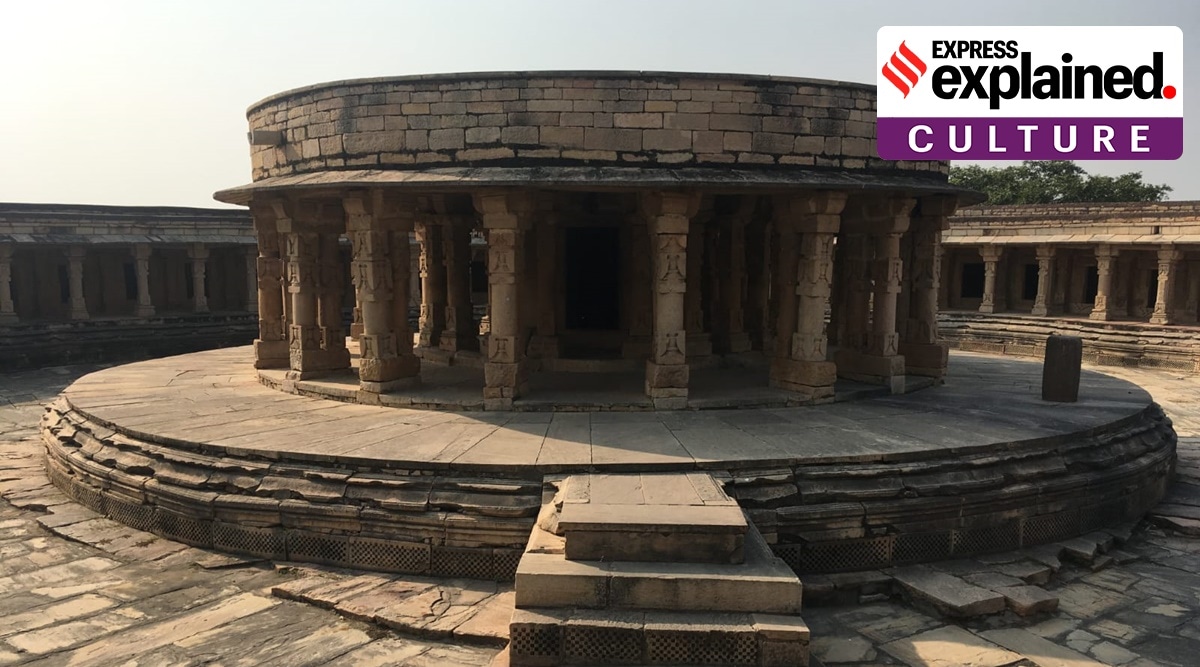 The central shrine of the Chausath Yogini temple in Mitaoli, Madhya Pradesh. (Express Photo: Yashee)
 From September 19, the ongoing special House session moved to the new Parliament building. The old Parliament will be turned into a museum.
“Today is an occasion to recollect and reminisce the parliamentary journey of 75 years of India before the proceedings are shifted to the newly inaugurated building,” Prime Minister Narendra Modi told the special session on Monday. “It is a very emotional moment to bid farewell to the old Parliament building …Its glory also belongs to us,” Modi said.
The circular, colonnaded Parliament building has for long been a symbol of India’s democracy, its graceful, dignified architecture enshrining the jostling aspirations of a billion people.
However, a similar, round and pillared structure in India pre-dates the Parliament by several centuries, and many believe it inspired the 20th century building. This structure is the Chausath Yogini temple in Mitaoli, Madhya Pradesh.
The old Parliament and its inspirations
Designed by British architects Edwin Lutyens and Herbert Baker when the British decided to move their capital to New Delhi, the 164-pillared building first housed the Imperial Legislative Council (From January 18, 1927 to August 15, 1947). After Independence, it served as the Constituent Assembly of India, and once the Constitution was adopted and India became a republic, as the Parliament of India, housing the Lok Sabha and the Rajya Sabha.
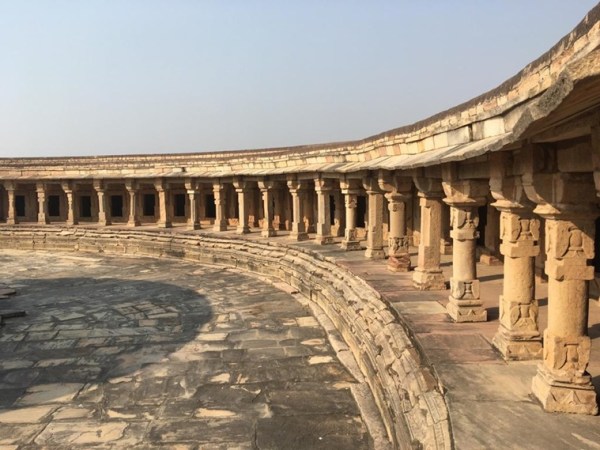 The Mitaoli temple has 64 chambers dedicated to the 64 yoginis. (Express photo: Yashee)
When New Delhi was being planned, the then Viceroy, Lord Hardinge, was quite clear that the buildings should have Indian elements and not look like foreign structures transplanted on Indian soil, even though Lutyens was quite convinced of the superiority of Western architecture. However, Hardinge made Lutyens and Baker visit most of the ancient and medieval sites of northern and central India for inspiration, like Mandu, Lahore, Lucknow, Kanpur, and Indore. Thus, the Parliament, the Rashtrapati Bhavan, and other buildings are a mix of Indian and Western-style architecture.
The grand Chausath Yogini temple stands atop a hillock in Mitaoli, about 40 kilometres from Gwalior, in the Morena district of Madhya Pradesh.
According to the Morena district’s website, it was built around 1323 by King Devapala of the Kachchhapaghata dynasty.
Dedicated to the 64 (chaunsath in Hindi) yoginis, its architecture is different from the temples dedicated to one deity.
The 64 yoginis are believed to be powerful warriors and sorceresses. According to mythology, a demon, Raktabija, had a boon that made him almost impossible to kill — everytime a drop of his blood fell on the floor, hundreds of offspring would be born off it. However, when Goddess Durga went to battle him, she unleashed an army of 64 yoginis who drank off his blood before it could touch the floor, and Raktabija was finally killed.
The Mitaoli temple is circular, with 64 chambers dedicated to the 64 yoginis, and a central shrine dedicated to Shiva. While most Hindu temples have a shikhara, or projecting dome, the Mitaoli temple, like other Chausath Yogini temples, is hypaethral, which means it has no roof. The Parliament-like pillars are on the inside of the stone temple complex. The central shrine has a slab with perforations, for excess rainwater to drain off. According to an article on the Madhya Pradesh government’s tourism portal, the temple has a diameter of 125 feet.
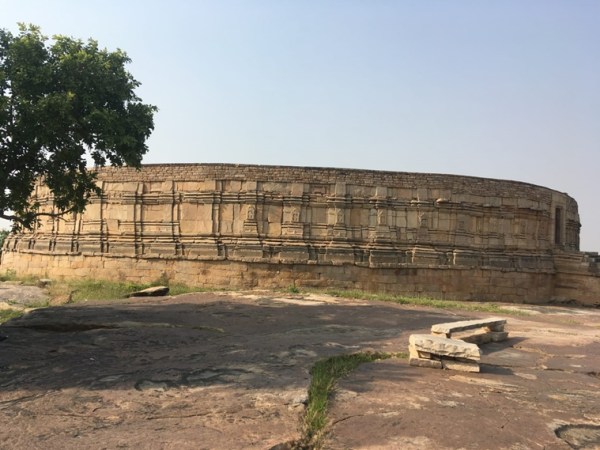 The pillars are on the inside of the Mitaoli temple complex, and can’t be seen from the outside. (Express Photo: Yashee)
The idols and carvings that would have once adorned the 64 chambers are all gone, and so not much is known about the temple. However, the Morena district website says the complex was probably also used for the study of jyotish (astrology) and mathematics.
Today, the temple stands majestic and mysterious on its lonely hilltop, holding its secrets close.
Locals in the area say so, though there is no evidence Lutyens or Baker ever visited it. The article on the MP tourism website says, “The Chausath Yogini Temple is in a Seismic Zone 3 area. Since its construction in the 1300s, the temple has withstood many an earthquake with almost no visible damage. One theory suggests that this could be the reason why Lutyens may have sought reference or inspiration from a building of such an unusual shape.”
Historian Swapna Liddle had earlier told The Indian Express, “Lutyens and Baker were sent off on this tour to look at examples of Indian architecture. They also might have seen photographs collected by the Archeological Survey of India. So even though there is no proof of them emulating Indian monuments, it is not inconceivable that they might have done so.”
On Monday, she said, “Baker did visit various sites, but there is no evidence that he visited this one. He of course may have seen photographs, though again there is no concrete proof.”