© The Indian Express Pvt Ltd
 5 min read


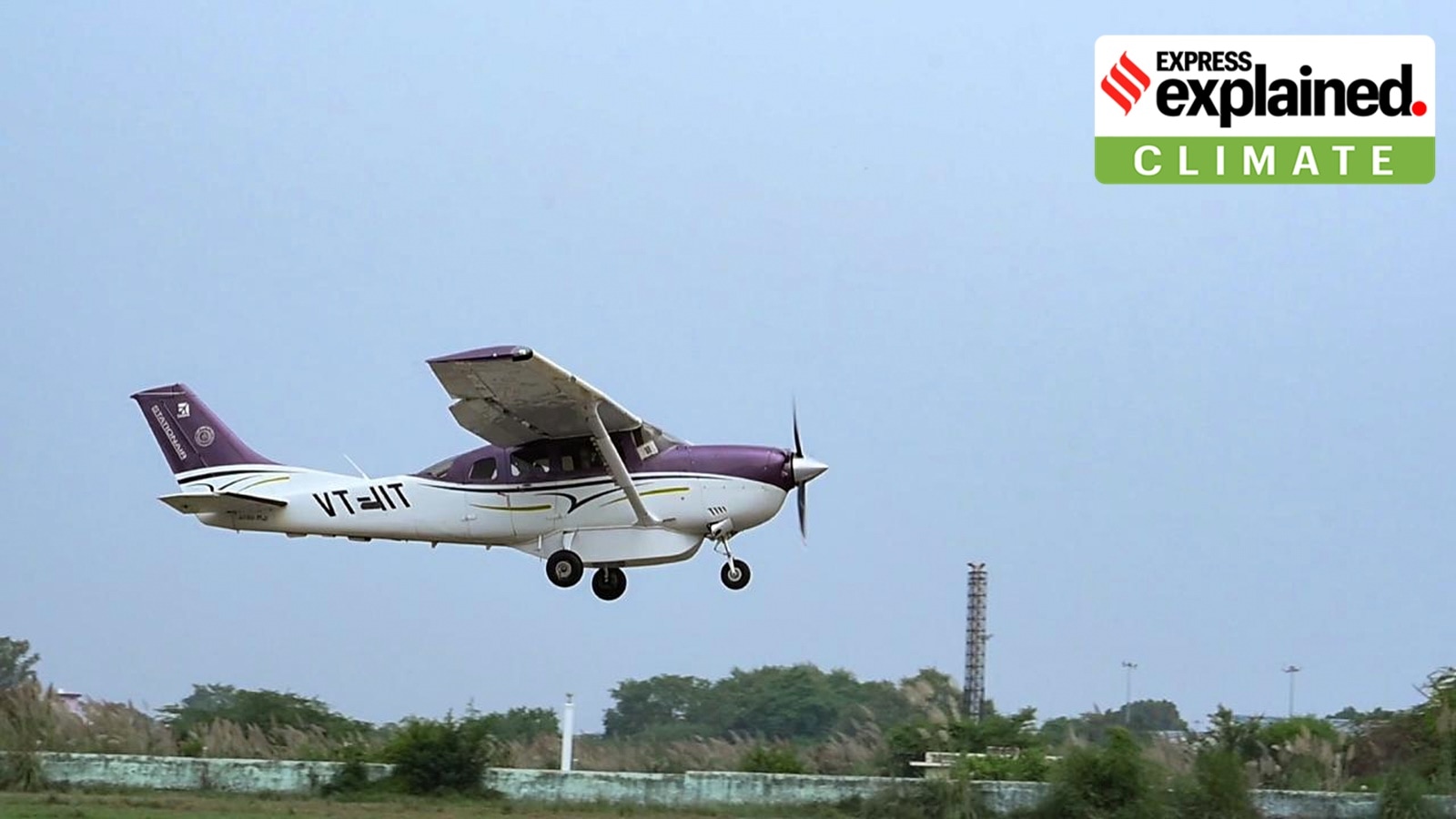 In this photo shared by Indian Institute of Technology, a plane takes off from Kanpur for New Delhi for a cloud seeding trial. (IIT via AP)
It is natural that on some level, humans get attracted to an adventurous (possibly questionable) recipe that promises a cure in a day instead of a longer therapy. But what if the disease returns the next day? This analogy applies to the idea of inducing artificial rain by cloud seeding.
For several years now, irrespective of who was in power, Delhi has looked towards cloud seeding as a potential solution to air pollution, as seen in the government’s recent experiments to induce artificial rain. With top Indian research institutions participating in the process, the matter deserves deep scrutiny from a scientific
perspective.
The technique
Let’s understand the basics of cloud seeding to disperse the clouds of confusion. Cloud seeding is a form of engineering of natural weather, where substances like silver iodide or sodium chloride are introduced into a particular class of clouds to artificially trigger rain. The underlying physics is straightforward — these chemicals act as cloud condensation nuclei or ice nuclei, around which water vapour condenses (or ice crystals form). Their accumulation may produce rain.
Crucially, seeding only works with a particular class of clouds, known as hygroscopic or warm-rain clouds, because they have abundant water content and respond quickly when extra nuclei are introduced.
The limitation
Hygroscopic clouds are rare and form under specific atmospheric conditions. They typically appear during the pre-monsoon period and throughout the monsoon.
Statistically, their probability of occurrence is about 51% during pre- and post-monsoon months, but it plummets to just 5 to 10% from November to January, when air pollution peaks in north India.
While some may argue for the technique as a solution to drought (which has its flaws, too), deploying it against pollution is a different story, because the specific clouds must be present on the very days when the Air Quality Index (AQI) spikes. The combination of these factors makes the chances of success razor-thin.
No solution to pollution
Proponents of the Delhi experiment claim that the AQI improved from the “Very Poor” category to “Poor” in several pockets of the city. However, this ignores the fact that in both cases, concentrations of PM2.5, the lead pollutant driving up the AQI in Indian cities, remained alarmingly above standards. The initial exposure to fine particles inflicts the greatest harm, further increments merely deepen the injury.
We must also thank nature that the drizzle, if it indeed resulted from seeding, did not coincide with cooler temperatures. Substantial rainfall is required to effectively wash out particulates, and light drizzles under cooler conditions often do the opposite. A secondary aerosol formation process is triggered and these fine particles attach to microdroplets, coagulate, and multiply, leading to a rebound in PM levels.
Even when supposedly successful, such interventions can only yield short-lived relief. Emissions are produced continuously and swiftly re-accumulate into concentrations through weather interactions. Within a day, we find ourselves back to square one.
Still, the experiment has led to a sense of relief for two reasons. First, it fulfilled a scientific curiosity, and second, the subsequent analysis will likely settle the debate on the scientific sanctity of such interventions. Smog towers, first tested in Delhi in 2021 with similar enthusiasm, have gradually found their quiet conclusion.
Air pollution in Delhi remains an unresolved, recurring challenge. Yet again, we are confronted with the same question: what is truly polluting Delhi?
Crop residue burning is a seasonal episode; festival fireworks last only a few days. Yet, the discourse continues to orbit around these transient factors, overlooking the systemic drivers.
It’s time to shift from a city-centric mindset to an airshed approach, one that considers the climatological “family area” responsible for the transboundary movement of pollutants, a proposition promoted by NARFI (National Air Quality Resource Framework of India) of NIAS, a project supported by the office of Principal Scientific Advisor to the Government of India. Air knows no administrative boundaries, and city-only solutions risk compromising the larger airshed.
Mitigation must be anchored in coordinated year-round actions targeting persistent sources. A clear starting point is accelerating the transition away from fossil fuels, where the emerging electric vehicle revolution offers promise.
According to latest estimates from the System of Air Quality and Weather Forecasting And Research (SAFAR), vehicular emissions contribute over 40% of Delhi’s PM2.5 load, and the rapid growth in vehicle numbers is offsetting the gains made from technological advances. Poor traffic management and congestion further worsen the situation.
Complex problems demand innovative solutions, backed by rigorous scientific evaluation to sustain credibility and impact. Above all, we must stop normalising toxic air. This is not merely a winter or Delhi problem, and certainly not a poor person’s problem. It is everyone’s problem, corroding our health, eroding our productivity, and weakening our collective dignity.
Beig is Chair Professor, National Institute of Advanced Studies, IISC-Campus, and Founder Project Director, SAFAR.