


© The Indian Express Pvt Ltd
Tags:


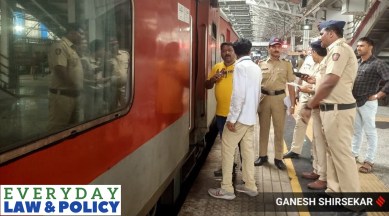
A constable of the Railway Protection Force (RPF) allegedly shot and killed four people on board the Mumbai-bound 12956 Jaipur-Mumbai Superfast Express on Monday (July 31) morning. The accused, Chetan Kumar, was arrested by Government Railway Police (GRP) at Mira Road station, and the weapon was seized.
One of those killed was a senior colleague of the accused, the other three were passengers on the train, which was scheduled to reach Mumbai Central at 6.55 am. The incident occurred between 5.20 am and 5.30 am, when the train was between the Vapi and Palghar stations.

The RPF is an armed force under the operational and administrative control of the Union Ministry of Railways, which is tasked with protecting and securing railway property, the passenger areas, and the passengers themselves.
The RPF was set up as a consequence of The Railway Protection Force Act, 1957, enacted by Parliament “to provide for the constitution and regulation of an armed force of the Union for the better protection and security of railway property and for matters connected therewith”. The Act came into force after Parliament passed significant modifications to it through The Railway Protection Force (Amendment) Act, 1985 (Act No. 60 of 1985). Rules under the Act were notified in 1987.
The RPF is led by a director-general.
According to a short history of the force on its website, the RPF has its origins in the ‘Watch and Ward’ set-up of the private railway companies during the time of the British Raj. “In the mid-forties, the portion of the Watch and Ward staff which remained under the control of these (private) Railways, was found inadequate to control thefts of their assets and consignments,” says the website.
A Committee under the Director of the Intelligence Bureau was set up in 1954, which recommended the reorganisation of the Watch and Ward into a statutory body.
The High Power Committee on Railway Security observed: “Security problems of the Railway passengers, especially those relating to the security of his person and property during his rail journey, are really serious. His problems start the moment he decides to travel by rail and continue till he has reached his destination. Throughout the journey, he is concerned about his own security as well as the security of his belongings. On top of this, the fear of terrorist activity in the form of blowing up of tracks and trains is always at the back of his mind giving him a sleepless journey. Unscheduled stoppages and delays due to law and order problems such as demonstrations, dharnas en route, compound his miseries. Any plan relating to Railway security, has, therefore, to give overriding priority to these security problems of the passengers, notwithstanding the fact as to which agency is responsible for doing this job.”
This led to the enactment of the RPF Act, 1957, which, after the amendments of 1985, “gave the RPF exposure to the other forces. It gained in maturity as it was regularly being deployed for assisting the State Police Forces”. In 2003, according to the website, the RPF Act and Railways Act were modified, and “the RPF partially took up the duties of escorting of passenger trains and access control at the railway stations”.
According to the RPF website, the force is more than 74,000 strong, and “distributed over the entire length and breadth of the country”. Its area of operation is massive, and its responsibilities huge. The website says:
“The Railways today own over 6,800 railway stations, run over 7,000 passengers trains, and more than 4,000 goods trains, daily… [and] carry approximately 22 million passengers and over 3 million metric tons of freight everyday over more than 63,000 kilometres of railway network… Both the railway assets and goods entrusted to it are vulnerable to depredations… The Railway Protection Force guards this vital artery of the economy of the Nation…and proves its mettle and worthiness, 24×7, all the 365 days of the year.”
The GRP is a part of the district police force, reporting to the state government. It works alongside the RPF, and should, under ideal circumstances, complement and strengthen its operations.
According to the Indian Railways website, “The Government Railway Police are responsible generally for the prevention and detection of crime on railways”. But their remit does not extend to protecting Railway property: “The protection of goods sheds, goods wagons at stations and parcel offices is not duty of the Railway Police, but of the Railway Protection Force of the Railway,” says the website.
According to the Railways website, “the duties of the Government Railway Police as regards the areas in their jurisdiction correspond in general to those of the District Police in the areas under their charge”. In addition, the GRP has some “special duties”, including:
(i) to maintain order at railway stations and in trains, wherein “order” refers to “control of passenger traffic within station premises, especially on platforms, in booking offices, waiting halls, at entrance and exit gates” etc., “control of vehicular and other traffic in station precincts”, “maintenance of order in passenger trains halted at stations and prevention of overcrowding in carriages”, “arrest of persons guilty of committing nuisance”, etc., and “to render assistance to railway officers and to the traveling public in so far as the rendering of such assistance is compatible with their own duties as Police officers”.
The Railways website says that “with the introduction of amendment in RPF and Railways Act, implications for GRP are:
* 36,600 GRP personnel of the country will be able to focus their attention on heinous crimes specially rape in trains and other crimes against women.
* While GRP will continue to do policing for Railways, it will get more time to concentrate on investigation of heinous crimes.
* GRP can be utilised for track patrolling and for effective investigation in cases of sabotage as defined in sections 150, 151 & 152 of The Railways Act.”
The RPF website points out that while the role of the RPF has diversified over the years, “the primary role of maintaining law and order remained the liability of the State Government. Hence, the system as it developed, led to a division of responsibilities between the State Police and the RPF”.
This can have practical implications and, as the RPF site says, “there are serious anomalies in the prevalent system”. Therefore:
“As the Government Railway Police (GRP) is organised on provincial lines, there is no continuity of jurisdiction. For instance, for a distance of 70 kilometres involving travel time of about an hour, between Ambala to Kalka, four GRP units look after a passenger. A seamless line of control and a single chain of command is lacking because of the boundaries of States and therefore, of their Police Forces.”
The RPF points to the “dilemma” of passengers in the current system: “With a multiplicity of security agencies operating on the Railway i.e. the Railway Protection Force (RPF), the Government Railway Police (GRP) and the District Police, he is confused and not sure whom to report to in case of a crime on the railway. For an ordinary passenger every man in khaki on the platform is a policeman.”


