


Tags:


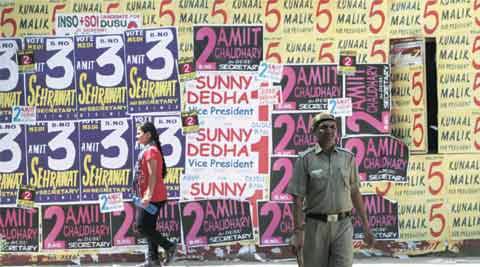

Student elections in Delhi University are often said to mirror the real elections — everything from the exuberance down to accusations of muscle and money power. Following a Supreme Court order, the Ministry of Human Resource Development had in 2006 constituted a committee headed by former Election Commissioner J M Lyngdoh to make recommendations on issues related to student bodies and student union election in institutions of higher education. The committee submitted its report on May 26, 2006, and the Supreme Court, in its order dated September 22, 2006, directed that the recommendations be implemented and followed by all colleges and universities for student elections. But on the ground, these rules are often broken.

Clause 6.3.1
“…no person, who is not a student on the rolls of the college/university, shall be permitted to take part in the election process in any capacity.”

[related-post]
Clause 6.6.1
“The maximum permitted expenditure per candidate shall be Rs 5000/-”
Those involved in the DU elections say this guideline is violated across the board since the spending limit is completely “unenforceable”. The university has 1.3 lakh students spread across 75 colleges in different parts of the city and student politicians say that simply travelling to these colleges would cost them much more than the Rs 5,000 limit set by the Lyngdoh Committee. Confident that every party in the fray is guilty of violating this rule, there is very little that holds student bodies from spending as they please. Thousands of posters, caps and pamphlets are printed by various student organisations, their cost itself adding up to greater than the prescribed limit.
Clause 6.7.5
“No candidate shall be permitted to make use of printed posters, printed pamphlets, or any other printed material for the purpose of canvassing. Candidates may only utilise hand-made posters…”
Given the expanse of Delhi University and the number of students, this guideline again seems largely unsuited for student body elections, participants in the process say. Therefore, there is very little control on the amount and content of the printed material that is used. Most parties in the fray have printed material, from caps to posters and pamphlets, often advertising ballot numbers. Printed manifestos are released in official press conferences, again a violation of the code.
Clause 6.7.9
“…Candidates may hold processions and/or public meetings, provided that (these) meetings do not… disturb the classes and other academic and co-curricular activities.”
This clause gets routinely flouted. Candidates and their supporters shout slogans, distribute pamphlets and enter classrooms to interact with students. With no consolidated campus and a grievance cell of merely 4-5 members, enforcement is near impossible.
Clause 6.9.1
“Any instance of acute lawlessness or the commission of a criminal offence shall be reported to the police by the university/college…”
Violence has become a routine byproduct of the student body elections. Parties use social media to accuse each other of violent politics. On Wednesday, for instance, the last day of campaigning, the NSUI and ABVP accused each other of hooliganism at Swami Shraddhanand College, with the CYSS then using the brawl as an example of why they should be voted in.


