Coronavirus (COVID-19): On Thursday, Mumbai’s Municipal Commissioner said the drug hydroxychloroquine would be administered as a preventive to 50,000 people in COVID-19 hotspots, down from the earlier plan of 1 lakh. While this is a scaling down, the national protocol for hydroxychloroquine announced during the outbreak is that it is to be administered it to very specific groups, such as healthcare workers exposed to COVID-19 patients.
Besides the hotspots, the Maharashtra government has also begun administering the drug among Mumbai police personnel, while Rajasthan has cleared it for police posted in hotspots.

What is hydroxychloroquine?
Hydroxychloroquine is an oral prescription drug that is used for the treatment of some forms of malaria, as well as autoimmune disorders such as rheumatoid arthritis and lupus. In use since the 1940s, the drug has shown anti-viral properties that have been studied for the last 40 years.
A combination of anti-malarial drug chloroquine and hydroxychloroquine, which is a derivative of chloroquine, is among the four lines of possible COVID-19 treatment that are being investigated by the global Solidarity trials under the aegis of the World Health Organization (WHO). While the efficacy of the combination is still being researched, a study in The Lancet Rheumatology has found that hydroxychloroquine decreases the acidity in compartments in the cell membrane. Since many viruses use the acidity of these compartments to breach the membrane and set off the process of replicating copies of itself, the reduction of acidity can potentially inhibit viral replication. In 2005, the drug was used to treat SARS, but it failed to decrease the viral load in mice.
The WHO notes that “there is insufficient data to assess the efficacy of either of these medicines (hydroxychloroquine and chloroquine) in treating patients with COVID-19, or in preventing them from contracting the coronavirus”.
What is the national protocol on the use of hydroxychloroquine in the COVID-19 outbreak?
In the context of COVID-19, the Indian Council of Medical Research (ICMR) has recommended hydroxychloroquine in very specific cases . It is to be used as a post-exposure prophylactic (preventive medicine) by asymptomatic healthcare workers involved in the care of suspected or confirmed cases of COVID-19, and by asymptomatic household contacts of laboratory-confirmed cases.
The Indian Express reported last week that the ICMR recently discussed the possibility of using the drug at a population level but the option was not taken forward. A source told this newspaper that during the discussion, questions were raised about the evidence available on the efficacy and side-effects of the drug.
Story continues below this ad
Maharashtra and Rajasthan, two of the states with the highest COVID-19 counts, have independently decided to allow use of the drug beyond healthcare workers. The Rajasthan Health Department has issued an advisory on administering hydroxychloroquine to policemen in COVID-19 hotspots.
What has Maharashtra decided?
The plan announced last week was that about a lakh people in COVID-19 hotspots, starting with the Dharavi and Worli Koliwada slums, would be administered the drug as a prophylaxis. On Thursday, the BMC revised it to 50,000.
📢 Express Explained is now on Telegram. Click here to join our channel (@ieexplained) and stay updated with the latest
A technical committee, comprising AIIMS doctors, NITI Aayog experts, and officials from the Maharashtra University of Health Sciences and Public Health Department, met on videoconferencing on April 13 to discuss the medication. Two groups will be created — one group will be given hydroxychloroquine along with Vitamin C tablets, while the other will be given hydroxychloroquine along with zinc tablets — to assess which combination has better outcomes.
Story continues below this ad
The BMC said last week that the drug would not be made compulsory but slum dwellers would be counselled to be administered it. The drug will not be given to people aged below 15, heart patients or pregnant woman. For people aged above 55, the drug’s effects will be closely monitored.
Mumbai police began the use of hydroxychloroquine last week after several personnel started showing symptoms. They are being given hydroxychloroquine along with vitamin C tablets, based on medical advice.
Maharashtra and Rajasthan, two of the states with the highest COVID-19 counts, have independently decided to allow use of the drug beyond healthcare workers. (AP)
What is the justification being given for all this?
Mumbai’s population density is 26,453 per sq km, states the environment report of the Brihanmumbai Municipal Corporation (BMC) in 2018-19, and in slums the population density doubles. At least 5-8 people stay in one 10×10 sq ft room in Dharavi, where cases have already crossed 50. “In such places, social distancing is not possible. We are advising hydroxychloroquine for the population in these hotspots as a preventive measure,” said Dr Subhash Salunkhe, who helped Maharashtra frame the policy. This was before the number was scaled down. The entire population in Dharavi and Worli is considered a high-viral burden pool; government officials see them all as “high risk” contacts.
After the target was reduced to 50,000 on Thursday, Municipal Commissioner Praveen Pardeshi said, “We are doing this on an experimental basis. It is a control group; we do not want to give it to a huge population.” Additional Municipal commissioner Suresh Kakani said, since there are known side-effects, the civic body held discussions over the last few days on how many and who all would be given hydroxychloroquine.
Story continues below this ad
What are the concerns?
Besides the fact that hydroxychloroquine’s efficacy as a COVID-19 cure or preventive is not yet established, there are concerns about its side effects. AIIMS Director Dr Randeep Guleria stressed hydroxychloroquine is “not a treatment for everyone”. “The drug has it owns side effects. One of them is cardiac toxicity leading to irregular heartbeat,” Dr Guleria said.
Last week, France’s national drug-safety agency raised the red flag over such side effects, specifically in COVID-19 patients. It released data of 43 patients who were given the drug and reported “heart incidents” linked to the drug. “The drug should only be used in hospitals, under close medical supervision. This initial assessment shows that the risks, in particular cardiovascular, associated with these treatments are very present and potentially increased in COVID-19 patients,” the agency said.
Don’t miss from Explained | Hydroxychloroquine is recommended for very specific cases — here’s why it’s no silver bullet
On March 25, Mayo Clinic cardiologists had issued a warning about the potential side effects of the drug. A team headed by Dr Michael J Ackerman released “urgent guidance” on patients at risk of drug-induced sudden cardiac death from off-label COVID-19 treatments.
Story continues below this ad
The specialists pointed out that the drug is known to cause “drug-induced” prolongation of QTc of some patients (QTc is a measure related to heat rates on an ECG). The specialists said patients with prolonged QTc are at risk for abnormalities that can lead to dangerous erratic heartbeats and also culminate in sudden cardiac death.
Another retrospective study (yet to be peer-reviewed), conducted at New York University’s Langone Medical Centre, looked at 84 COVID-19 patients on hydroxychloroquine and the antibiotic azithromycin (a combination being strongly pushed by US President Donald Trump, although the evidence is still emerging.
The NYU study made two observations: in 30% of the patients, QTc increased beyond the normal range), and in 11% it rose to a level that represents a “high-risk group of arrhythmia”.
Don’t miss these articles on Coronavirus from the Explained section:
‣ How coronavirus attacks, step by step
‣ Mask or no mask? Why the guidance has been shifting
Story continues below this ad
‣ Besides a face cover, should I wear gloves when I go outdoors?
‣ How the Agra, Bhilwara and Pathanamthitta Covid-19 containment models differ
‣ Can coronavirus damage your brain?


 8 min read


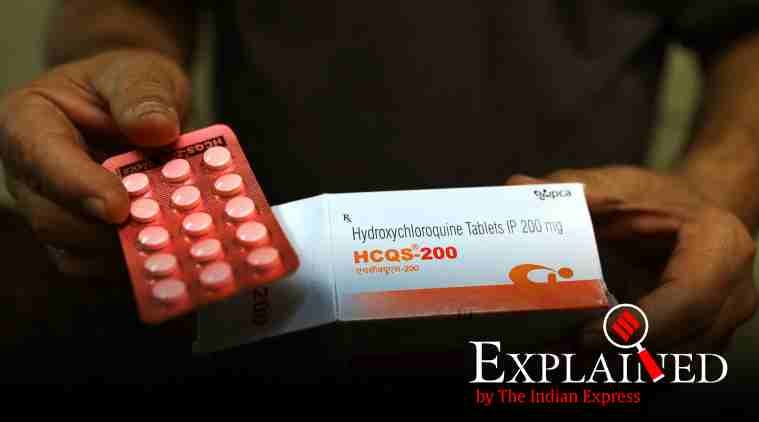 A chemist displays hydroxychloroquine tablets in New Delhi, India. (AP Photo: Manish Swarup, File)

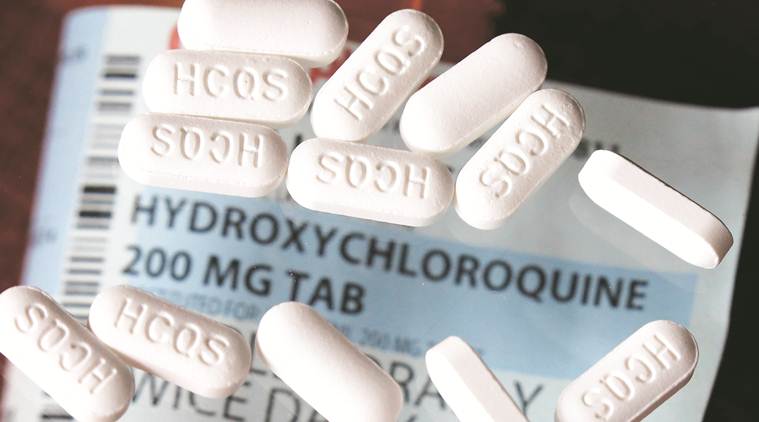 Maharashtra and Rajasthan, two of the states with the highest COVID-19 counts, have independently decided to allow use of the drug beyond healthcare workers. (AP)