Premium
This is an archive article published on September 19, 2021

Explained: CM Amarinder Singh misread early signs, leadership kicked the can until it was too late

As many as 33 newly elected MLAs wrote him a letter seeking a probe into the alleged role of former Akali minister Bikram Singh Majithia in a drugs case citing statements to the Enforcement Directorate.

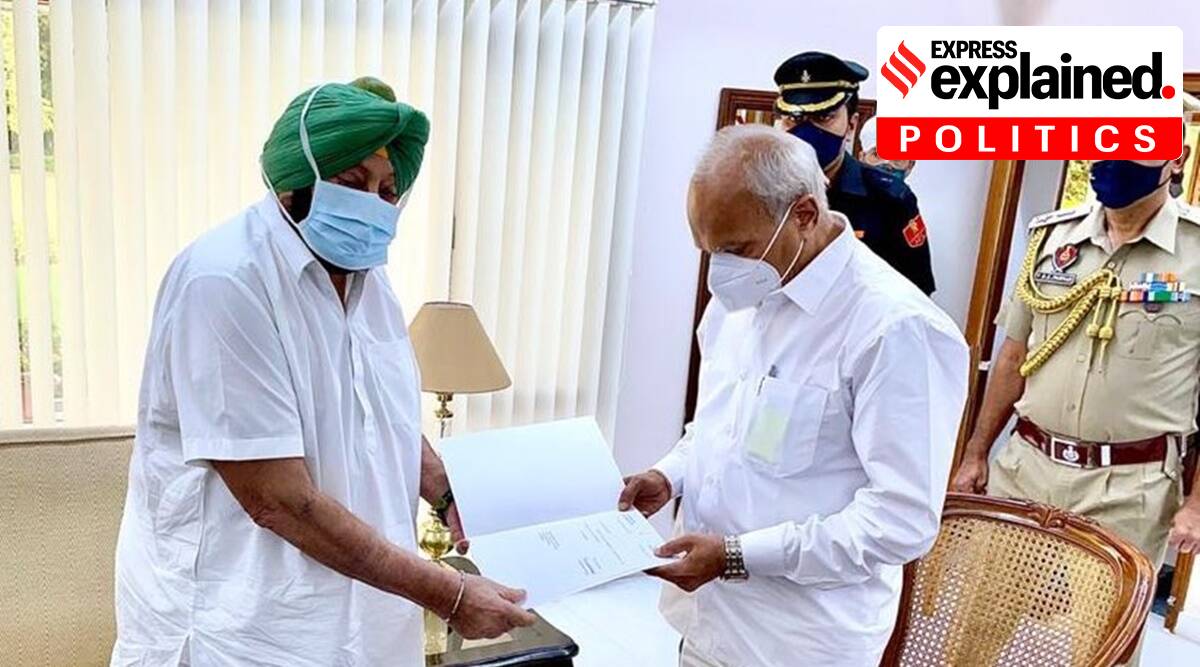
Captain Amarinder Singh handed his resignation to Punjab Governor Saturday. (Express Photo)Captain Amarinder Singh handed his resignation to Punjab Governor Saturday. (Express Photo)

The first warning sign had come very early, on August 8, 2017, barely five months after Captain Amarinder Singh took charge as Chief Minister of Punjab. As many as 33 newly elected MLAs wrote him a letter seeking a probe into the alleged role of former Akali minister Bikram Singh Majithia in a drugs case citing statements to the Enforcement Directorate. That letter gathered dust. Saturday, months before the Assembly elections are notified, comes the CM’s resignation in a burst of anger.

Between these two points is the journey of a powerful Chief Minister who, critics say, failed to sense resentment on the ground; who saw in dissenting voices merely ambitious rivals and a high command that kept kicking the political can down the road — until it was too late.

That first warning shot came because in the run-up to the 2017 polls, Singh had taken oath on a gutka (holy book) to wipe out the “drug menace” within a month of taking charge. The MLAs hoped “big fish” would be ensnared but nothing happened.

The cases of sacrilege dating back to October 2015, when torn pages of Guru Granth Sahib strewn outside a Bargari gurudwara led to widespread outrage and death of two protesters in police firing, continued to languish in court.

Even though the Justice Ranjit Singh Commission, set up by Amarinder Singh in 2017 to look into incidents of alleged sacrilege, categorically indicted the Badals for shielding Dera Sacha Sauda — in its report June 30, 2018 — the Special Investigation Teams formed thereafter could not make much headway.

There was growing anger on the ground but it did not reach the ears of the Chief Minister who seldom visited the Civil Secretariat. Many MLAs claimed his office was effectively run by Suresh Kumar, a 1983-batch IAS officer the CM had appointed as his Chief Principal Secretary immediately after taking over.

Although that appointment was subsequently quashed by the High Court and Kumar resigned, the CM refused to accept his resignation and the government continued to appeal the HC verdict. A senior Congress leader recounts how, at a function in Jalandhar, the compere introduced Kumar as the “de-facto CM”. Kumar, finally, put in his papers Saturday soon after Amarinder’s resignation.

Story continues below this ad

The CM later shifted to his farmhouse, making access even more difficult. The pandemic lockdown only deepened his isolation – and the sense of him being cut off.

As the clamour grew by the end of 2019, the CM appointed six MLAs critical of him as his advisers in late 2019. But their appointment could not get the governor’s sanction and they quit.

Meanwhile, Navjot Singh Sidhu, who left BJP to join Congress before the 2017 elections, much against the wishes of Capt Amarinder Singh, began to sulk after he was divested of his local bodies portfolio in a Cabinet reshuffle in July 2019 after the Lok Sabha elections.

Sidhu quit the Cabinet in a huff only to re-emerge this April after the Punjab and Haryana High Court quashed the investigation into the Kotkapura firing, calling it “politically motivated.’’

Story continues below this ad

On April 13, Sidhu visited the Bargari shrine and slammed Amarinder Singh for what he called was his inaction.

Disaffected legislators, led by three ministers from the Majha region of Punjab, Tript Rajinder Bajwa, Sukhbinder Sarkaria and Sukhjinder Singh Randhawa, found a rallying point in Sidhu. The CM’s camp dismissed these voices as disgruntled “non-performing” legislators who were afraid they wouldn’t get tickets.

As Sidhu launched a tirade against the government, the Congress high command watched quietly. There was no attempt to call the warring camps to Delhi, lay down the line or broker peace. It was only in May that the Congress set up a three-member panel under Mallikarjun Kharge. There were also reports of the party commissioning surveys by external agencies to gauge the popularity of the CM, who was given an 18-point agenda to fulfil after the panel submitted its report early June.

Rather than quelling Sidhu’s outbursts, this hardened the rift. But the high command continued to dither, taking over a month to appoint him as PPCC chief on July 19. Sources said the surveys favoured Sidhu and found that the CM’s popularity was dipping.

Story continues below this ad

While the party in charge Harish Rawat said Sidhu and the CM would now work together, the message that dissidents got was that Sidhu would be elevated.

Meanwhile, Amarinder Singh got to work, making public appearances, offering a hand of friendship to Sidhu, and addressing some manifesto promises: the old age and widow pension was doubled; loan waiver was sanctioned for landless labourers and prize money for gallantry winners hiked.

But it was too little, too late.

The dissidents continued to rally support to replace the CM arguing that facing the electorate under Amarinder Singh’s leadership was a challenge. The final straw was a letter signed by over 40 legislators and four ministers to party interim president Sonia Gandhi Wednesday, seeking a CLP meeting. That was the push which came to a shove — and forced the CM to quit.

Manraj Grewal Sharma is a senior journalist and the Resident Editor of The Indian Express in Chandigarh, where she leads the newspaper’s coverage of north India’s most politically and institutionally significant regions. From Punjab and Haryana to Himachal Pradesh and the Union Territory of Chandigarh, she oversees reporting at the intersection of governance, law, politics and society. She also reports on the diaspora, especially in Canada and the US. With a career spanning journalism across several countries, academia and international development, Manraj brings a rare depth of perspective to regional reporting. She is widely regarded as a leading chronicler of Punjab’s contemporary history and socio-political evolution, particularly its long shadow of militancy, federal tensions and identity politics. Her book, Dreams after Darkness, remains a definitive account of the militancy years and their enduring aftermath. Professional Background & Expertise A gold medalist in mass communication and a post-graduate in English literature, Manraj has a multifaceted career spanning journalism, academia, and international development. She was also awarded a fellowship by National Foundation of India and did several in-depth pieces on Manipur. Internationally, she has reported from Israel, US, UK, Myanmar, and Mauritius Her key focus areas include: Regional Politics, History, Agriculture, Diaspora, and Security. Of late, she has started focusing on Legal & Judicial Affairs: Much of her recent work involves reporting on high-stakes cases in the Punjab and Haryana High Court, ranging from environmental policy to civil rights. International Consulting: She previously served as a consulting editor for the Asia Pacific Adaptation Network and a publishing consultant for the Asian Development Bank (ADB) in Manila. Academia: For five years, she was the managing editor of Gender, Technology and Development, a peer-reviewed international journal at the Asian Institute of Technology, Bangkok. Recent Notable Articles (Late 2025) Her recent reportage focuses heavily on judicial interventions and regional governance: 1. Environment & Governance "‘NGT can’t test legality of policy’: HC hears challenge to Punjab’s ‘Green Habitat’ plan" (Dec 22, 2025): Covering a critical legal battle over whether the National Green Tribunal has the authority to strike down a state policy regularizing farmhouses on delisted forest land. "High court pulls up Punjab poll panel over audio clip probe" (Dec 10, 2025): Reporting on judicial concerns regarding the transparency and fairness of local body elections. 2. Legal Rights & Social Welfare "HC issues notice to Punjab, Haryana over delay in building old age homes" (Dec 22, 2025): Reporting on a contempt petition against top officials for failing to establish government-run homes for the elderly as promised in 2019. "Victims can appeal acquittals in sessions court without seeking special leave" (Dec 19, 2025): Highlighting a significant procedural shift in criminal law following a Supreme Court ruling. "HC upholds benefits for Punjab FCI officer acquitted in 20-year-old bribery case" (Dec 19, 2025): A report on the concept of "honourable acquittal" and its impact on employee benefits. 3. Human Rights & Identity "As Punjab denies parole to MP Amritpal Singh, HC asks it to submit ‘foundational material’" (Dec 1, 2025): Covering the legal proceedings regarding the radical preacher and sitting MP's request to attend Parliament. "Protecting life paramount: HC backs Muslim woman in live-in after verbal divorce" (Nov 6, 2025): Analyzing judicial protections for personal liberty in the context of traditional practices. Signature Beats Manraj is recognized for her ability to decode complex judicial rulings and relate them to the everyday lives of citizens. Whether it is a 30-year-old land battle in Fazilka or the political implications of Kangana Ranaut’s candidacy in Mandi, her writing provides deep historical and regional context. Contact @grewal_sharma on X manrajgrewalsharma on Instagram ... Read More

 

Latest Comment
Post Comment
Read Comments
Advertisement
Advertisement
Advertisement
Advertisement