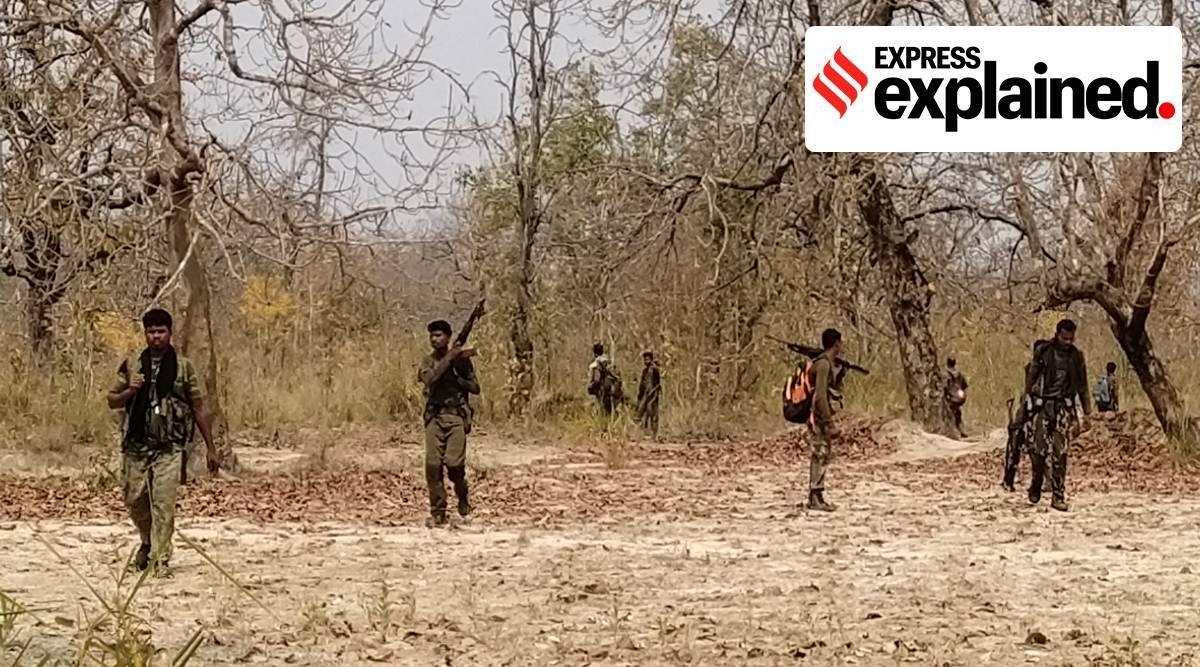
Woman held for 2021 Maoist attack: What was the ambush that killed 22 cops
The NIA on Sunday arrested Madkam Ungi alias Kamla, a resident of Muthamadgu village in Bijapur. Kamla was the medical team in-charge of PLGA Battalion No 1.
On April 2, 2021, security forces received intelligence inputs about the presence of armed Maoists in the villages of Peddagelur, Tekulgudem, Jonaguda, and Jeeram in Bijapur district. A special team of over 1,000 personnel, consisting of District Reserve Guard (DRG), Special Task Force (STF) and Commando Battalion for Resolute Action (COBRA) unit of the Central Reserve Police Force (CRPF) was formed.
The next day, around 10.30 am, as the team exited Peddagelur and Tekulgudem after search operations, they were ambushed by around 350 to 400 Maoists, including members of the People’s Liberation Guerrilla Army (PLGA). The rebels fired indiscriminately with their automatic, semiautomatic, and country-made weapons. They also used huge quantities of Barrel Grenade Launchers (BGL), disorienting the security forces.
The police personnel fought back and killed four Maoists, but suffered heavy casualties.
When did the NIA take over the case?
The Centre believed that the attack, a scheduled offence under the National Investigation Agency Act, 2008, should be investigated by the central probe agency due to its gravity and ramifications on national security. The NIA took over the case from Tarrem police on June 5, 2021.
The NIA on Sunday arrested Madkam Ungi alias Kamla, a resident of Muthamadgu village in Bijapur. Kamla was the medical team in-charge of PLGA Battalion No 1. Two more arrests, of Muchaki Budhra and Madkam Kosi, were made on January 18.
Story continues below this ad
The first accused, Madkam Rama, was arrested on June 28 last year. On December 22, the NIA filed a chargesheet before a special NIA court against 23 accused. Taken together, around 350-400 people have been listed as wanted in the case.
What has changed since the attack?
The year 2022 saw the lowest number of police casualties in the Maoist-affected Chhattisgarh in the past 20 years. Further, the Bastar police have managed to kill some of the Maoists involved in the 2021 attack and some have surrendered before the police.
“There have been many positive changes since 2021. The security vacuum in the region has been addressed to a great extent after opening up of security camps in Silger, Kunded, Galgam, Nambi, Elmagunda, and Potakapalli,” said P Sundarraj, Inspector General of Bastar range.
As per the statistics provided by the Bastar police, the number of personnel killed in 2022 dropped to nine from 46 in 2021. In 2019, about 21 personnel were killed and in 2020, the figure was 36.
Story continues below this ad
The number of Maoists surrendering before the police increased in 2021-2022, when 966 gave up arms. In 2019-2020, this number was 653.
What is the big reason for concern?
A major challenge that remains is instances of villagers being killed by Maoists for being ‘mukhbirs’ or police informers. While in 2021, 33 villagers were killed, in 2022, 31 lives were lost.
These Maoists attacks, termed Tactical Counter Offensive Campaign (TCOC), generally take place in March, April and May, as visibility is better in the summer season.
Jayprakash S Naidu is a Principal Correspondent for The Indian Express, currently serving as the state correspondent for Chhattisgarh. With an extensive career in frontline journalism, he reports on the political, security, and humanitarian landscape of Central India.
Expertise and Experience
Specialized Conflict Reporting: Jayprakash is a leading voice on the Maoist/Naxalite conflict in the Bastar region. His reporting provides a critical, ground-level view of:
Internal Security: Tracking high-stakes encounters, surrender programs for senior Maoist leaders, and the establishment of security camps in formerly inaccessible "heartland" villages.
Tribal Rights & Displacement: Investigative reporting on the identity and land struggles of thousands of displaced tribals fleeing conflict zones for neighboring states.
Governance & Bureaucratic Analysis: He consistently monitors the evolution of Chhattisgarh as it marks 25 years of statehood, covering:
Electoral Politics: Analyzing the shift in power between the BJP and Congress and the impact of regional tribal movements.
Public Policy: Reporting on landmark infrastructure projects (e.g., mobile connectivity in remote zones) and judicial interventions, such as High Court rulings on civil and family law.
Diverse Investigative Background: Prior to his current focus on Chhattisgarh, Jayprakash held reported from Maharashtra, where he specialized in:
Crisis & Disaster Management: Notable for his extensive coverage of the Cyclone Tauktae barge tragedy (P-305) and the COVID-19 pandemic’s impact on frontline personnel.
Legal & Human Rights: Investigative pieces for platforms like Article-14, focusing on police accountability and custodial deaths across India.
Environmental & Social Justice: Authoritative reporting on the Hasdeo Aranya forest protests and the approval of major tiger reserves, highlighting the tension between industrial mining and environmental preservation. ... Read More