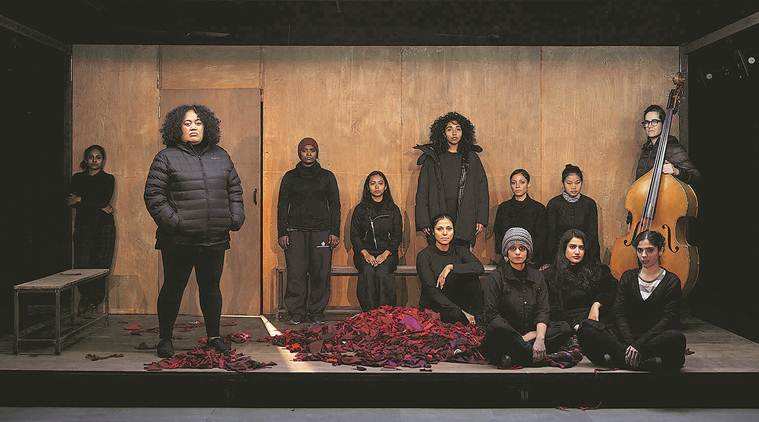
The opera, by an all-women team, is drawn from everyday acts of gender violence
On a shaky coach of a Mumbai local, women balance boards on their knees and chop vegetables to make a quick bhaaji when they reach home. They belong to a large sisterhood that works 24×7, unseen at home, and barely noticed outside. The work of women is one of the primary images of Daughters Opera, directed by Delhi-based Anuradha Kapur with libretto written by Australian independent producer Tammy Brennan, which opens in Delhi today. The opera is a direct call to action and is part of a larger social activism artwork, The Daughters Opera Project. Kapur, former Director, National School of Drama, is a veteran of plays that push the envelope on form and content, such as 2013’s Viraasat, a complete retelling of Mahesh Elkunchwar’s Wada trilogy. “I enjoy attending operas because I have an interest in music but I haven’t directed an opera before, so this project was very challenging as it deals with a difficult and complex subject,” she says. Excerpts:
Daughters Opera has been several years in the making. How has it evolved over time?
The project started as a conversation in 2013, when Tammy Brennan was in Delhi to perform at the Bharat Rang Mahotsav (the annual theatre festival of NSD) and we were responding to the intensifying brutal violence towards women and children across the world in the 21st century. The dialogue that stared at the time turned into an opera when she wrote the piece, as a librettist and it was composed by David Chisolm in Australia. We met over the years, discussing it and seeing how the piece happens. Finally, there was a concert in Australia last year of all the 12 pieces of music in the Fado form. The Fado is a Portuguese form of music that evokes a longing and nostalgia for things that are lost and you knowingly mourn.
What is the storyline of the opera?
There is no distinct storyline but an excavation of violence on women. It is a process to understand the figure of a working woman on stage in reference to a musical tradition. Deepan Sivaraman, the scenographer, and I had to figure out how to find a place for action and singing. In an opera, there is singing as well as an orchestra and our main proposal was: ‘how do you mesh action with that?’, ‘how can we make a narrative on the experience of women with this?’ We have a series of images which mesh, but there is no storyline other than that of women labour. We have tried to think up on how women expand their day, which is a 24-hour work day every single day. We look at the women’s work through action, while the music runs parallel and intermeshes in various ways. At the end, three pieces are sung.
How did the Indian and Australian artistes come together in this piece?
We invited actors, singers and dancers. Victoria Hunt from Australia, who is a brilliant dancer and a movement language expert, agreed to collaborate and has done the choreography. The Indian and Australian artistes have been a part of the body language and musicality of the piece. There are small singing sections and a fair amount of movement section. The latter is contemporary, about everyday movements, just as the costumes are saris and track suits and, if the women are in factories, boiler suits.
Opera is not common to India and most auditoriums here are not equipped for it. How did you address this problem?
Story continues below this ad
We have an opera tradition in the sense that nautanki is an opera because it has more singing than speaking. There are some other traditions where there is more singing than speaking. Sangeet-natak has a huge amount of integration, with a large number of songs. But, we won’t call it an opera even if it has 11 songs by artistes such as Bal Gandharva. We will call it natak. In the West, when speech moved away from Greek drama in one direction and music in another, it became spoken drama and opera. This hasn’t happened here except in the naturalistic tradition. In that sense, we have our auditoriums built for music but not for opera like in the West. The Western opera has a slightly different requirement, as we see in Mumbai. We should not necessarily build for the Western opera but take into account the accoustics of any auditorium.
How does Black Box, which is an intimate space, add to the experience of Daughters Opera?
We chose it because we wanted an intimate space as there are two guitarists, a singer and a double bass. It is a small, classic chamber music. The venue provides performers a sort of a residency. We have been performing and building here. We could use the material of the space, which used to be a factory, such as the walls and the concrete, in the work.
From January 3 to 5, at Black Box Okhla, Delhi. Donor pass available at the venue
Dipanita Nath is a Senior Assistant Editor at The Indian Express, based in Pune. She is a versatile journalist with a deep interest in the intersection of culture, sustainability, and urban life.
Professional Background
Experience: Before joining The Indian Express, she worked with other major news organizations including Hindustan Times, The Times of India, and Mint.
Core Specializations: She is widely recognized for her coverage of the climate crisis, theatre and performing arts, heritage conservation, and the startup ecosystem (often through her "Pune Inc" series).
Storytelling Focus: Her work often unearths "hidden stories" of Pune—focusing on historical institutes, local traditions, and the personal journeys of social innovators.
Recent Notable Articles (December 2025)
Her recent reporting highlights Pune’s cultural pulse and the environmental challenges facing the city during the winter season:
1. Climate & Environment
"Pune shivers on coldest morning of the season; minimum temperature plunges to 6.9°C" (Dec 20, 2025): Reporting on the record-breaking cold wave in Pune and the IMD's forecast for the week.
"How a heritage tree-mapping event at Ganeshkhind Garden highlights rising interest in Pune’s green legacy" (Dec 20, 2025): Covering a citizen-led initiative where Gen Z and millennials gathered to document and protect ancient trees at a Biodiversity Heritage Site.
"Right to breathe: Landmark NGT order directs PMC to frame norms for pollution from construction sites" (Dec 8, 2025): Reporting on a significant legal victory for residents fighting dust and air pollution in urban neighborhoods like Baner.
2. "Hidden Stories" & Heritage
"Inside Pune library that’s nourished minds of entrepreneurs for 17 years" (Dec 21, 2025): A feature on the Venture Center Library, detailing how a collection of 3,500 specialized books helps tech startups navigate the product life cycle.
"Before he died, Ram Sutar gave Pune a lasting gift" (Dec 18, 2025): A tribute to the legendary sculptor Ram Sutar (creator of the Statue of Unity), focusing on his local works like the Chhatrapati Shivaji statue at Pune airport.
"The Pune institute where MA Jinnah was once chief guest" (Dec 6, 2025): An archival exploration of the College of Agriculture, established in 1907, and its historical role in India's freedom struggle.
3. Arts, Theatre & "Pune Inc"
"Satyajit Ray, Ritwik Ghatak were not rivals but close friends, says veteran filmmaker" (Dec 17, 2025): A deep-dive interview ahead of the Pune International Film Festival (PIFF) exploring the camaraderie between legends of Indian cinema.
"Meet the Pune entrepreneur helping women build and scale businesses" (Dec 16, 2025): Part of her "Pune Inc" series, profiling Nikita Vora’s efforts to empower female-led startups.
"How women drone pilots in rural Maharashtra are cultivating a green habit" (Dec 12, 2025): Exploring how technology is being used by women in agriculture to reduce chemical use and labor.
Signature Style
Dipanita Nath is known for intellectual curiosity and a narrative-driven approach. Whether she is writing about a 110-year-old eatery or the intricacies of the climate crisis, she focuses on the human element and the historical context. Her columns are often a blend of reportage and cultural commentary, making them a staple for readers interested in the "soul" of Pune.
X (Twitter): @dipanitanath ... Read More
On Sunday, actor Nupur Sanon tied the knot with her longtime boyfriend and singer Stebin Ben in a lavish yet intimate Christian and Hindu wedding ceremonies in Udaipur. Several celebrities from the Hindi film industry were present at the occasion, including the bride’s sister Kriti Sanon, her rumoured boyfriend Kabir Bahira, and actors Mouni Roy and Disha Patani.


 5 min read


 The opera, by an all-women team, is drawn from everyday acts of gender violence