

 4 min read
Click here to follow Screen Digital on YouTube and stay updated with the latest from the world of cinema.
Premium
This is an archive article published on July 1, 2016
Down the Rathole
Chandrashekhar Reddy’s documentary, Fireflies in the Abyss, exposes the dangers in coal-mining through the eyes of a child.



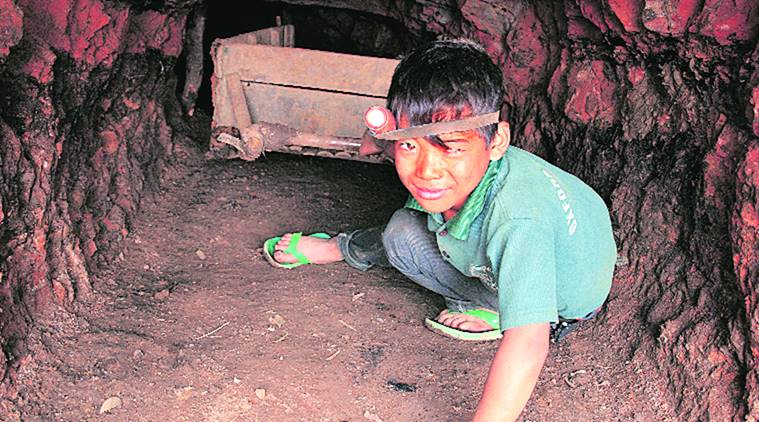 A still from Fireflies in the Abyss.
WHEN Chandrashekhar Reddy heard a loud banging on his shack’s door at 7 pm, he knew his luck had run out. A sense of foreboding had been nagging him the entire day, and just a few hours earlier, he decided to back up all his photographs and videos. Now, the owner of the mine and his henchmen had barged into his room, totally drunk. They accused Reddy of filming inside the coal mines without their permission.
Reddy was undoubtedly guilty. For the last six months, he had been selling the mine owner a story about his passion for photographing the natural beauty of the Jaintia Hills in Meghalaya, where the mines were located. But his real focus were the miners working in the dangerous “rat-holes”, which are narrow tunnels dug to reach the coal below. Reddy was shooting a documentary about the miners’ lives, seen through the eyes of an 11-year-old mine worker, Suraj. The owner, who according to Reddy, didn’t know the difference between a still camera and a video camera, readily bought his story until someone tipped him off.
“I could have just gone in, taken a lot of interviews, shot some footage for a week, and then disappeared,” says Reddy. “But I wanted the film to be a narrative of individual miners. I was lucky to meet Suraj. His family has abandoned him. Some of his friends, mining workers older than him, had pooled together money to send him to school,” adds Reddy. During the course of the documentary, Suraj sees the difficulties and loneliness of the miners. He tries to get an education, the only way he can escape the coal cutting business.
The job is a physical and mental trial, day after day. “You have to crawl 200 to 300 feet in. There’s no space to even kneel. Miners spend eight hours a day clambering through these rat-holes and carting around heavy baskets of coal. The holes often collapse in the rains or get flooded, killing the miners inside.” On one occasion, while Reddy was crawling through the pitch-black mines, he passed out from lack of oxygen. “When I regained consciousness, I could see the flickering of the miners’ torches. They came across like fireflies,” he says. That’s how the name of the documentary, Fireflies in the Abyss, came about.
The argument raged on that evening at Reddy’s shack — dozens of mine workers had also gathered around it, all inebriated and shouting out their opinions.
Finally, Reddy took out the memory card from his camera and threw it on the ground, inviting the mine owner to do whatever he wanted with it.
“There was a minute of complete silence,” says Reddy. He adds, “The owner, of course, had no clue what it was. But he needed to save face in that crowd. So, he ended up letting me keep it on the condition that his men would follow me around for the rest of the time I was there.” Luckily for Reddy, the majority of his shooting was complete; he had been planning on spending only a week more at the mines.
Story continues below this ad
This is the first time that Reddy, who divides his time between the UK and Bangalore, had ever been face-to-face with tangible danger. The 40-year-old documentary filmmaker, who makes independent documentaries for the National Geographic, says that the mining areas in the Jaintia Hills suffer from a complete absence of law and order. As villages fight one another for the rights to coal-rich land, coal traders reportedly carry out their excesses with impunity.
The documentary looks at miners who end up in a huge debt, although they can earn up to Rs 10,000. “Far away from home and families, workers often turn to alcohol and gambling. Betting on archery competitions is very popular too,” says Reddy. “Many come hoping to get rich quickly and leave, only to stay on for years and resign themselves to the thankless task of coal cutting,” he says.
Fireflies in the Abyss was screened at the Busan International Film Festival and various film festivals all across Mumbai, and is now heading to Hot Docs, the Canadian International Documentary Festival. The 90-minute long documentary will release in the metros on July 1.
Advertisement


More Entertainment




Advertisement
PHOTOS

PHOTOS





Top Stories








Must Read







Advertisement
- 01
- 02
- 03
- 04
- 05
Advertisement
