5 min read
© The Indian Express Pvt Ltd
Latest Comment
Post Comment
Read Comments



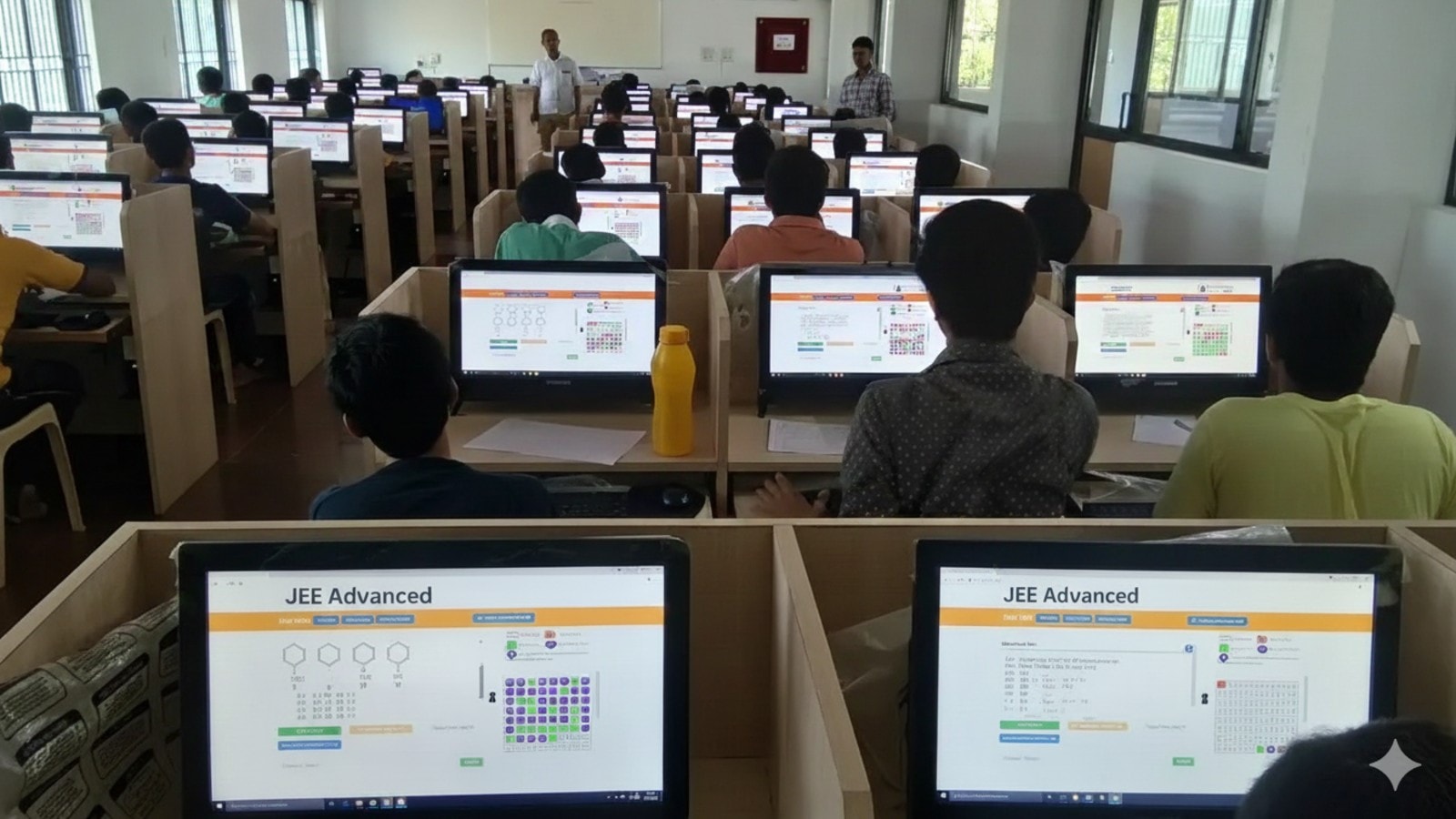 The IIT Council meeting was held last August after a gap of two years. The Council is led by Union Education Minister Dharmendra Pradhan as the chairperson and includes Directors of all IITs and chairpersons of their Board of Governors (representative image/ Gemini-generated)
In a move aimed at making the JEE Advanced exam “a better and less stressful assessment,” the IIT Council has recommended that an expert committee evaluate the possibility of making the test adaptive, where questions are dynamically generated and adjusted in real-time depending on the candidate’s ability.
The Council, which is the apex coordination body of the premier institutes, has also recommended that an optional adaptive test be held as a pilot ahead of the next JEE Advanced exam this year for data to be collected on performance.

Based on the results, a phased roadmap with specific timelines for the transition to adaptive testing can be outlined, according to the minutes of the meeting held on August 25 last year and released on Monday.
The Council has also recommended that sanctioned posts be created for mental health professionals at IITs.
The IIT Council meeting was held last August after a gap of two years. The Council is led by Union Education Minister Dharmendra Pradhan as the chairperson and includes the Directors of all IITs and chairpersons of their Board of Governors.
According to the minutes of the meeting, IIT Kanpur Director Prof Manindra Agrawal shared concerns regarding the current structure of JEE Advanced, which is the common entrance exam for the IITs, the prevalence of a huge coaching industry, and the significant emotional and financial stress on families.
Pointing out that the exam needs to better assess critical thinking and reasoning skills, Agrawal proposed a shift to adaptive testing. “This model further reduces coaching dependency, enhances fairness, and allows flexible, secure testing environments,” the minutes stated.
The IIT Council then recommended that a panel led by the JEE Apex Board (JAB) and IIT Kanpur consider the proposal, the operational logistics involved and its potential to reduce dependency on coaching, according to the minutes. The Council also recommended that a tool be developed to generate questions of varying difficulty levels.
According to the minutes, the Council suggested holding a free mock test two months ahead of the exam, which is usually held in May. Last year, over 1.80 lakh candidates had appeared for the computer-based JEE Advanced exam with 54,378 qualifying.
Also read | ‘Limited specialisations, scarce internships’: IIT Council takes stock as MTech participation lags
When contacted by The Indian Express, Prof Agrawal said the expert committee is yet to be constituted.
“In an adaptive test, questions are generated on the fly. There will be questions of varying difficulty levels; a candidate starts with simple questions, and as they solve these, the difficulty level increases. After a period of time, you can pinpoint the difficulty level to which a student can solve questions,” he said.
“If we bring in the component of aptitude-based questions, it can reduce the impact of coaching. Aptitude co-relates with innate intelligence. Coaching can only train students to use intelligence better; it cannot change that intelligence,” he said.
On the matter of mental health, with the IITs witnessing student deaths by suicide in recent years, the Council sought the deployment of mental health professionals. “In order to create a sustainable and long-term solution within IITs, which have a student population ranging from 3,000 to 18,000, along with faculty, families, and a broader community, a proper structure of posts and a cadre for ensuring mental health must be created. Posts ranging from counsellors to psychologists and psychiatrists need to be created within the IITs,” the minutes stated.
The Council suggested that the posts can be filled either on a regular or contractual basis. It asked IIT Gandhinagar to define a proper structure for these posts at IITs, including avenues for promotion and quality assessment.
When contacted, IIT Gandhinagar Director Prof Rajat Moona said: “Mental wellbeing is a very serious concern at engineering institutes and at IITs. Psychologists are regularly hired at IITs now to handle such issues in a proactive manner. The efforts put in by various institutions are the guiding factor to bring in coherence in our efforts.”
According to Moona, every IIT “has its own procedure”. “For example, on how many counsellors should be there…some IITs have a counsellor per 500 students, while some may have one counsellor per smaller or larger set of students. Some institutes have a fixed number of counsellors. There are also different levels of intervention, including clinical counselling and medical intervention. The IITs are aiming to work on creating a recommendation on this, which will be presented at the next IIT Council meeting,” he said.