


© The Indian Express Pvt Ltd
Tags:


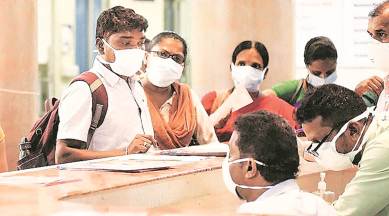
While welcoming the move to begin random testing of a few people showing signs of pneumonia or influenza, scientists from some of India’s leading institutions have urged the government to ensure further increase in the number of tests being done to detect people infected with novel coronavirus (COVID-19).
India has so far concentrated its efforts on testing only those people who have travelled from abroad, or those they had come in contact with. In the last few days, however, each of the 52 designated government laboratories across the country were asked to carry out random tests on samples of at least 20 pneumonia patients admitted in local hospitals.


”Also, the way patients are currently being selected for (random) screening is not clear. For example, we don’t know what is the geographical coverage of such testing and whether patients are ‘self-selecting’ themselves in some way. Broadening the base of those being tested will help in identifying asymptomatic or weakly symptomatic cases, which might be the bulk of the actual cases,” he said.
Professor L S Shashidhara, a developmental biologist at the Ashoka University, said there were reliable mathematical models to estimate the people who were at high risk within the community, and they needed to be included in the testing process.
“It is better to test everyone with symptoms rather than only those who have returned from abroad. Random checks in the community, especially around those who have tested positive, is absolutely necessary,” Shashidhara said.
Another scientist working with a Pune-based government laboratory, who asked not to be identified, said aggressive random testing, and dramatically expanding the test base would be crucial for containment of the virus. “If we pull through the next three weeks without any dramatic cluster behaviours, we should have reason to feel a little optimistic,” he told The Indian Express.
Menon, whose interests include modelling the spread of infectious diseases, said the government can even consider making testing available on demand, may be for a price. “I think we are not detecting cases simply because we are not looking for it. There is a need to understand where the cases are coming from and where they are spreading to. This evidence, if at all available in the community, will help us plan ahead. There is no doubt that the government is making commendable efforts, but, I think, there is a need to involve private laboratories as well and subsidise the cost of the test,” he said.
”Social distancing can help prevent the epidemic from going out of control. But this extreme forms of isolation cannot continue indefinitely. We need to be alert to the fact that our health systems should not be stressed. There is an anticipation that cases will rise, but just how fast it will rise is something that has to be controlled as far as possible so that our health services, hospitals and ICUs are not overwhelmed by the large number of patients,” he said.
Meanwhile, Renu Swarup, Secretary, Department of Biotechnology, said 11 laboratories under her department were ready to take up testing work, alongside the laboratories of the ICMR.
”Our research consortia is also putting in more funding so that in addition to the existing test kits, we can look for newer ones and speed up the detection,” she said.
“ In case there is an eventuality of community testing, we are also working with private partners and start-ups to see what their preparedness levels are,” Swarup said, adding that in a recent meeting with the Drug Controller General of India, a rapid response regulatory framework had been finalised.
”While test kits have to be validated by the National Institute of Virology, we have taken all measures to keep ourselves prepared. We are looking at existing test kits with PCR or development of newer test kits – DNA diagnostic or molecular diagnostic kits,” she said.
Here’s a quick coronavirus guide for you to stay updated: Who all should be tested for Covid-19 and when? | How should you quarantine yourself? | How often (and how) should you clean your home? | What is the Janata Curfew announced by PM Modi? | Who are restricted from coming to India, and from when? | How long can the virus live on surfaces or in air around you? | Still more Coronavirus Q&A Explained news here


