Premium
This is an archive article published on April 9, 2020

Tales from Delhi colony that accounts for bulk of hunger calls

There is no social distancing in Bawana's JJ Cluster as groups of women wash their clothes at the canal, while men relieve themselves nearby. Children fish for coconuts floating in the water, hoping to sell them at Rs 15 a piece.

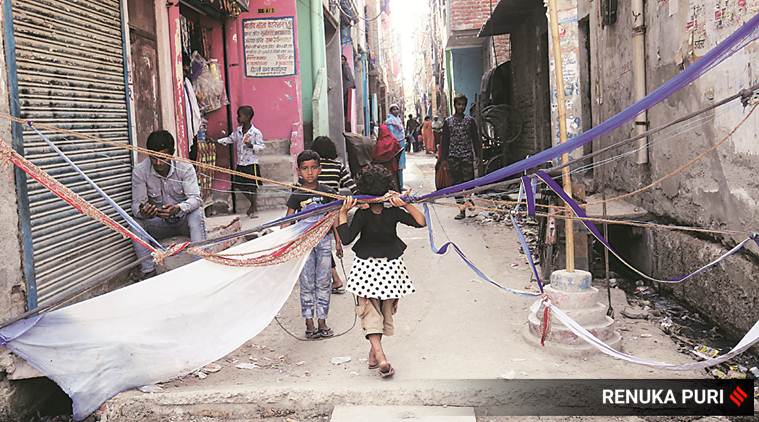
india coronavirus, india lockdown, delhi coronavirus, delhi lockdown, delhi lockdown poor hungry, delhi lockdown food for hunger, delhi city news The colony entrance has been blocked with bright strings. (Express photo by Renuka Puri)

The entrance to the alleys inside Bawana’s JJ colony are barricaded with blankets and sarees, held together with ropes and bright red strings. While residents hope this will keep coronavirus at bay, they believe hunger is a far bigger crisis. Delhi Police helplines have been buzzing, with a substantial number of ‘hunger calls’ coming from the Bawana colony.

DCP (Licensing) Asif Mohammad Ali said while they were analysing the calls for food, “around 25% of the hunger calls are from Bawana” — making it one of the areas with the maximum calls in Delhi.

Several factory workers, out of jobs since work halted at the Bawana Industrial Area, live at the colony. The main road is filled with sewage dug up from manholes, and a small canal, filled with water that has turned black, passes through the colony.

There is no social distancing here as groups of women wash their clothes at the canal, while men relieve themselves nearby. Children fish for coconuts floating in the water, hoping to sell them at Rs 15 a piece.

Read | New Delhi identifies COVID-19 containment zones, areas will face stricter restrictions

One of the residents, Mohammad Iqbal, is among the few keeping the supply lines to Bawana running. He heads to Narela every day to bring back goods. On Monday, he said it took him over two hours to haul his wooden cart filled with potatoes till Bawana. On spotting a police patrol vehicle, Iqbal quickly steered his cart into the colony hoping personnel wouldn’t impound it. “Police colony ke bahar jaane nahi deti,” he said.

Nearby, a group of women carrying vegetables and fodder for goats trudge through the lanes. They used to work at the Bawana Industrial Area, earning Rs 6,000 at a fan-making unit. After the lockdown, the owner handed them their previous month’s salary and some ration to tide through the week.

Story continues below this ad

Rani Bai (32) got around Rs 4,500 from her employer. She will finally be able to feed her family of eight, who were dependent on volunteers at a local school to feed them. “Sirf dal-chawal aur khichdi se kaam kaise hoga?” Bai asked.

Another resident, Raj Kumar (25), who used to work at an auto parts manufacturing unit, said he had to dip into his savings for ration to pay his landlord Rs 2,500. “Ek hafte se bhik maang raha hun. Aur nahi mangunga,” he said.

Israti Khatun (35), who has nine family members, borrowed money from her sister. “Log bole muft mein ration milega. Ek chutki bhi nahi mila mujhe,” she said.

Single mothers face an even tougher challenge. Ritu (35) used to earn Rs 6,000 a month at a plastic-making unit. Her husband was electrocuted at their house. She has now been begging her neighbours for ration for the past week. “Log bol rahe hai ki mujhe corona hogaya hai. Nahi milta koi ab mujhse,” she said.

Story continues below this ad

For Raju Devi, a mother of seven, having to wait in line for ration is an exercise fraught with anxiety. “Dar lagta hai line mein khade hone se. Bimaar pad jaungi,” she said.

Here’s a quick Coronavirus guide from Express Explained to keep you updated: What can cause a COVID-19 patient to relapse after recovery? | COVID-19 lockdown has cleaned up the air, but this may not be good news. Here’s why | Can alternative medicine work against the coronavirus? | A five-minute test for COVID-19 has been readied, India may get it too | How India is building up defence during lockdown | Why only a fraction of those with coronavirus suffer acutely | How do healthcare workers protect themselves from getting infected? | What does it take to set up isolation wards?

Anand Mohan J is an award-winning Senior Correspondent for The Indian Express, currently leading the bureau’s coverage of Madhya Pradesh. With a career spanning over eight years, he has established himself as a trusted voice at the intersection of law, internal security, and public policy. Based in Bhopal, Anand is widely recognized for his authoritative reporting on Maoist insurgency in Central India. In late 2025, he provided exclusive, ground-level coverage of the historic surrender of the final Maoist cadres in Madhya Pradesh, detailing the backchannel negotiations and the "vacuum of command" that led to the state being declared Maoist-free. Expertise and Reporting Beats Anand’s investigative work is characterized by a "Journalism of Courage" approach, holding institutions accountable through deep-dive analysis of several key sectors: National Security & Counter-Insurgency: He is a primary chronicler of the decline of Naxalism in the Central Indian corridor, documenting the tactical shifts of security forces and the rehabilitation of surrendered cadres. Judiciary & Legal Accountability: Drawing on over four years of experience covering Delhi’s trial courts and the Madhya Pradesh High Court, Anand deconstructs complex legal rulings. He has exposed critical institutional lapses, including custodial safety violations and the misuse of the National Security Act (NSA). Wildlife Conservation (Project Cheetah): Anand is a leading reporter on Project Cheetah at Kuno National Park. He has provided extensive coverage of the biological and administrative hurdles of rewilding Namibian and South African cheetahs, as well as high-profile cases of wildlife trafficking. Public Health & Social Safety: His recent investigative work has uncovered systemic negligence in public services, such as contaminated blood transfusions causing HIV infections in thalassemia patients and the human cost of the fertilizer crisis affecting rural farmers. Professional Background Tenure: Joined The Indian Express in 2017. Locations: Transitioned from the high-pressure Delhi City beat (covering courts, police, and labor issues) to his current role as a regional lead in Madhya Pradesh. Notable Investigations: * Exposed the "digital arrest" scams targeting entrepreneurs. Investigated the Bandhavgarh elephant deaths and the impact of kodo millet fungus on local wildlife. Documented the transition of power and welfare schemes (like Ladli Behna) in Madhya Pradesh governance. Digital & Professional Presence Author Profile: Anand Mohan J at Indian Express Twitter handle: @mohanreports ... Read More


Latest Comment
Post Comment
Read Comments
Advertisement
Advertisement
Advertisement
Advertisement