4 min read

Click here to join Express Pune WhatsApp channel and get a curated list of our stories
© The Indian Express Pvt Ltd



 'Mental and physical disorders often occur together; we must be responsive and care for both. Just as we focus and invest in physical health, so must we for mental health and well-being,', said Dr Pratima Murthy
For Dr Pratima Murthy, Director, National Institute of Mental Health and Neurosciences (NIMHANS), the Nelson Mandela Award for Health Promotion is important as the institution has been working consistently towards introducing mental health care in primary care settings. “The award is important as it recognises initiatives in mental health, which so far has not been adequately recognised within the larger realm of health,” Dr Murthy told The Indian Express.
She added that the award was significant as it comes at a time when NIMHANS is commemorating 70 years of its inception as the first mental health institution in the country (All India Institute of Mental Health AIIMH) and 50 years of the formation of NIMHANS.
At Friday’s special ceremony at the 77th World Health Assembly in Geneva, awards will be presented to eight persons and institutions worldwide for their outstanding contributions to public health. The 2024 Nelson Mandela Award for Health Promotion was jointly bestowed to Bengaluru-based NIMHANS and Professor Bontle Mbongwe from Botswana.
The National Mental Health Survey suggests that one in 10 people have a diagnosable mental disorder, Dr Murthy said. “Many also have psychological distress and aftercare for mental health is very important like for any chronic non-communicable disease,” she pointed out.
“Psychiatric disorders occur due to similar reasons that physical disorders occur or are precipitated by. Mental and physical disorders often occur together; we must be responsive and care for both. Just as we focus and invest in physical health, so must we for mental health and well-being,” the expert added.
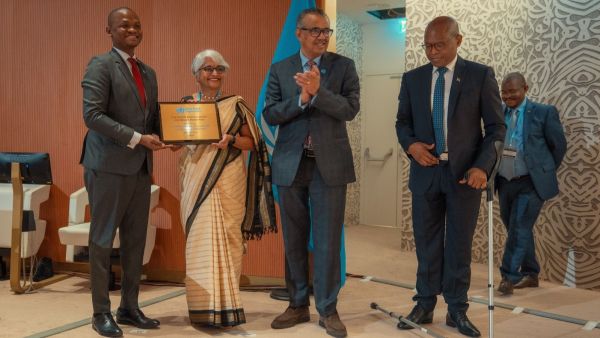 The institution involves young people as change agents within district youth-empowerment centres to bridge the gap between young people and their families reaching about six million young people. (Express Photo)
While the Telemanas helpline has reached a million calls in one and a half years, with people calling mainly for low mood, sleep disturbances, relationship problems, and anxiety, Dr Murthy said there was a need to strengthen on-the-ground services and get people to reach out.
“At the same time, we need to work on programs to improve mental health resilience and increase support for vulnerable people and during vulnerable times,” Dr Murthy said. She pointed out that as longevity increases, the elderly become more vulnerable to issues related to loneliness, isolation, and growing physical problems. “These are invariably associated with mental health problems, deteriorating sensory functions, as well as degenerative conditions like dementia,” Dr Murthy added.
Apart from delivering state-of-the-art clinical care, and carrying out training and research, NIMHANS collaborates with central and state governments in framing, informing, and implementing national policies and strategies such as the National Mental Health Policy (2014), the Mental Healthcare Act, 2017, and the National Suicide Prevention Strategy (2022), the NIMHANS director said.
The institution involves young people as change agents within district youth-empowerment centres to bridge the gap between young people and their families (reaching about six million young people), apart from engaging in a national initiative for child protection, mental health, and psychosocial care (reaching more than three million people). Other major programs led by the institute include urban mental health and integrating mental health issues arising out of climate change into primary mental health care delivery, as well as training and accrediting community volunteers to deliver mental health first aid: 18,000 ‘gatekeepers’ have been trained to facilitate the early identification of suicide risk and to intervene.
“It is important to increase knowledge about the importance and techniques of self-care for mental health, promote mental health and well-being as well as encourage help-seeking for mental health problems, tell people that help, both medical and psychological, is available,” Dr Murthy added.