6 min read

Click here to join Express Pune WhatsApp channel and get a curated list of our stories
© The Indian Express Pvt Ltd



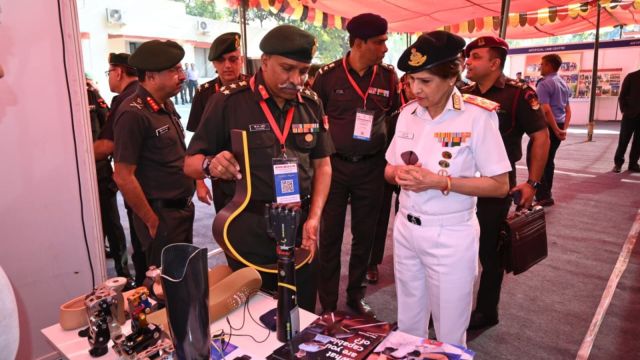 Surgeon Vice Admiral Arti Sarin, Director General Armed Forces Medical Services, at the inaugural function of ‘Continuing Rehabilitation Education-2025’ at ALC, Pune, on the theme ‘Improving Outcomes in Amputee Rehabilitation’. (Express Photo)
Surgeon Vice Admiral Arti Sarin, Director General Armed Forces Medical Services (DGAFMS), said in Pune on Thursday that plans are underway to introduce Early Post-Operative Prosthesis (EPOP) in all armed forces hospitals.
“The Artificial Limb Centre (ALC), in coordination with the office of senior consultant (surgery), is introducing EPOP in all AFMS hospitals. By fitting EPOP as early as two days after amputation, patients can benefit from faster recovery, improved morale and significantly better functional outcomes,” Surgeon Vice Admiral Sarin said.
She was speaking at the inaugural function of ‘Continuing Rehabilitation Education-2025’ at ALC, Pune, on the theme ‘Improving Outcomes in Amputee Rehabilitation’.
Early prosthetic fitting and independent ambulation are major objectives of the physical and psychosocial rehabilitation of the amputee, with early walking playing a vital role. At ALC, a premier medical institute of the Indian armed forces, comprehensive rehabilitation care is provided to help amputee patients (disabled soldiers, veterans and civilians) progress from hesitant first steps to confident strides.
“A technically perfect amputation is only the beginning. The real measure of success, however, lies in the quality of rehabilitation that follows, a domain in which ALC excels,” Surgeon Vice Admiral Sarin said.
Brigadier C N Satish, Commandant, ALC, explained that it is scientifically proven that the longer the person is without a limb, the poorer the outcome. “Usually, it takes a month or two after an amputation for a patient to get a limb and walk. Hence, EPOP is a new innovation where a temporary artificial limb can be made and fitted to the patient as early as two to three days after the amputation. The advantage is it boosts morale, and the healing process starts sooner,” he told the media after the inaugural event.
In her speech, Surgeon Vice Admiral Sarin said that across the world, there has been a rise in the number of people living with limb loss due to road trauma, diabetes and conflict. “For the armed forces, this challenge is even more acute. Modern warfare increasingly produces survivable yet disabling injuries. At AFMS, we stand at the intersection of trauma care, rehabilitation, and national security. Our responsibility is two-fold: to return the wounded soldier to duty as soon as possible and to ensure that those who cannot return continue to lead purposeful, dignified, and productive lives,” she added.
The AFMS has greatly strengthened battlefield medical readiness through the Yodha Rakshak Doctrine and the BACHAAV protocol, preparing every frontline soldier to be a capable first-responder, the DGAFMS said. She added that training centres across India impart the intensive two-day Yodha Rakshak capsule, equipping combatants in modern methods of rapid haemorrhage control, damage-mitigation, resuscitation and early evacuation to maximise life and limb salvage.
“This covers all aspects of the acronym BACHAAV, that is, bleeding management, airway management, circulation, hypothermia, analgesia and antibiotics, atirikt karvaiye (additional procedures), and vyakt karna or documentation, and usage of the Yodha Rakshak Kit. The Artificial Limb Centre fits perfectly into this continuum,” Surgeon Vice Admiral Sarin added.
She also inaugurated the Additive Manufacturing Lab that can enable precise, patient-specific prosthetic designs for better comfort and fit. “This facility is a more specialised form of 3-D printing. The conventional method to manufacture an artificial limb takes longer, and the chances of a precise fit may not be that good, and there may be difficulty in replicating a good prosthesis. In 3-D printing, we scan stumps into a computer, which is used to print the artificial limb. It speeds up the process as we can print multiple sockets and replicate them later if required,” Brig Satish explained.
For 80 years, the Artificial Limb Centre (ALC) has represented excellence in amputee rehabilitation—combining innovation, technology and compassion for battle casualties, veterans, and civilians, Surgeon Vice Admiral Arti Sarin said on Thursday, adding that a proposal to make it a National Centre of Excellence will be submitted.
“Current collaborations are there with DEBEL [Defence Bioengineering and Electromedical Laboratory] on exoskeleton development for spinal-cord-injured patients, and apart from the state-of-the-art Gait and Balance Lab and Upper Limb Training Lab, ALC has also expanded into additive manufacturing and formal academic training,” Surgeon Vice Admiral Sarin added.
“The ALC has also played a decisive role in the victories of the Services Paralympic Team, whose athletes hold national and international records. Murlikant Petkar, India’s first Paralympic gold medallist, whose life inspired the film Chandu Champion, was rehabilitated at this very centre,” she said.
“Looking ahead, our aim is to collectively elevate ALC into a National Centre of Excellence for amputee rehabilitation. This will include structured training programmes, strong research collaborations, national registries and data systems, innovation hubs linked to academia and industry, indigenous, affordable, high-performance prosthetic designs and tele-rehabilitation platforms and augmented Artificial Limb Service Centres for remote care,” she said.
In her virtual keynote speech, Sminu Jindal, Managing Director of Jindal SAW Limited and Founder-Chairperson of Svayam, an accessibility rights organisation, spoke about her challenges. At the age of 11, she was involved in an accident while travelling from Jaipur to New Delhi that resulted in her needing a wheelchair for the rest of her life. Jindal set up Svayam and, for the last 25 years, has dedicated herself to reshaping societal perspectives about individuals with reduced mobility.
“Everyone deserves equal access to the built environment, and over the years, there have been changes. However, there is still a need to make accessibility truly seamless. Accessibility should be viewed as an investment rather than an expense,” she said, adding that the role of the armed forces is significant in collaborating to improve lives.