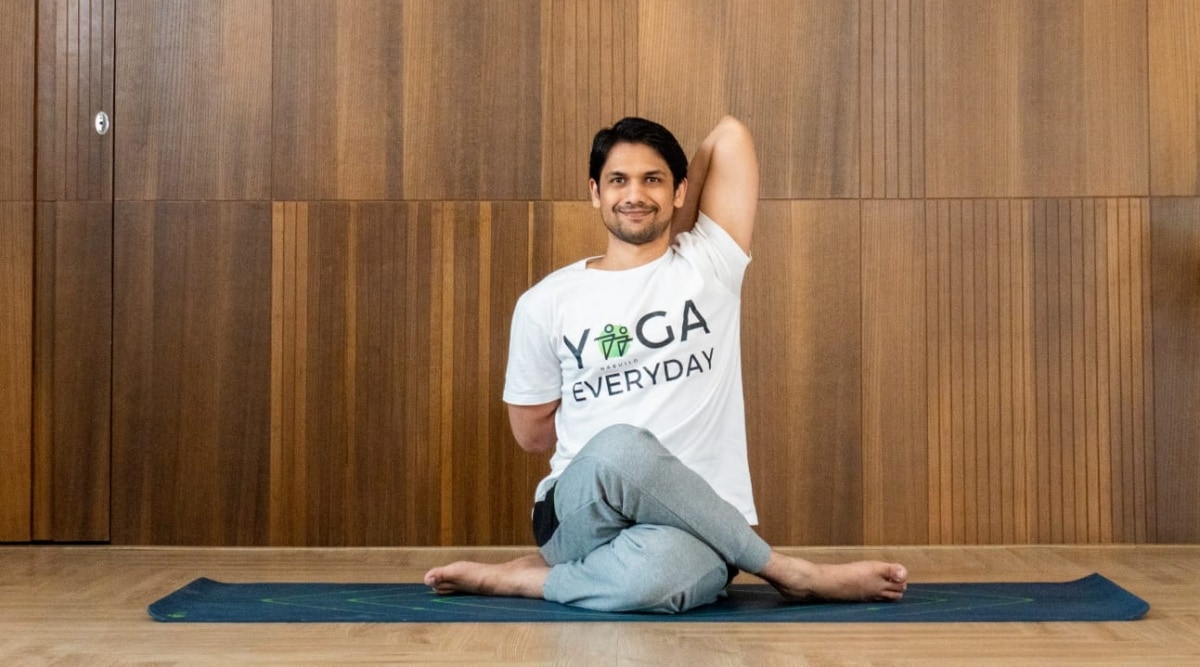
In the picture, Saurabh Bothra, engineer from IIT-BHU. (Express photo)
Listen to this article
An accidental startup that now teaches yoga to thousands across the globe
x
00:00
1x1.5x1.8x
On March 22, 2020, when a Janata Curfew was announced in India, a group of yoga practitioners decided to offer lessons over Zoom and YouTube because it was the best that they could do for a country under lockdown.
Every morning for 45 minutes, Saurabh Bothra, an engineer from IIT-BHU, and Pramod Yadav, a fitness buff from Nagpur, took viewers through simple breathing exercises, surya namaskar, and asanas for the upper body, lower body, core, and flexibility. They did not think that their journey would end in a startup and held the sessions for free.
By late May, there were 1,500 clients. Four months later, when the instructors started charging a fee because they wanted people to show up regularly, the numbers grew and kept growing even after the pandemic ended and yoga and fitness centres opened. Today, the initiative has turned into one of the country’s fastest-growing wellness platforms, called Habuild, which has trained more than 10 lakh people across the world and has 42,000 active members at present. Its total earnings are around $2 million.
Habuild stands for ‘habit building’. The company was founded by Bothra, Sheetal Pungliya, Trishala Bothra and Anshul Agarwal and is operated out of Pune and Nagpur. Trishala’s background is IIT-Bombay and London Business School while Agarwal is from IIT-BHU and IIM Calcutta. “What we talk about and promote is that people should commit to some form of exercise, even if it is as simple as walking for 10 minutes on a mat. Movement not only has benefits at the physical level but also the emotional and interpersonal levels,” says Pungliya, a Pune-based techie. “Once people have made a habit of moving, they are ready for breathing, meditation, and a gradual progress to other exercises,” she adds.
India’s wellness industry is buzzing with products and services. According to the Federation of Indian Chambers of Commerce and Industry (FICCI), the sector was worth Rs 1,10,000 crore in 2017, with a pre-covid estimated growth rate of 13 per cent to 15 per cent. More recently, the International Market Analysis Research and Consulting Group has calculated that India’s health and wellness market is likely to grow at 5.55 per cent during 2023-2028.
Research had shown the Habuild team that the majority of people were health conscious but only a minority had the discipline to go to a gym or for sports regularly. Using Artificial Intelligence — the company is increasing expenditure on technology—the company created a system that makes it easy for people to cut laziness and inculcate the habit of exercising every day. What came as a surprise to everybody was that women signed up in large numbers and form the company’s main client base even now. Habuild sessions are also held at specific timings and no recordings are given out, a rule that, despite being inconvenient, has shown positive results.
Habuild’s business model is a market disruptor. The company is not open to funding. “The primary reason for this is that, when you bring an investor, they would want returns and that is not the primary goal of what we are trying to do. What we want to do is to reach more people. We are community-driven and everything we do is about people,” says Bothra.
Story continues below this ad
Habuild is also majorly reliant on referrals, which is a traditional way to generate clients and revenue, but slow and uncertain. “In the long run, referrals are the best way to build a brand. Our target audience doesn’t even go on a website to look for us. They find us on YouTube, Instagram or WhatsApp. These are the primary mediums of communication for us,” says Bothra.
The company’s strengths are its community-building initiatives. Apart from yoga sessions every day, they have events on journaling, face yoga and fasting. Bothra, who is the face of the company, leads from the front by exercising every day and following a yoga lifestyle, which includes eating before sunset and observing maun or silence on certain days.
On June 21, International Yoga Day, Habuild will attempt a world record with World Records Union for maximum concurrent viewership in live yoga sessions by launching a 21-day free online yoga challenge. The accidental startup is also looking at a “practical target” of reaching 1 lakh members by January 2024.
Dipanita Nath is a Senior Assistant Editor at The Indian Express, based in Pune. She is a versatile journalist with a deep interest in the intersection of culture, sustainability, and urban life.
Professional Background
Experience: Before joining The Indian Express, she worked with other major news organizations including Hindustan Times, The Times of India, and Mint.
Core Specializations: She is widely recognized for her coverage of the climate crisis, theatre and performing arts, heritage conservation, and the startup ecosystem (often through her "Pune Inc" series).
Storytelling Focus: Her work often unearths "hidden stories" of Pune—focusing on historical institutes, local traditions, and the personal journeys of social innovators.
Recent Notable Articles (December 2025)
Her recent reporting highlights Pune’s cultural pulse and the environmental challenges facing the city during the winter season:
1. Climate & Environment
"Pune shivers on coldest morning of the season; minimum temperature plunges to 6.9°C" (Dec 20, 2025): Reporting on the record-breaking cold wave in Pune and the IMD's forecast for the week.
"How a heritage tree-mapping event at Ganeshkhind Garden highlights rising interest in Pune’s green legacy" (Dec 20, 2025): Covering a citizen-led initiative where Gen Z and millennials gathered to document and protect ancient trees at a Biodiversity Heritage Site.
"Right to breathe: Landmark NGT order directs PMC to frame norms for pollution from construction sites" (Dec 8, 2025): Reporting on a significant legal victory for residents fighting dust and air pollution in urban neighborhoods like Baner.
2. "Hidden Stories" & Heritage
"Inside Pune library that’s nourished minds of entrepreneurs for 17 years" (Dec 21, 2025): A feature on the Venture Center Library, detailing how a collection of 3,500 specialized books helps tech startups navigate the product life cycle.
"Before he died, Ram Sutar gave Pune a lasting gift" (Dec 18, 2025): A tribute to the legendary sculptor Ram Sutar (creator of the Statue of Unity), focusing on his local works like the Chhatrapati Shivaji statue at Pune airport.
"The Pune institute where MA Jinnah was once chief guest" (Dec 6, 2025): An archival exploration of the College of Agriculture, established in 1907, and its historical role in India's freedom struggle.
3. Arts, Theatre & "Pune Inc"
"Satyajit Ray, Ritwik Ghatak were not rivals but close friends, says veteran filmmaker" (Dec 17, 2025): A deep-dive interview ahead of the Pune International Film Festival (PIFF) exploring the camaraderie between legends of Indian cinema.
"Meet the Pune entrepreneur helping women build and scale businesses" (Dec 16, 2025): Part of her "Pune Inc" series, profiling Nikita Vora’s efforts to empower female-led startups.
"How women drone pilots in rural Maharashtra are cultivating a green habit" (Dec 12, 2025): Exploring how technology is being used by women in agriculture to reduce chemical use and labor.
Signature Style
Dipanita Nath is known for intellectual curiosity and a narrative-driven approach. Whether she is writing about a 110-year-old eatery or the intricacies of the climate crisis, she focuses on the human element and the historical context. Her columns are often a blend of reportage and cultural commentary, making them a staple for readers interested in the "soul" of Pune.
X (Twitter): @dipanitanath ... Read More


 5 min read