


Journalism of Courage



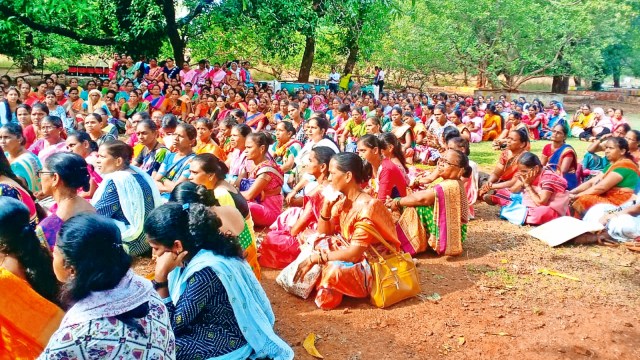 “This strike will continue until our demands are met. There are women who have been working as anganwadi workers for over 20 years, yet they receive only Rs 10,000. They aren’t included in any salary scale, gratuity, provident fund, and social security,” said Kamal Parulekar, secretary of the Anganwadi Sevika Union.
As the ongoing strike of two lakh anganwadi workers enters one month, the nutritional programmes for over 50 lakh individuals have been severely impacted. Pregnant women, lactating mothers, and innocent children have been caught in the crossfire, enduring the halt in hot meals for children and dry food ration for mothers.
At 23, Sangeeta Gawli was compelled to leave her undernourished two-year-old and three-year-old in Jalna with her in-laws, relocating to a sugarcane factory with her husband. The children, accustomed to hot meals from the local Anganwadi centre, have suffered as the service remains disrupted for over a month, resulting in the declining health of her younger child.
Anganwadi centres provide hot cooked meals which contain a vital mix of nutrients supporting child development, including rice, pulses, vegetables, fruit, and occasional protein sources. “Tribal families struggle to afford balanced nutrition for their growing children. Discontinuing meals for a month can have severe repercussions on their well-being,” said Jyoti Thekedhar, a school helper who currently provides food.
All of Maharashtra’s 2 lakh anganwadi workers, who have been on strike since last year to press for various demands, marched to Azad Maidan in protest against the state government.
Follow Live Updates: https://t.co/pi4a42mqqp pic.twitter.com/9ydODweXWB
— Express Mumbai (@ie_mumbai) January 3, 2024
Anganwadi workers are responsible for the nutrition of pregnant women, lactating mothers and children up to the age of six. They serve hot cooked meals to around 40 lakh children between the ages of three months to six years. They also provide dry ration food which includes cereals, rice, oil, salt, egg and vegetables to around 10 lakh pregnant and lactating women from vulnerable communities.
But all the centres have been closed down until their demands are met.
“We have ceased the preparation and distribution of meals for mothers and children entirely. They are now managing on their own, as we have been instructed not to resume food provision until our demands are addressed,” said Sushila Ravindar Vasave, 46, an anganwadi worker from Nanded who came to Mumbai on Tuesday for the protest with her husband.
Their demands include a Rs 18,000 honorarium, pension, and government employee status. Additionally, they seek an increase in meal prices, proposing Rs 16 per meal for typical children and Rs 24 per meal for severely malnourished children, as the current rate of Rs 8 is deemed insufficient.
However, government officials assert helplessness, stating that Integrated Child Development Services (ICDS) projects fall under the jurisdiction of the central government. Rubal Agarwal, ICDS, Commissioner, Mumbai, said, “We’ve floated tenders to hire 20,000 new anganwadi workers. Their honorarium was raised to Rs 10,000 last April. Additionally, we’ve upgraded 13,000 mini anganwadi centres to main ones.”
#UddhavThackeray and other Sena (UBT) leaders met the protesting anganwadi workers at Azad Maidan.
Follow Live Updates: https://t.co/pi4a42mYfX
Express photos by Amit Chakravarty pic.twitter.com/DGsOZP92V1
— Express Mumbai (@ie_mumbai) January 3, 2024
The state’s Women and Child Development (WCD) Department is taking alternative measures to ensure essential hot-cooked food for children. They’ve utilised around 10,000 open anganwadi centres to supply nearby areas and coordinate with schools for distribution, urging dedicated anganwadi workers to serve children in need. “We are striving to provide food at home in crisis situations,” said Agarwal.
This month, the WCD would also have to face the challenge of supplying dry ration food to mothers. “What they are doing is completely unethical. Stopping such essential services is just blackmailing,” she added.
Not only that, the weights of malnourished children are going unrecorded, highlighting a critical gap in tracking crucial health indicators. The Poshan App, a portal overseen by the Central government, remains inactive, failing to incorporate any data in Maharashtra. This lapse leaves the government without updated information on malnutrition, maternal health, and the well-being of children, underscoring a significant oversight in monitoring essential health metrics.
“There is a massive black hole of data over the past month. We lack information on the nutritional levels of the children, crucial for determining their meal requirements. Identifying malnourished children is vital. We’ve now enlisted ASHA workers to track this information and bridge the data gap,” Agarwal added.
Officials fear that this under-recording of cases might even impact budgetary funding from the central government.
Anganwadi workers have rallied in Mumbai, staging protests at Azad Maidan. They highlight that despite their substantial contributions, their compensation falls below that of ASHA workers, who earn Rs 18,000 along with additional benefits. Anganwadi unions have referred to labour laws, specifying a minimum wage of Rs 18,000 for contract workers, excluding dearness allowance. Workers have underscored their dedication, spending almost five hours on-site and an additional four hours at home for tasks like daily data filling and record-keeping.
“This strike will continue until our demands are met. There are women who have been working as anganwadi workers for over 20 years, yet they receive only Rs 10,000. They aren’t included in any salary scale, gratuity, provident fund, and social security,” said Kamal Parulekar, secretary of the Anganwadi Sevika Union.

 5 min read


