


Stay updated with the latest - Click here to follow us on Instagram
Tags:


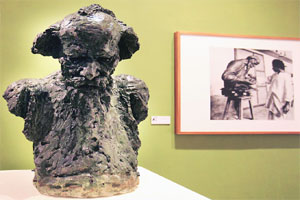
The first retrospective of Indias pioneer sculptor Ramkinkar Baij is being held at Mumbais National Gallery of Modern Art.
Mounting the entire retrospective of Ramkinkar Baij is going to be a nightmare for the curator, painter and art historian KG Subramanyan had once remarked. Subramanyan,a protégé of Baij,who spent his formative years under his guidance at Kala Bhavan in Santiniketan,had observed how a large part of the life and work of Indias most iconic sculptor remained undocumented save for a 1975 documentary by filmmaker Ritwik Ghatak,titled Ramkinkar Baij: A Personality Study. He didnt keep his works and there was very little archived of his life as an artist, he added.


Titled Ramkinkar Baij A Retrospective,it is the first full-fledged retrospective of the artist being held at NGMA. Baij is regarded as one of Indias first modernists who set the precedent for modern sculpture in the country,and has created some of the most landmark public sculptures (his sculpture of Mahatma Gandhi and the bust of Rabindranath Tagore in Santiniketan are considered iconic,as is the Yaksha and Yakshi sculpture outside the Reserve Bank of India,Delhi).
This is also perhaps the first time an exhibition has attempted to contextualise the works as well as the artist. This retrospective aims to help Indian artists of the generation after Ramkinkar Baij (he died in 1980) see,accept,reject,understand or misunderstand the master creator, says Radhakrishnan. To facilitate this,the exhibition boasts photographs from personal collections capturing Baij at work and at leisure,documentations in the form of letters from his students and his preparatory notes for his monumental sculptures.
For example,the breakdown of his creative process behind the creation of the sculpture of Yaksha Yakshi and the bust of Tagore have been shown through photographs and working notes. A look at the process gives you a sense of his style of work. Sometimes,the final sculpture may not have any resemblance to the real person he has drawn inspiration from,his sculptures often didnt adhere to traditional human anatomy. He had his own sense of aesthetics,an independent,original sense of structure, Radhakrishnan adds.
There are drawings called study of hen,horse,goat and baboon,and his renowned works on the tribal people of Goalpara village speak of the artists rootedness. Santhal Family,one of his famous works installed in Santiniketan,and other such similar structures have been presented in the form of photographic blowups amidst texts by R Siva Kumar and KG Subrzamanyan,both of whose publications on Baij are part of the retrospective.
At the inauguration event that took place on Tuesday was present one of Mumbais significant artists Akbar Padamsee,Chief Secretary of Maharashtra Jayanta Kumar Banthia also attended the ceremony along with NGMA Director Rajeev Lochan and Curator KS Radhakrishnan. The retrospective,which has already concluded in Delhi and Bangalore,will be on display till December 16. After this it will travel to Kolkata.


Stay updated with the latest - Click here to follow us on Instagram


