Journalism of Courage



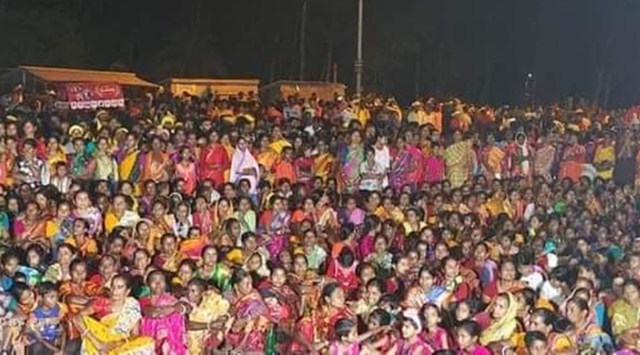 The protests have been going in Paschim Medinipur and Purulia districts since April 5. E(xpress Photo)
 With hundreds of members of the Kurmi community from West Bengal, Jharkhand and Odisha staging protests in West Bengal’s Paschim Medinipur and Purulia districts since April 5, road and railway services have come to a grinding halt in parts of the state.
The nodes of the protests — Kustaur in Purulia and Khemasuli in Paschim Medinipur — have Kurmi-dominated population.
Since April 5, at least 496 trains have been cancelled on the Kharagpur-Tatanagar and Adra-Chandil sections of the South Eastern Railway, key routes in the state. While agitations have been ongoing at the Kustaur and Khemsauli stations, the Kurmi groups have planned another agitation at the Kotshila station in Purulia. “The protesters are negotiating with the state government and the Railways doesn’t have a role in this. They don’t have a railway-related demand as well. Trains are being forced to be cancelled. Passengers are really suffering,” Aditya Kumar Chaudhary, the press official for South Eastern Railway, said. Due to the ongoing stir, some trains on the affected routes have been rerouted. “There are limitations when it comes to running trains on different routes because there isn’t enough capacity to run too many trains on one route. We are rerouting only as many trains as possible because we can’t do that for all trains. How many trains can run on one track?” asked Chaudhary.
Manoranjan Mahata, a member of the Adivasi Kurmi Samaj, an community-based organisation, said, “We have three key demands. First, we want inclusion in the Scheduled Tribe list from which we have been unjustly excluded. Second, we want the Indian government to make efforts to save our culture and language. No tribe can survive without these. Third, we want the Kurmali language to be included in the Eighth Schedule of the Constitution.”
Ajit Prasad Mahato, a leader of the Adivasi Kurmi Samaj, said, “We want the government to include ‘Sarna’ as a separate religion for indigenous groups in the next census.”

 2 min read