Journalism of Courage



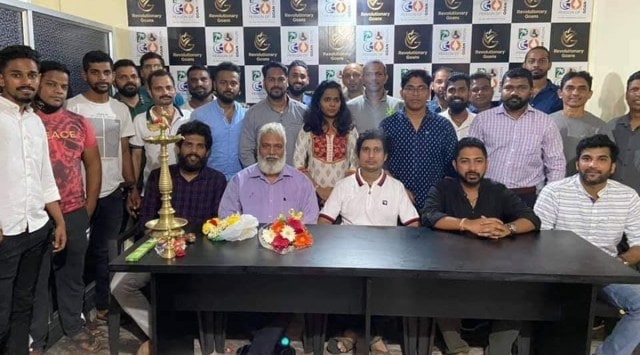 Revolutionary Goans Party (Facebook/Manoj Parab)
The swanky commercial building in Panaji’s Patto had fallen silent on Saturday evening when many of its occupants had called it a day. In the Revolutionary Goans Party (RGP) office, however, Viresh Borkar, the party’s newly elected MLA sat alone before a smartphone, participating in a discussion on a Marathi news channel. In a car parked outside the building, party chief Tukaram alias Manoj Parab (37) held a smartphone in his hand and did the same.
Since the election results were declared on March 10, 28-year-old Borkar, who scored the first goal for the party that contested its maiden election on its football symbol, has gone through a series of interviews in the local media. In the run up to the election, Parab, however, said that the RGP had been written off by the media and Goa’s ‘intellectuals’ as “bachchein (kids)”.
Among the many new players that entered the poll fray in Goa this time, the RGP was the only new homegrown party that took shape from a movement started by angry Goan youth out to “save” Goa. “Twenty years ago, Goa was very different. Now it has changed drastically. Goans have to go abroad and migrants are coming in Goa and doing illegal businesses, they are encroaching on our land, taking up our jobs. Goans were going in the wrong direction. That’s why we came into the picture and we fought for Goa and Goans have believed in us,” said Borkar, set to make his assembly debut after defeating BJP’s Francisco Silveira in the St Andre constituency by a wafer-thin margin of 76 votes.
The Person of Goan Origin Bill (POGO) is the RGP’s top poll promise. Parab said every MLA in the outgoing assembly was asked to endorse the Bill but none did because “nobody wanted to define who is the Niz Goenkar (original Goan)”. In its vision document, the RGP defined Niz Goenkar as “any person or whose either parents or grandparents born or living in Goa prior to 20th December 1961 (a day after Goa was liberated from Portuguese rule) and his family, who were citizens of India post liberation irrespective of nationality they hold currently (sic).” For such persons of Goan origin, the RGP promised 100 per cent reservation in government and semi-government jobs, 100 per cent housing board projects, government schemes, benefits and loans, government contracts and business licenses, comunidade land and 80 per cent reservation in private jobs.
Labeled ‘radical’ and compared often to late Bal Thackeray’s Shiv Sena in its early years or his nephew Raj Thackery’s Maharashtra Navnirman Sena that have often stoked emotions with the ‘insider-outsider’ card in the neighbouring state, Parab, however, says the RGP is modelled after neither.
Parab said, “We have a unique style of politics. We empower the youth with RTIs, Gram Sabha, Panchayat Act, and their basic rights. We train our youth so that they get empowered.” Pointing at his smartphone, he said, “This is our weapon. Whenever there is an illegality, we do live videos that everyone sees. This cannot be a misguided revolution. When we say uzzo (fire) is our trademark, it is a channelled fire like in a welding machine. This is a different kind of politics that many are not trying to understand or are misunderstanding.”
The lack of affordable housing or the laws of ownership of land in Goa, have left many Goans without a house to their name, he said. “People from Delhi, Bangalore are coming and investing in Goa. They are buying flats for Rs 1 crore, Rs 2 crore, second home, third home, holiday home and we are here unable to buy a house that costs even Rs 10 lakh because our salary structure is so low. No one is thinking of Goans. No one is speaking for us,” said Parab, a geology graduate.
Unlike the AAP and the TMC that came to Goa riding on their success in their home states, electoral experience, resources and social media armies, the homegrown RGP that won its first assembly seat with a small margin, however, won a vote share of 9.96 per cent.
The AAP that won two seats in Goa for the first time had a vote share of 6.77 per cent and the TMC that drew a blank had a vote share of 5.21 per cent.
In the election that the BJP won with the support of the MGP and Independents, the RGP contested 38 of the 40 assembly seats in Goa. They finished second in three seats including Valpoi where Parab lost to BJP’s heavyweight Vishwajit Rane by a margin of 8,085 but pocketed 23.64 per cent of the votes. They ate into the votes of not only the Congress, which rued the division of Opposition votes after its defeat, but also those of the BJP and the Maharashtrawadi Gomantak Party (MGP).
This election, the MGP has come down to two seats from three that it won in the 2017 election. MGP chief Ramkrishna alias Sudin Dhavalikar described the RGP’s performance this election as “dhumakul (havoc)”. A BJP leader also said that whether or not anybody liked the RGP’s brand of politics, they can no longer be ignored.
But in the political environment of Goa where unlikely allies have often formed precarious governments, Parab says the RGP aligns with no one because no one will raise the issues that they will. Before they were registered as a political party in November 2021, Revolutionary Goans was a five-year-old movement started by Parab, Borkar and their colleague Vishwesh Naik. Parab and Borkar worked with the AAP for months before leaving disenchanted.
Borkar said the party has about 20,000 registered members, mostly young Goans from Bahujan communities.
The election office in the commercial hub is equipped with tripods, studio lights, a projector, white boards bearing RGP’s election scores constituency-wise, and brown plastic chairs. Parab said the space was ‘donated’ to them by a supporter and they will have to vacate it now. On their agenda are the upcoming village panchayat elections in June, a registration drive to add supporters, a ‘clean-up’ of Goa’s voter list and crowd-funding to get a new office space.

 7 min read