


Stay updated with the latest - Click here to follow us on Instagram
Tags:


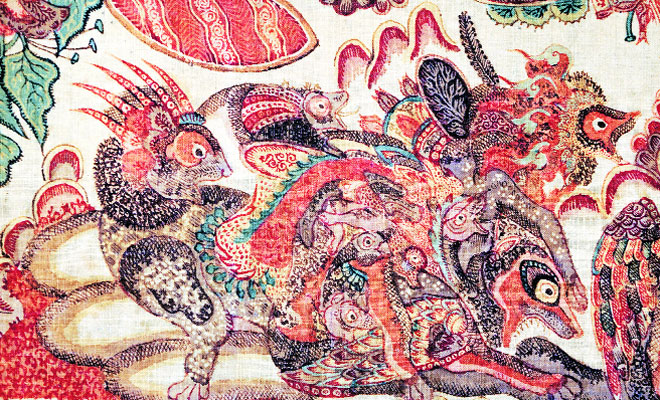
Indias kalamkari expertise in the seventeenth century is celebrated through an exhibition.
Seventeenth century was a period of transition for India,both politically and economically. While the Mughals strengthened their hold in the north,economic relations were thriving along the Coromandel coast. Merchant guilds flourished across the region,catering to Europeans,exploring far away lands in search of spices and textiles. Besides relishing Indian cloves,Europe was also wearing Indian cotton and soon decorating homes with it. Perhaps it was around this time that a 230 x 180 cm fabric,with kalamkari print,travelled to France.


The exhibition titled Safar-Nama: Journeys Through a Kalamkari Hanging,at the National Museum,comprises images of the fragile fabric that is now in the collection of the Museum of Printed Textiles in Mulhouse. It was perhaps Koechlin Textile & Co,which was active in France then,that took the fabric there. Another school believes the Danish East India Company might have taken it from India to Europe, says Sarkar. Co-curator of the exhibition with Sarkar,Dr Lotika Varadarajan says that the textile boasts of a chintz design the term used to describe cotton textiles imported to Europe from India,printed with designs featuring flowers and other patterns in different colours,typically on a light plain background.
While the complete provenance of the piece cannot be traced,Varadarajan says that it would have belonged to a patron familiar with motifs across South East Asia. Floral patterns find place with animals deer prancing,monkeys collectively making elephants figures,peacocks,fish and butterflies and even what appears to be lord Narasimha. Sarkar says,The motifs that appear like spearheads are typically tumpal motifs that are classical Indonesian. Usually design elements from India are seen in South East Asia,but this represents a reverse flow of ideas. The oblong patterns are associated with Islamic architecture and the hill-like formations are Chinese. There are also elements from miniatures,Persian,Deccan and Mughal school.
The exhibition is on at National Museum till April 21. Contact: 23019272


Stay updated with the latest - Click here to follow us on Instagram


