7 min read
Stay updated with the latest - Click here to follow us on Instagram

Journalism of Courage



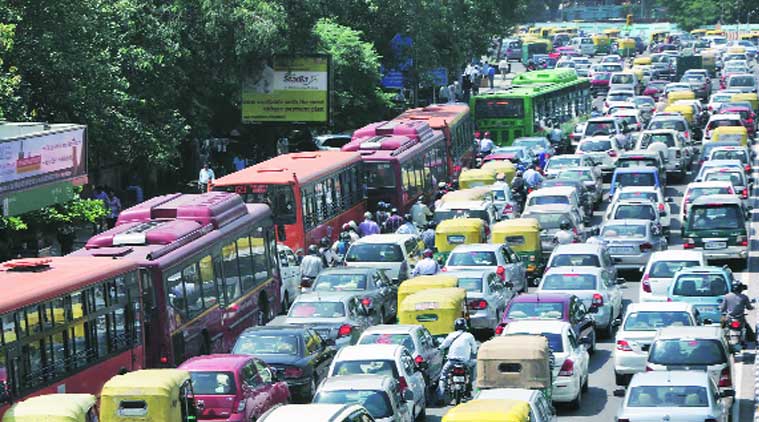 A recent report, by a high-powered inter-ministerial committee, submitted to the Prime Minister details a nine-point agenda to decongest the capital.
ROAD INFRASTRUCTURE
The future: More bypasses, elevated signal-free corridors
According to the committee, building eight-12 lane roads has not solved congestion even in other countries, including China and in cities like Sao Paulo and Los Angeles. “On the contrary, the problems have worsened” and brought down the average travel speed on major corridors even in developed cities. Reportedly, this is because more lanes make room for more vehicles, leading to congestion, air pollution, traffic hazards, inefficient use of public transport and retarded development. The committee has estimated an expenditure of Rs 30,000 crore for development of elevated roads, tunnels and bypasses.
ISSUE
According to the report, in the absence of a secondary road network system, the arterial roads at present form the city’s road network. Besides, local traffic on arterial roads adds to the congestion. The committee has also pointed out how signal-free corridors have restricted movement of traffic and people between neighbourhoods on either side. Also, links between colonies are not planned to enable direct connectivity to local destinations, forcing people to use arterial roads even for short trips locally.
“Railway corridors are especially big barriers as they do not provide enough underpasses and overpasses to enable traffic in the city to move in a proper network. Such archaic policies need to be modified,” the report states. Also, Delhi, being at the heart of NCR, witnesses a lot of thorough truck traffic and workforce movement even though, most often, the traffic is not Delhi-bound.
RECOMMENDATION
The committee has recommended multiple bypass routes to reduce traffic passing through the city. Signal-free corridors should be in the form of elevated corridors instead of flyovers. This allows movement of people at the ground level without hampering city traffic movement.
With regard to road infrastructure, the report has detailed out projects categorising them as short-, medium- and long-term. While Barapullah phase-IV, which will be extended till the airport, is one of the medium-term projects proposed by the report to decongest AIIMS, the committee has proposed an elevated road from Palam Vihar to Anand Parbat, among others.
EXPERTSPEAK: Pradip Sarkar, head of transport planning at SPA, said, “The government has to have a strong policy. The city is adding roughly 1,200 vehicles a day. Either the policy should support private vehicles or public transport. It cannot be in-between.”
PARKING & CYCLING HIGHWAY
Cycle tracks and competitive parking rates in focus
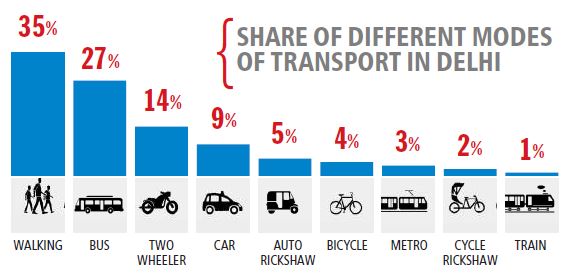 With focus on public transport, the committee has observed that free or inexpensive parking is a key factor contributing to the use of personal vehicles over choosing to use bus, Metro, carpool or even walk. Besides, the report states that more cyclists are being killed on city roads every year, mainly due to lack of dedicated cycling infrastructure. Although 35 per cent of Delhi’s population own cycles, only six per cent use them on roads due to lack of safety. The government has estimated an expenditure of Rs 2,525 crore on improving parking and boosting bicycle-use.
ISSUE
According to the report, the phenomenal increase in personal vehicles has contributed to the problem of parking and its unregulated pricing. Also, seldom vehicles are parked within the designated area, resulting in vehicles spilling onto roads and adding to congestion.
With regard to cycling infrastructure, the committee says that “inadequate cycling facilities is slowly pushing the population to use vehicles, harming the environment, health and life”.
RECOMMENDATION
For parking, the committee has recommended that pricing should be based on ‘user-pay’ principle and that no government-subsidised parking for private vehicles should be provided in public spaces or roads. The committee has also suggested that parking on footpaths should be made a cognizable offence, on-street and off-street parking on roads and parking lots should be clearly demarcated, parking fee should be market driven and vary around the city based on time, location and local demand/congestion levels through the day, all multi-level or exclusive parking facilities must also provide at least 10 per cent of total space for intermediate public transport modes, non-motorised vehicles and feeder buses.
Addressing the issue of bicycle-sharing, the committee has suggested that bicycle infrastructure needs to be provided at a higher level with protected edges to prevent monsoon flooding or encroachments by parked vehicles, intersections with bicycle-queuing arrangement and signals for easy crossover.
EXPERTSPEAK: Experts say while congestion tax is welcome, there has to be proper designing as far as cycle tracks go. “Most often than not, cyclists are sandwiched between motorised vehicles and there is no proper mobility,” an expert said.
MULTI-MODAL INTEGRATION AT METRO STATIONS, BRT SYSTEM AND BUSES
Needed: Better access to Metro stations, BRT revamp
 From last-mile connectivity and modernising the ‘poor man’s vehicle’ to revamping the Bus Rapid Transport System (BRTS), the report lays stress on “prioritising and promoting public transport”. The government has estimated an expenditure of Rs 6,530 crore for this.
ISSUE
The Delhi Metro may have ushered in a new era in mass transport, providing world-class services to Delhi and on track to become its lifeline in future. But, the report says “there is lack of planning and integration beyond the immediate station buildings in the earlier phases”, which is now a source of major inconvenience to almost 80 per cent of its users. Access to the stations is inadequate due to “poor quality of buses and non-motorised transport”, forcing people to use their own vehicles, adding to the congestion, the report adds.
Additionally, the report says although total trips per day by buses constitute more than 60 per cent of the total public transport trips in Delhi — which is a significantly higher share than the Metro’s at a fraction of its cost — “it is still seen as a poor man’s vehicle”. The city is in need of bus services within walking distance of homes, low-floor and air-conditioned buses, and cheaper fares, among others.
RECOMMENDATION
The committee has suggested that a comprehensive strategy to improve accessibility to Metro stations for pedestrians and non-motorised transport must form “a mandatory part of all Metro station designs”. Suggestions include providing well-planned and designated spaces for all modes such as buses and rickshaws within five-minute walking catchment of the stations, high-quality walking environment including safe crossings and walkways, direct pedestrian skywalks to all neighbourhoods within the catchment so that people can walk to stations directly.
For improving bus services, the committee has suggested the setting up of an ‘Urban Transport Fund’, which will “rationalise the budget allocation to augment available funding for public transport, etc.”
Referring to the opposition faced by BRTS in Delhi, the report mentions how BRTS “still carries significantly more people per hour than all vehicles put together in the BRTS corridor. It’s a high-capacity bus system and, therefore, should be integrated with the regular bus system in terms of fare collection, interchange and parking spaces”.
For making BRTS a success, the committee has suggested including provision of a common mobility card for seamless travel, IT-based real-time operations for BRTS and bus services, integrating BRTS operations with DTC operations under single authority.
EXPERTSPEAK: Chetan Vaidya, Director, SPA, said, “I agree with the idea of ensuring last-mile connectivity and encouraging walking and cycling. But when it comes to the BRTS, I have my reservations. It cannot be implemented in congested areas.”
Stay updated with the latest - Click here to follow us on Instagram