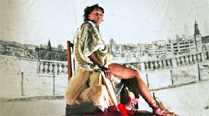
Chopra was a masters student at the Ohio State University when he conceived Sir Raja in 2003. (Photo Courtesy: Nikhil Chopra)
Over 70 years ago, Subhas Chandra Bose had launched an armed struggle against the British with his popular war cry “Give me blood and I will give you freedom”. Goa-based artiste Nikhil Chopra uses this line as the title for his performance art as he assumes the character of a female warrior. Willing to sacrifice her life for freedom, the ominous battle will continue for 50 hours, with Chopra emerging as a victorious black monster in the climatic finale. The battleground is the 2014 Singapore International Festival of Arts beginning on August 14, the eve of India’s independence.
You’ve Read Your Free Stories For Now
Sign up and keep reading more stories that matter to you.
“Bose sought support from the larger Indian community, across Southeast Asia, including Singapore, Malaysia and Japan. Women played an important role in the Indian National Army,” says the artiste, who, for the performance, is referring to Rani of Jhansi as a “symbol of empowerment” . “There is an interesting dichotomy, with regard to split ideas during the freedom struggle and the alliances Bose sought. I am also looking at the economic success of Singapore after the second World War, the way maps were drawn. I’ll bicycle as part of the performance — the imperial army cycled between Japan and Singapore,” says the 39-year-old. In Mumbai, an appropriate costume is being designed and the lights for the sets too. Unlike his usual venue which is an art gallery, in Singapore the platform is theatrical.
To think of stage fright is preposterous. Chopra was a masters student at the Ohio State University when he conceived Sir Raja in 2003. A stereotype of the Indian prince from the colonial era, the character was at the end of a 350-foot red carpet, seated at a table with food, fruits and flowers, urging viewers to question the excesses. In 2005, he was surrounded by velvet drapes and adorned in silk and jewels for the The Death of Sir Raja III. He resurfaced though in 2013, in an “introspection” of sorts, at the Whitworth Art Gallery in Manchester. For this much-acclaimed performance in UK, Chopra had endorsement from Marina Abramovic, one of the biggest names globally in performance art. Over 17 days, Chopra played numerous characters, from a loin-clothed native gobbling chocolate cake to Sir Raja and The Queen, wearing a lacy dress. He was also Yog Raj Chitrakar, the protagonist loosely based on his paternal grandfather Yog Raj Chopra. Educated at Goldsmiths, University of London, in the 1920s, he was a landscape painter who captured the grandeur of Kashmir Valley. Nikhil projected him in various guises, from an explorer to conqueror and painter. He even used one of his paintings from the 1930s as the basis of his own wall-drawing for Yog Raj Chitrakar: Memory Drawing VIII.
It was his grandfather who discovered the artist in him, when he found the class 10 student doodling in his notebook. The commerce graduate was encouraged to travel and two years later he was studying art at MS University of Baroda, followed by the Maryland Institute College of Art in the US. He returned home with Sir Raja. “I conceptualised him in the US, but was eager to bring him to India to see how he is received. It was a packed house. It’s the artists who are perhaps reluctant to experiment, not the audience in India,” says Chopra. That was 2005. There has been no looking back since. If in 2009 he was at the 53rd Venice Biennale, in 2008-2009 he pitched a tent outside Serpentine Gallery in UK for Indian Highway, where Chopra walked about as a fur-coated gentleman, as an Ottoman general. At the Kiran Nadar Museum of Art last year as part of the series Blackening he engaged with the mall environs of the museum. More recently, in February 2014, at the Wolverhampton Art Gallery in the UK, Chopra broke the usual practise of remaining silent during his performance, interacting with the audience who posed for a portrait. “Each performance is sight specific and this called for interaction, the people posing were immigrants, each with their own story,” says Chopra, adding that by not naming his characters now, they have more of him than earlier.
For now, the Singapore outing awaits. One can expect the usual — drama, art, theatrics, action — and the unusual as charcoal drawings replace ink. “There is a history to it. Ink is associated with the region and also in the more potent sense of ink and blood in literature,” says Chopra. The climax will have him doused in ink. “The intention is not to be a tragic hero, rather poetic, like black poetry,” he says.
Vandana Kalra is an art critic and Deputy Associate Editor with The Indian Express. She has spent more than two decades chronicling arts, culture and everyday life, with modern and contemporary art at the heart of her practice.
With a sustained engagement in the arts and a deep understanding of India’s cultural ecosystem, she is regarded as a distinctive and authoritative voice in contemporary art journalism in India.
Vandana Kalra's career has unfolded in step with the shifting contours of India’s cultural landscape, from the rise of the Indian art market to the growing prominence of global biennales and fairs. Closely tracking its ebbs and surges, she reports from studios, galleries, museums and exhibition spaces and has covered major Indian and international art fairs, museum exhibitions and biennales, including the Venice Biennale, Kochi-Muziris Biennale, Documenta, Islamic Arts Biennale.
She has also been invited to cover landmark moments in modern Indian art, including SH Raza’s exhibition at the Centre Pompidou in Paris and the opening of the MF Husain Museum in Doha, reflecting her long engagement with the legacies of India’s modern masters.
Alongside her writing, she applies a keen editorial sensibility, shaping and editing art and cultural coverage into informed, cohesive narratives. Through incisive features, interviews and critical reviews, she brings clarity to complex artistic conversations, foregrounding questions of process, patronage, craft, identity and cultural memory.
The Global Art Circuit: She provides extensive coverage of major events like the Kochi-Muziris Biennale, Serendipity Arts Festival, and high-profile international auctions.
Artist Spotlights: She writes in-depth features on modern masters (like M.F. Husain) and contemporary performance artists (like Marina Abramović).
Art and Labor: A recurring theme in her writing is how art reflects the lives of the marginalized, including migrants, farmers, and labourers.
Recent Notable Articles (Late 2025)
Her recent portfolio is dominated by the coverage of the 2025 art season in India:
1. Kochi-Muziris Biennale & Serendipity Arts Festival
"At Serendipity Arts Festival, a 'Shark Tank' of sorts for art and crafts startups" (Dec 20, 2025): On how a new incubator is helping artisans pitch products to investors.
"Artist Birender Yadav's work gives voice to the migrant self" (Dec 17, 2025): A profile of an artist whose decade-long practice focuses on brick kiln workers.
"At Kochi-Muziris Biennale, a farmer’s son from Patiala uses his art to draw attention to Delhi’s polluted air" (Dec 16, 2025).
"Kochi Biennale showstopper Marina Abramović, a pioneer in performance art" (Dec 7, 2025): An interview with the world-renowned artist on the power of reinvention.
2. M.F. Husain & Modernism
"Inside the new MF Husain Museum in Qatar" (Nov 29, 2025): A three-part series on the opening of Lawh Wa Qalam in Doha, exploring how a 2008 sketch became the architectural core of the museum.
"Doha opens Lawh Wa Qalam: Celebrating the modernist's global legacy" (Nov 29, 2025).
3. Art Market & Records
"Frida Kahlo sets record for the most expensive work by a female artist" (Nov 21, 2025): On Kahlo's canvas The Dream (The Bed) selling for $54.7 million.
"All you need to know about Klimt’s canvas that is now the most expensive modern artwork" (Nov 19, 2025).
"What’s special about a $12.1 million gold toilet?" (Nov 19, 2025): A quirky look at a flushable 18-karat gold artwork.
4. Art Education & History
"Art as play: How process-driven activities are changing the way children learn art in India" (Nov 23, 2025).
"A glimpse of Goa's layered history at Serendipity Arts Festival" (Dec 9, 2025): Exploring historical landmarks as venues for contemporary art.
Signature Beats
Vandana is known for her investigative approach to the art economy, having recently written about "Who funds the Kochi-Muziris Biennale?" (Dec 11, 2025), detailing the role of "Platinum Benefactors." She also explores the spiritual and geometric aspects of art, as seen in her retrospective on artist Akkitham Narayanan and the history of the Cholamandal Artists' Village (Nov 22, 2025). ... Read More