Premium
This is an archive article published on September 18, 2021

Captain Amarinder Singh: The ‘people’s maharaja’ who lost the common touch

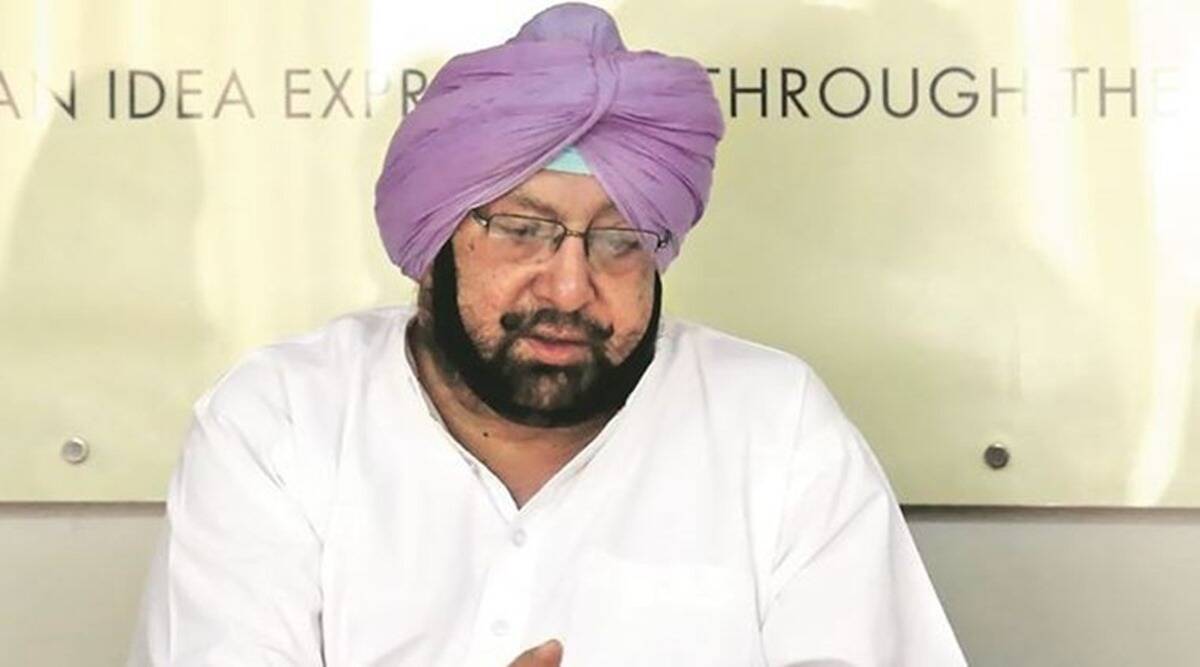
Unlike other Congress chief ministers, Captain Amarinder has seldom been deferential to the high command and its various functionaries, a fact that led many in the party to say that Punjab is an “independent republic of Amarinder”.

Amarinder SinghUnlike other Congress chief ministers, Captain Amarinder has seldom been deferential to the high command and its various functionaries, a fact that led many in the party to say that Punjab is an “independent republic of Amarinder”. (Express file photo)

A soldier, a military historian, a chef, an avid gardener, and a politician.  Former Punjab chief minister Amarinder Singh is one of those rare political leaders who can traverse different fields with elan. But clearly, he failed to negotiate the political landmine, which is partly of his own making, in Punjab.

Everything seemed to be going his way in March 2017, when the Congress swept to power in the state with over two-third majority, relegating to the third place its arch rival, the Shiromani Akali Dal, in the maiden three-cornered contest in the state.

Wracked by incidents of sacrilege, rampant drug abuse, and growing unemployment, the state saw a saviour in Amarinder.  But the government ran into a sandstorm in its very first year when a minister close to the CM was caught in a sand-mining scam. The glass, however, was still half-full for Amarinder as he managed to cleanse the state of gangsters.  And the slow pace of development was blamed on “tall promises” made by poll strategist Prashant Kishor.

The CM’s political problems began much before the Congress victory when the high command inducted cricketer Navjot Singh Sidhu into the party from BJP.  Amarinder was said to be against his inclusion but Sidhu was supported strongly by Rahul Gandhi.

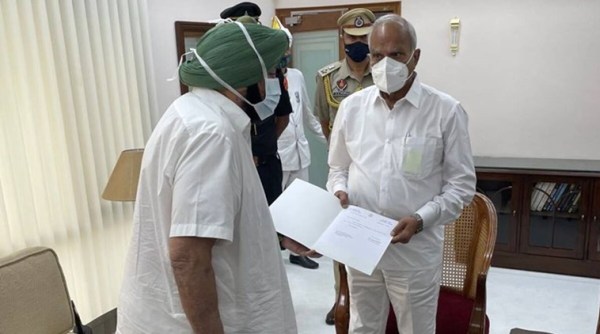
Amarinder Singh Amarinder Singh resigns as Punjab Chief Minister (Express photo)
The buzz was that Sidhu would be made the deputy chief minister. But that did not happen. Amarinder, who had scripted the Congress victory in the state, was in no mood to kowtow to the high command.

Unlike other Congress chief ministers, Captain Amarinder has seldom been deferential to the high command and its various functionaries, a fact that led many in the party to say that Punjab is an “independent republic of Amarinder”.

In 2015, too, he had succeeded in replacing Rahul Gandhi’s man Partap Singh Bajwa as the PPCC chief due to his hold over the state.

Earlier, during his first stint as the chief minister, Amarinder had upset the party chief Sonia Gandhi when he legislated the state out of the SYL agreement without giving her a heads-up. A furious Sonia had reportedly refused to give him audience for months.

Story continues below this ad

It’s this autonomy of spirit and connect with the masses that made the Captain a winner in Punjab.  But in his present stint as the CM, he failed to read the mood on the ground. His legislators began to write letters to him in 2017 itself but he failed to act. And the perception that he was soft on the Badals, which stemmed from inaction on the issues of sacrilege and drugs, cost him the popular support. Finally, it was a group of ministers, once considered close to him, that turned on him.

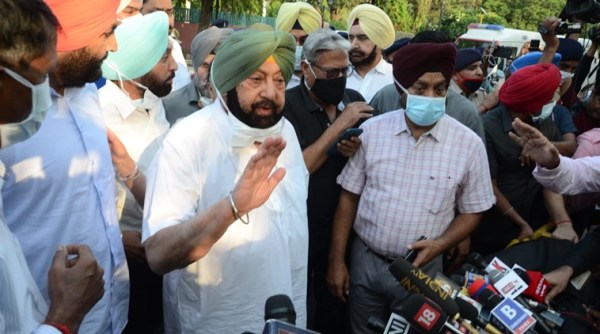
Amarinder Singh Amarinder Singh speaks to the media on Saturday (Express photo)
Scion of the erstwhile princely state of Patiala, Amarinder’s first introduction to politics took place while he was studying with Rajiv Gandhi in Doon school, and would often be invited to holiday with him at the residence of India’s first Prime Minister Pandit Jawaharlal Nehru in Delhi.  It came as no surprise when Rajiv Gandhi persuaded him to join Congress and contest the Lok Sabha polls from Patiala. In 1977, immediately after Emergency, he lost his maiden polls to Akali stalwart Gurcharan Singh Tohra from Patiala.  Three years on, he entered the Lok Sabha from the same seat.

Though close to Rajiv, Amarinder quit Congress to join Akali Dal in 1984, soon after Operation Bluestar. He often recounts how he was playing golf at Naldhera in Himachal when he heard the news on radio. In an Idea Exchange with The Indian Express, Amarinder had said that he would be writing a book on the events that unfolded in Punjab during the dark decade of militancy.

It was during his stint in the Akali Dal that he was first elected to the state legislature from Talwandi Sabo, home to one of the five holy seats (takhts) of the Sikhs,  and became a minister for Agriculture, Forest, Development and Panchayats in the state government. But temperamentally, he was ill suited to the party, and quit it to form Shiromani Akali Dal (Panthic) in 1992. Six years on, he merged with the Congress after his party was wiped out in the 1998 Assembly election in which he polled a mere 856 votes.

Story continues below this ad

An alumnus of National Defence Academy and Indian Military Academy, Amarinder was commissioned into the Sikh regiment in 1963. Though he served for only three years, a notable part of it as an ADC to Lt Gen Harbaksh Singh during the 1965 Indo-Pak war, the army service defined his life in politics as well. In his first stint, he was known for taking important decisions in minutes. A senior bureaucrat, comparing him to his predecessor Parkash Singh Badal, recalled how Amarinder would take important decisions in minutes  while Badal would take months.

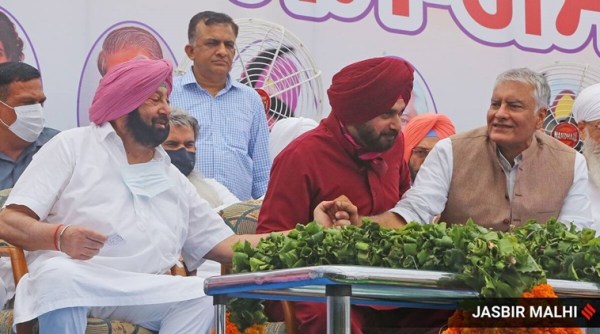
Amarinder Singh Amarinder Singh, Navjot Sidhu and Sunil Jakhar at Punjab Congress Bhawan in July this year (Express file photo by Jasbir Malhi)

Amarinder was a big proponent of ties between East and West Punjab during his first stint as the CM, when he hosted the chief minister of Pakistan Punjab. He had said, “I want to have breakfast in Amritsar and lunch in Lahore.” He, however, always drew a line when it came to India’s integrity.

Despite their ideological differences, BJP acknowledges him as a nationalist.  Amarinder was all fire and fury after the Pulwama terror attack. Addressing the Punjab assembly, he had thundered, “I want to tell this to General Bajwa (Pakistan army chief) that if you are a Punjabi, we too are Punjabis and you dare try to enter our territory, we will set you right.”

In a state that has always seen a mix of religion and politics, Amarinder remained steadfastly secular.  Many attribute Congress’s landslide victory in 2017 to the shift of Hindu votes to the party after the Maur blast in the run-up to the assembly polls in 2017.

Story continues below this ad

The Aam Aadmi Party, which was drawing large crowds during the campaign, failed to convert  these into votes due to the party leaders’ alleged hobnobbing with radical elements.

It was Amarinder himself who first floated the possibility of a Hindu chief minister in the state in the 2019 when, while campaigning for former PPCC chief Sunil Jakhar in Gurdaspur, he said Jakhar could also be the next CM.

But in the end, ‘The People’s Maharaja’, as his biography is titled, lost the support of people, which was his biggest strength.

Manraj Grewal Sharma is a senior journalist and the Resident Editor of The Indian Express in Chandigarh, where she leads the newspaper’s coverage of north India’s most politically and institutionally significant regions. From Punjab and Haryana to Himachal Pradesh and the Union Territory of Chandigarh, she oversees reporting at the intersection of governance, law, politics and society. She also reports on the diaspora, especially in Canada and the US. With a career spanning journalism across several countries, academia and international development, Manraj brings a rare depth of perspective to regional reporting. She is widely regarded as a leading chronicler of Punjab’s contemporary history and socio-political evolution, particularly its long shadow of militancy, federal tensions and identity politics. Her book, Dreams after Darkness, remains a definitive account of the militancy years and their enduring aftermath. Professional Background & Expertise A gold medalist in mass communication and a post-graduate in English literature, Manraj has a multifaceted career spanning journalism, academia, and international development. She was also awarded a fellowship by National Foundation of India and did several in-depth pieces on Manipur. Internationally, she has reported from Israel, US, UK, Myanmar, and Mauritius Her key focus areas include: Regional Politics, History, Agriculture, Diaspora, and Security. Of late, she has started focusing on Legal & Judicial Affairs: Much of her recent work involves reporting on high-stakes cases in the Punjab and Haryana High Court, ranging from environmental policy to civil rights. International Consulting: She previously served as a consulting editor for the Asia Pacific Adaptation Network and a publishing consultant for the Asian Development Bank (ADB) in Manila. Academia: For five years, she was the managing editor of Gender, Technology and Development, a peer-reviewed international journal at the Asian Institute of Technology, Bangkok. Recent Notable Articles (Late 2025) Her recent reportage focuses heavily on judicial interventions and regional governance: 1. Environment & Governance "‘NGT can’t test legality of policy’: HC hears challenge to Punjab’s ‘Green Habitat’ plan" (Dec 22, 2025): Covering a critical legal battle over whether the National Green Tribunal has the authority to strike down a state policy regularizing farmhouses on delisted forest land. "High court pulls up Punjab poll panel over audio clip probe" (Dec 10, 2025): Reporting on judicial concerns regarding the transparency and fairness of local body elections. 2. Legal Rights & Social Welfare "HC issues notice to Punjab, Haryana over delay in building old age homes" (Dec 22, 2025): Reporting on a contempt petition against top officials for failing to establish government-run homes for the elderly as promised in 2019. "Victims can appeal acquittals in sessions court without seeking special leave" (Dec 19, 2025): Highlighting a significant procedural shift in criminal law following a Supreme Court ruling. "HC upholds benefits for Punjab FCI officer acquitted in 20-year-old bribery case" (Dec 19, 2025): A report on the concept of "honourable acquittal" and its impact on employee benefits. 3. Human Rights & Identity "As Punjab denies parole to MP Amritpal Singh, HC asks it to submit ‘foundational material’" (Dec 1, 2025): Covering the legal proceedings regarding the radical preacher and sitting MP's request to attend Parliament. "Protecting life paramount: HC backs Muslim woman in live-in after verbal divorce" (Nov 6, 2025): Analyzing judicial protections for personal liberty in the context of traditional practices. Signature Beats Manraj is recognized for her ability to decode complex judicial rulings and relate them to the everyday lives of citizens. Whether it is a 30-year-old land battle in Fazilka or the political implications of Kangana Ranaut’s candidacy in Mandi, her writing provides deep historical and regional context. Contact @grewal_sharma on X manrajgrewalsharma on Instagram ... Read More

Stay updated with the latest - Click here to follow us on Instagram

Latest Comment
Post Comment
Read Comments
Advertisement
Loading Taboola...
Advertisement