4 min read
Stay updated with the latest - Click here to follow us on Instagram

Journalism of Courage



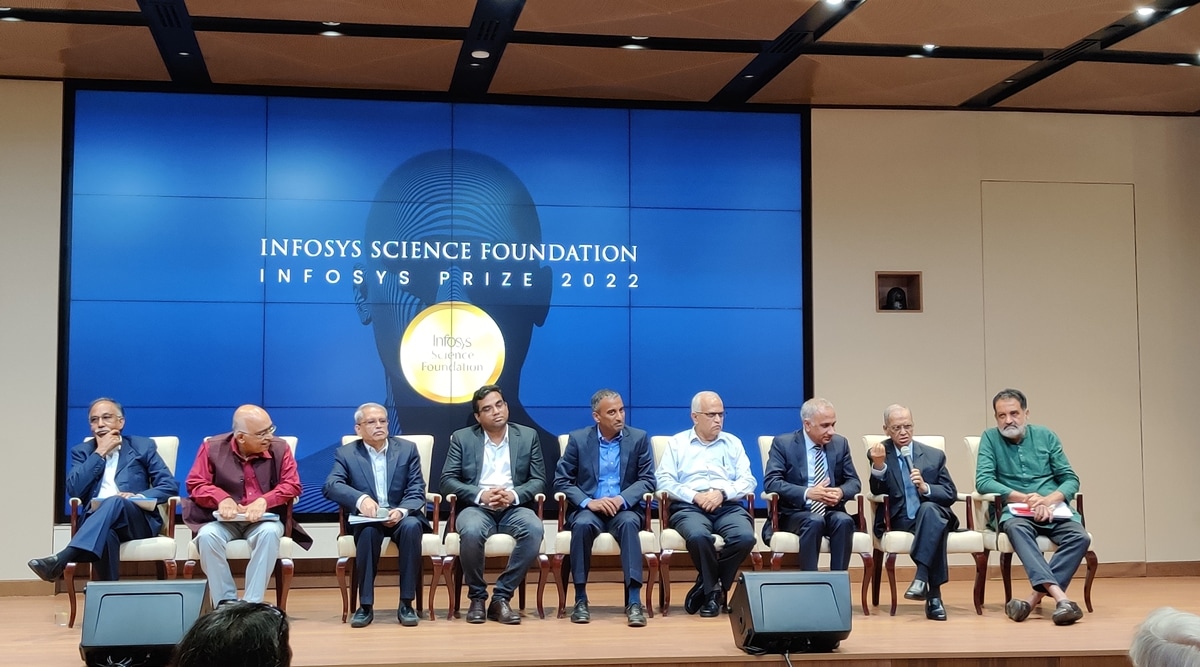 “The death of 66 children in Gambia… has dented the credibility of our pharmaceutical regulatory agency,” Murthy said. (Express)
While India has had a healthy run in scientific and technological progress in the last few years, the nation needs to do more in the field of scientific research, said Infosys founder Narayana Murthy Tuesday.
Speaking at the Infosys Science Foundation (ISF), Murthy said: “The country has had a healthy run in scientific and technological progress in the last few years. We rolled out our Covid-19 vaccines for billions of Indians. These were produced by Indian firms and this was a remarkable achievement. But we still have challenges. There is not a single Indian institution of higher learning in the top 250 of the world university global rankings that were announced in 2022. Consequently, we have still not produced a vaccine for dengue and chikungunya, which have been ravaging us for the last 70 years.”
He also said the recent death of 66 children in Gambia, resulting from India-produced cough syrup, has brought unimaginable shame to the country.
“The death of 66 children in Gambia… has dented the credibility of our pharmaceutical regulatory agency,” Murthy added.
He said the Indian education system needs a reorientation. “The first component is to reorient our teaching in schools and colleges towards Socratic questioning in classrooms to solve real-world problems around them rather than passing the examinations by just rote learning,” Murthy said.
The Infosys Science Foundation (ISF) announced the winners of the Infosys Prize 2022 in six categories – Engineering and Computer Science, Humanities, Life Sciences, Mathematical Sciences, Physical Sciences, and Social Sciences.
Panels of accomplished jurors comprising world-renowned scholars and experts shortlisted the winners of the Infosys Prize 2022 from 218 nominations.
Kris Gopalakrishnan, the president of Infosys Science Foundation, said: “The Infosys Prize is promoting stellar research in India by identifying and rewarding individual scholars. Even as our laureates add to the sum total of human knowledge, their work has a real impact in the here and now. We hope that their work will have far-reaching effects not just in solving our current problems but will set the stage for finding solutions for the existential crises facing humanity such as the effects of climate change, accessible diagnostics and healthcare, challenges of mental health, fulfillment of fundamental human rights, and others.”
Elaborating on the importance of funding science and research in India, Murthy said: “There is an urgent need for both government and private sectors to invest more in science and research. This is the best way forward to solve the many problems that confront us as a nation and humanity as a whole. Our researchers are the country’s frontline warriors in the war against our grand problems. That is why we must encourage them. Winners of the Infosys Prize have gone on to do useful work in their desire to solve the daunting problems that face the nation and the world today.”
This year, Suman Chakraborty, professor of Mechanical Engineering, and dean of Research and Development, Indian Institute of Technology, Kharagpur, was awarded for his contribution to the field of Engineering and Computer Science. The other winners were Sudhir Krishnaswamy, vice chancellor, National Law School of India University, Bengaluru, in Law; Vidita Vaidya, professor and chairperson, Department of Biological Sciences, Tata Institute of Fundamental Research, Mumbai, in Life Sciences; Mahesh Kakde, Professor of Mathematics, Indian Institute of Science, Bengaluru, in Mathematical Sciences; Nissim Kanekar, professor, National Centre for Radio Astronomy, Pune, in Physical Sciences; and Rohini Pande, Henry J Heinz II professor of economics and director, Economic Growth Center, Yale University, in Social Sciences.
Stay updated with the latest - Click here to follow us on Instagram